How Defense Contractors Use RFID to Prevent Asset Loss


- Defense asset loss often means an item is still on site but operationally unavailable because its location or custody is unclear.
- Fixed RFID, handheld search and active technologies solve different accountability problems and are often used together.
- The strongest systems connect RFID identity and movement history to asset status such as assignment, maintenance or calibration.
Asset loss in a defense manufacturing environment rarely looks like a dramatic loss event. More often, a tool, fixture, test set or piece of support equipment is somewhere on site but unavailable to the people who need it. It moved with a job, was left in another work area, changed hands without a clean transaction or ended up in a storage location that the system does not know about. The asset still exists, but operationally it has disappeared.
That distinction matters because the cost usually shows up somewhere other than an “asset loss” account. Technicians search. Supervisors interrupt other teams. Production waits. A replacement is purchased because locating the original is slower than buying another one. In regulated programs, the problem can also create a documentation gap: the organization knows an asset should be controlled, but cannot reconstruct where it went or who last had it. That evidence question is addressed more directly in our article on RFID, defense traceability and compliance controls.
Why defense tool accountability is difficult
Defense manufacturing combines several conditions that make manual asset control fragile. Tools and equipment are shared across shifts and work centers, facilities can be large, work orders move, and many assets have attributes beyond location that matter to whether they may be used at all. A calibrated tool that is physically present but out of calibration is not operationally available. The same is true of an asset assigned to another program or restricted to a particular area.
Barcode systems can manage this well when the process reliably pauses for a scan. The difficulty comes when the physical movement is routine enough that people begin treating the transaction as administrative work rather than part of the work itself. One missed scan may not matter. Hundreds of small exceptions over time create a system record that the floor no longer trusts.
In conversations with manufacturers, this is often the point where the problem becomes expensive. The team is not asking for a more elegant asset database; it already has one. It needs a better way to keep that database aligned with the way tools and equipment actually move.
What RFID changes
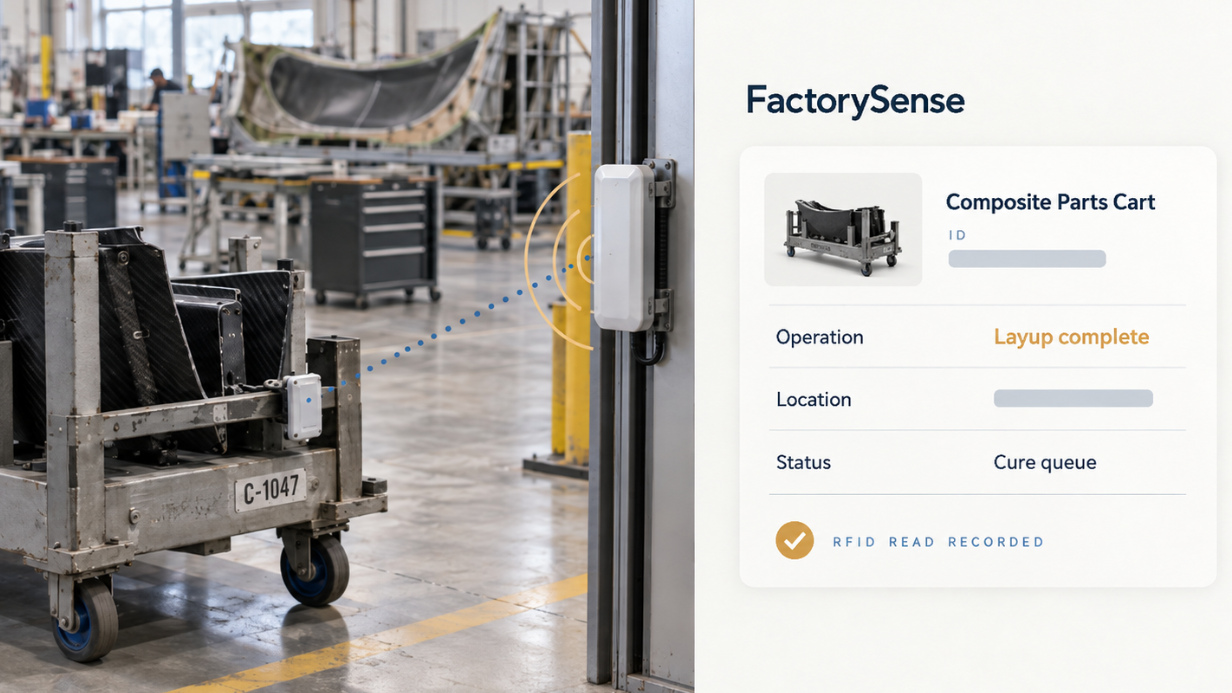
RFID gives the operation additional ways to observe an asset without requiring a line-of-sight scan every time. A passive UHF tag can be read at a tool crib, doorway, work area or other controlled point. A handheld can be used to inventory a room or search for a specific EPC. Active technologies can be used when the requirement is broader zone-level presence rather than checkpoint-based movement.
The important design decision is not which technology sounds most advanced. It is what the business needs to know. If the question is whether a tool left a controlled crib, a fixed read point may be sufficient. If the question is which building contains a piece of mobile equipment across a large campus, the architecture may need broader coverage. Once assets move between facilities, suppliers or depots, the problem begins to look more like the defense logistics architecture than a single-site location system. If the tool is occasionally misplaced inside a work area, handheld search can solve the exception without instrumenting every bench.
At Northrop Grumman's Space Park, for example, FactorySense deployed RFID asset tracking across approximately 1.5 million square feet and 46 buildings. At that scale, “somewhere on campus” is not a useful location. The system has to narrow the search enough that the asset can be recovered without sending people building to building. The deployment is described in this case study.
Movement history is often more useful than a dot on a map
Asset-tracking discussions can become overly focused on current location. Current location matters, but movement history is what lets a team investigate an exception. If a tool was last read leaving a crib, then appeared at a production area and never returned through the expected control point, that history tells a much more useful story than a database field that simply says “unknown.”
This is also where RFID begins to improve accountability without turning every movement into a manual custody form. The event history can show which controlled areas the asset passed through, when it moved and which reader observed it. Depending on the process, that event can be associated with a work order, employee assignment, tool status or other business context in the system of record.
The goal is not to collect radio data for its own sake. It is to preserve enough evidence that operations can answer the ordinary questions that become surprisingly difficult after the fact: Where was it last seen? Did it leave the expected area? Was it returned? Was it assigned to the correct program? Was it still eligible for use?
Tool accountability becomes more valuable when location is joined to status
Location alone can remove search time, but defense manufacturers often gain more when RFID is connected to maintenance, calibration or assignment data. FactorySense has deployed systems where a tool's location is tied to calibration management, so the user can see both where the asset is and whether it remains eligible for use. That combination is described in our calibration case study.
The practical difference is significant. A supervisor who finds the tool but then has to open another system to check calibration has solved only half the problem. When the identity used by RFID resolves to the same asset record used by the maintenance or quality system, location becomes part of a larger operational record rather than another standalone dashboard.
Fixed infrastructure and handhelds solve different parts of the problem
There is a tendency to treat fixed readers and handheld readers as competing approaches. In defense asset tracking they are usually complementary. Fixed readers are strongest where movement is predictable and worth capturing automatically: crib entrances, controlled doors, transfer points or other chokepoints. Handhelds are strongest when a person needs to inventory an area, investigate a discrepancy or find one tagged object among many.
A practical deployment often uses fixed reads to maintain the history and handhelds to close the exceptions. The U.S. Army has also discussed RFID and automated identification technology as part of military inventory and sustainment visibility, which is a useful example of the same principle at a very different scale. That also gives the program a sensible way to scale. The business can instrument the highest-value movement points first, learn where the remaining blind spots are, and add coverage only where the operational value justifies it.
RFID does not remove the need for process ownership
RFID cannot compensate for an asset that was never tagged, a tag that was selected without regard to the object it is attached to, or a workflow that legitimately allows assets to move through unmonitored areas with no alternative control. Nor does a long read range automatically make the system better. In a tool crib, reading tools on the other side of a wall may create more ambiguity than visibility.
The implementation therefore starts with process boundaries: what assets are in scope, which movements matter, where custody or availability changes, and what should happen when the system sees something unexpected. Once those questions are clear, tag selection and reader placement become engineering decisions rather than guesses.
What to measure
A defensible asset-accountability project should begin with the cost of the present process. Search time is usually the most visible measure, but it is not the only one. Duplicate purchases, production interruptions, audit effort, overdue calibrations and time spent reconciling asset records can all matter. The baseline does not need to be elaborate; it needs to be credible enough that operations and finance agree on what is being improved.
After deployment, the relevant measures are similarly practical: how long it takes to find an asset, how often records require correction, how many replacement purchases are avoided, whether return-to-crib behavior improves, and whether calibration or assignment exceptions are being caught earlier. RFID read counts are engineering diagnostics. They are not the business outcome.
For defense contractors, the strongest case for RFID asset tracking is usually straightforward. When a high-value or operationally important asset moves, the business needs a reliable record of that movement. The less that record depends on someone remembering to create it, the more trustworthy the asset history becomes.
Can RFID prevent every lost tool?
No. RFID improves the movement and location record, but assets still need appropriate tags, defined process coverage and a control strategy for unmonitored movement.
Should defense tool tracking use fixed readers or handhelds?
Often both. Fixed readers capture predictable movement automatically; handhelds are useful for audits, searches and exceptions.
Can RFID track calibration status?
RFID identifies the asset and its movement. Calibration status normally remains in the maintenance or quality system and becomes useful when that record is joined to the RFID identity.
Schedule a complementary working session with an RFID professional to discuss your floor or yard, your systems of record, and where the visibility gap between them is costing you.
Book a session