
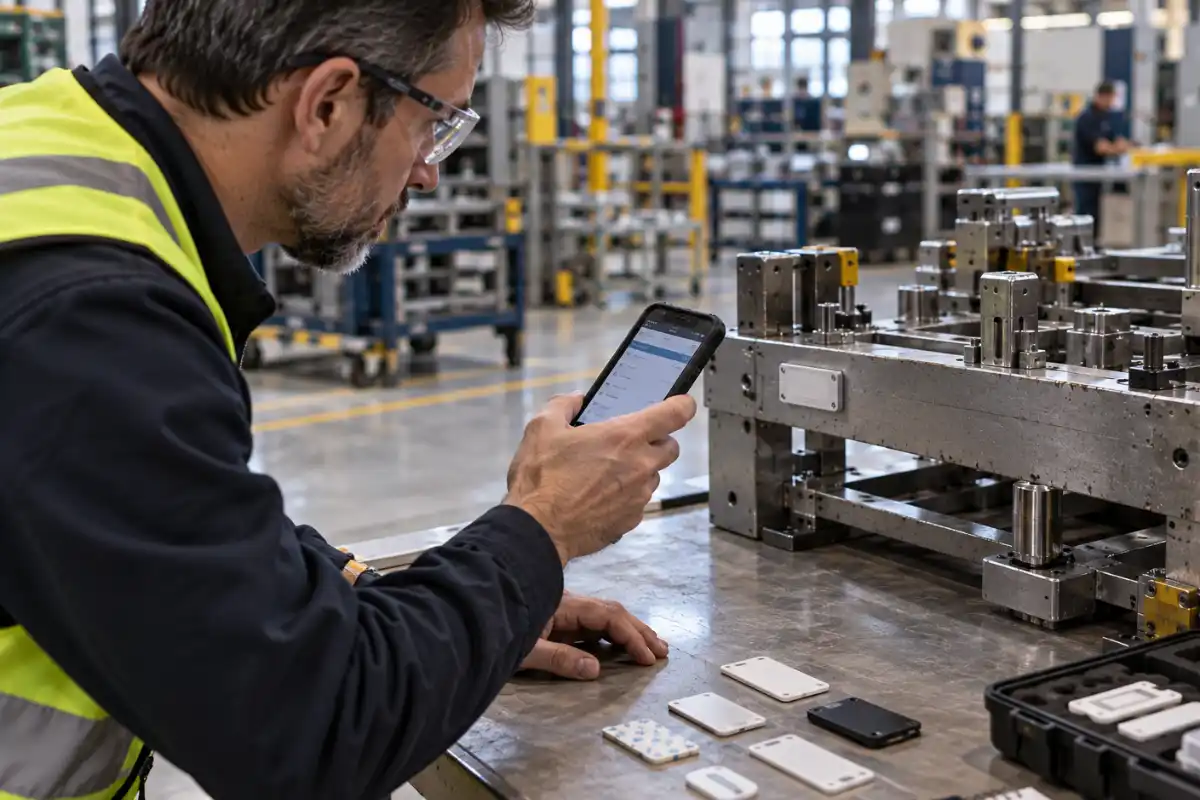

Industrial RFID for manufacturing.
FactorySense helps manufacturers track assets, inventory and work in process across production facilities and supporting warehouses, distribution centers and outdoor laydown yards. RFID consulting, the FactorySense.io software platform and hardware expertise connect physical movements to enterprise records, with integration and ongoing support from the same accountable team.

RFID applications by industry
Industrial RFID connects identified assets, materials and work in process to movement records that support manufacturing decisions.
Aerospace and defense
RFID in aerospace and defense manufacturing can connect serialized assemblies, tooling and ground support equipment to observed production movements. A tagged traveler or carrier can help show where a work order was last seen and which handoff needs attention. For example, read points at controlled areas can record arrivals and departures, while handheld search helps locate shared equipment before the next operation. Metal surfaces, closely spaced workstations and adjacent traffic require testing to distinguish an intended movement from a nearby read. FactorySense designs the capture method and event rules around that workflow, then connects accepted events to production and asset records. The published Honeywell Aerospace and Northrop Grumman cases show different applications of this approach.

Asset visibility across 46 buildings at Northrop Grumman Space Park
Northrop Grumman combined fixed and handheld RFID, standardized tagging and enterprise integration so teams could locate assets and review movement history across a 1.5-million-square-foot campus. Northrop Grumman reported materially lower search effort, fewer asset-loss problems and a more reliable movement history.
Electronics manufacturing
In electronics manufacturing, RFID can help identify material carriers and confirm movements between storage, kitting and production. Examples include tagged SMT reels and trays or ESD-safe totes linked to a kit, work order or material lot. For moisture-sensitive devices, recorded storage and production transitions can feed floor-life calculations when the workflow captures the required events and applies the approved handling rules. A tag read alone does not establish material condition. Small components, metal enclosures and dense storage make tag placement and read-zone testing essential. FactorySense evaluates the actual carrier, packaging and production route before selecting hardware and connecting accepted movements to inventory or manufacturing records. The published Honeywell Aerospace case shows how a passive RFID redesign restored confidence in work-in-process data.
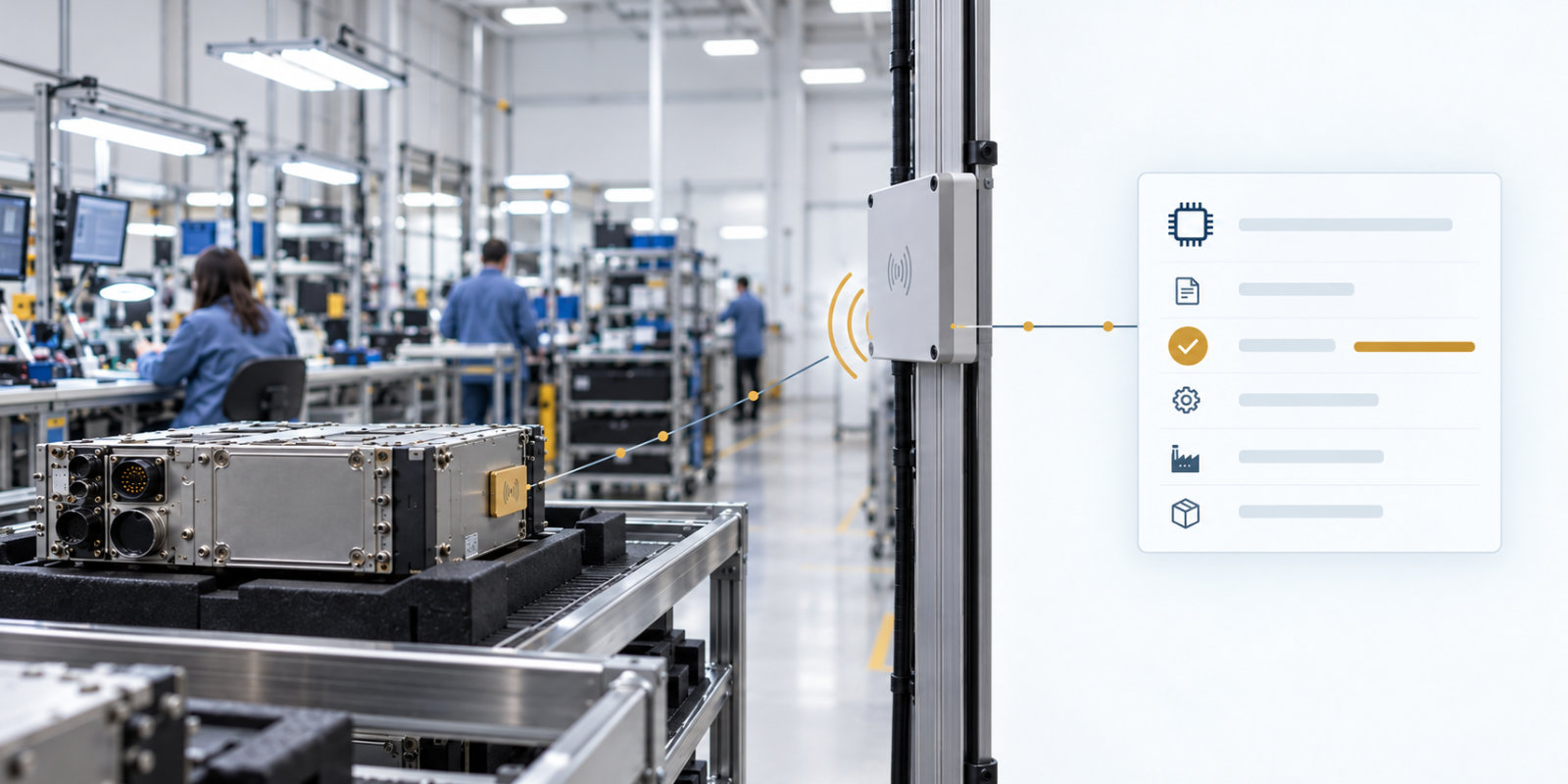
"The FactorySense RFID solution is user-friendly and accurate. It has streamlined our operations and reduced errors."
Adam Overbo, Materials Manager, Honeywell Aerospace. FactorySense rebuilt the WIP deployment around passive RFID, redesigned read points and validated production events. Honeywell subsequently extended the infrastructure to carts, tooling and other mobile assets.
Medical device manufacturing
In medical device manufacturing, RFID can connect item or carrier identity to production movements and support lot and serial genealogy. Observed handoffs can contribute evidence to a device history record when integrated with the manufacturing and quality systems that maintain it. Examples include tracking a work order between assembly stages or confirming cleanroom transfers using tags and mounting methods suited to the process. An RFID identity can be mapped to the relevant lot, serial or UDI record where required, with the approved identifier and labeling process maintained by the manufacturer. Quality and validation teams define the accepted events, exception handling and record requirements. RFID adds movement evidence; approvals and release decisions remain in the authoritative quality workflow.

More complete WIP records in medical device manufacturing
A multinational medical device manufacturer used fixed RFID checkpoints, handheld verification and ERP integration to make production movement records more complete and timely. Zone-based records added evidence around controlled-area transfers while the existing quality procedures remained authoritative.
Automotive manufacturing
RFID in automotive manufacturing can help confirm the movement of returnable containers and parts between receiving, storage and production. At line-side supermarkets, an observed container handoff can support replenishment or kanban workflows when the event is linked to the correct part, quantity and destination. The design must account for reused containers, changing contents and nearby traffic so a read becomes a reliable movement record. FactorySense tests the read points at production speed and defines how accepted events update the existing ERP or WMS. Operators need a clear exception path when the observed movement differs from the expected transaction. The published automotive supplier case illustrates inventory and audit improvements from one deployment.

One automotive supplier cut manual inventory audit time by more than 70%
A Tier 1 automotive supplier connected RFID observations at selected material handoffs to its ERP, with handheld readers for checks and exceptions. The supplier reported less time spent on manual inventory audits and improved inventory accuracy.
Industrial equipment manufacturing
RFID can help industrial equipment manufacturers locate shared gauges and torque tools and connect tool identity to custody and calibration records. For example, tool crib check-out can associate an instrument with a person or work area, while a later read helps confirm its return or observed location. Calibration due dates and approved status come from the authoritative calibration system, so finding a tool and approving it for use remain separate decisions. FactorySense designs tag mounting and capture methods around how tools are stored, issued and serviced, then connects accepted events to the records teams use. The published equipment manufacturer case shows how one customer improved retrieval and calibration visibility.
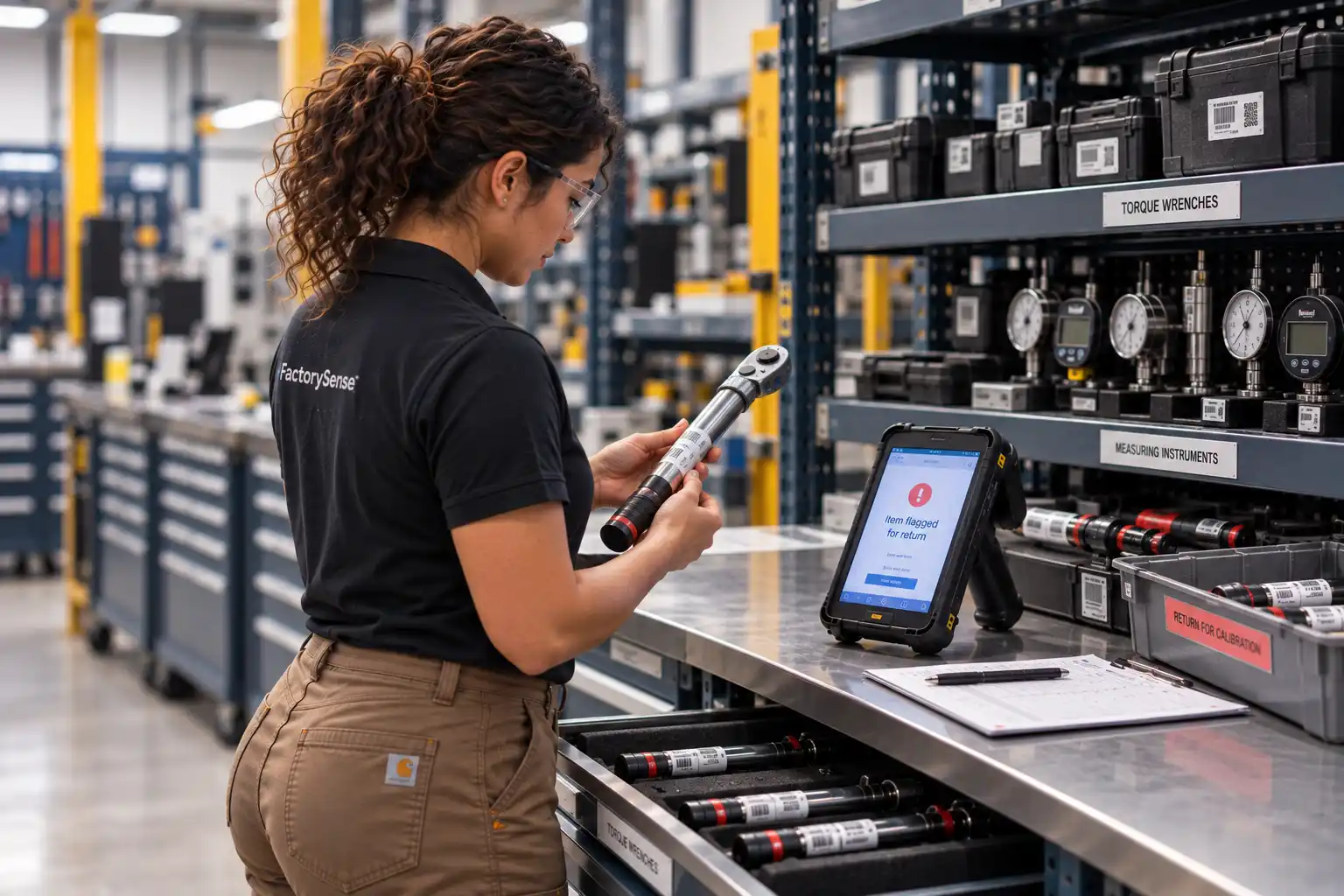
One equipment manufacturer reduced tool retrieval time by 73%
A global heavy equipment manufacturer combined passive RFID, BLE and handheld search with calibration information in a common asset workflow. The manufacturer reported a 73% reduction in tool retrieval time and expanded the approach to additional sites.
Composites manufacturing
In composites manufacturing, RFID can preserve material identity as prepreg rolls become cut pieces, kits and plies moving toward cure. Each split or transfer needs a recorded relationship to the source lot so production history follows the material through changing forms. Validated freezer exit and return events can feed cumulative prepreg out-time calculations using the approved limits for that material. Freezer logs and temperature history require appropriate records or sensors; an ordinary RFID tag does not measure temperature. Tag placement must also suit packaging and handling, with carriers or tooling used where direct tagging is unsuitable. FactorySense connects accepted movements to material and work-order records, with an exception workflow for missed transitions or uncertain identity.
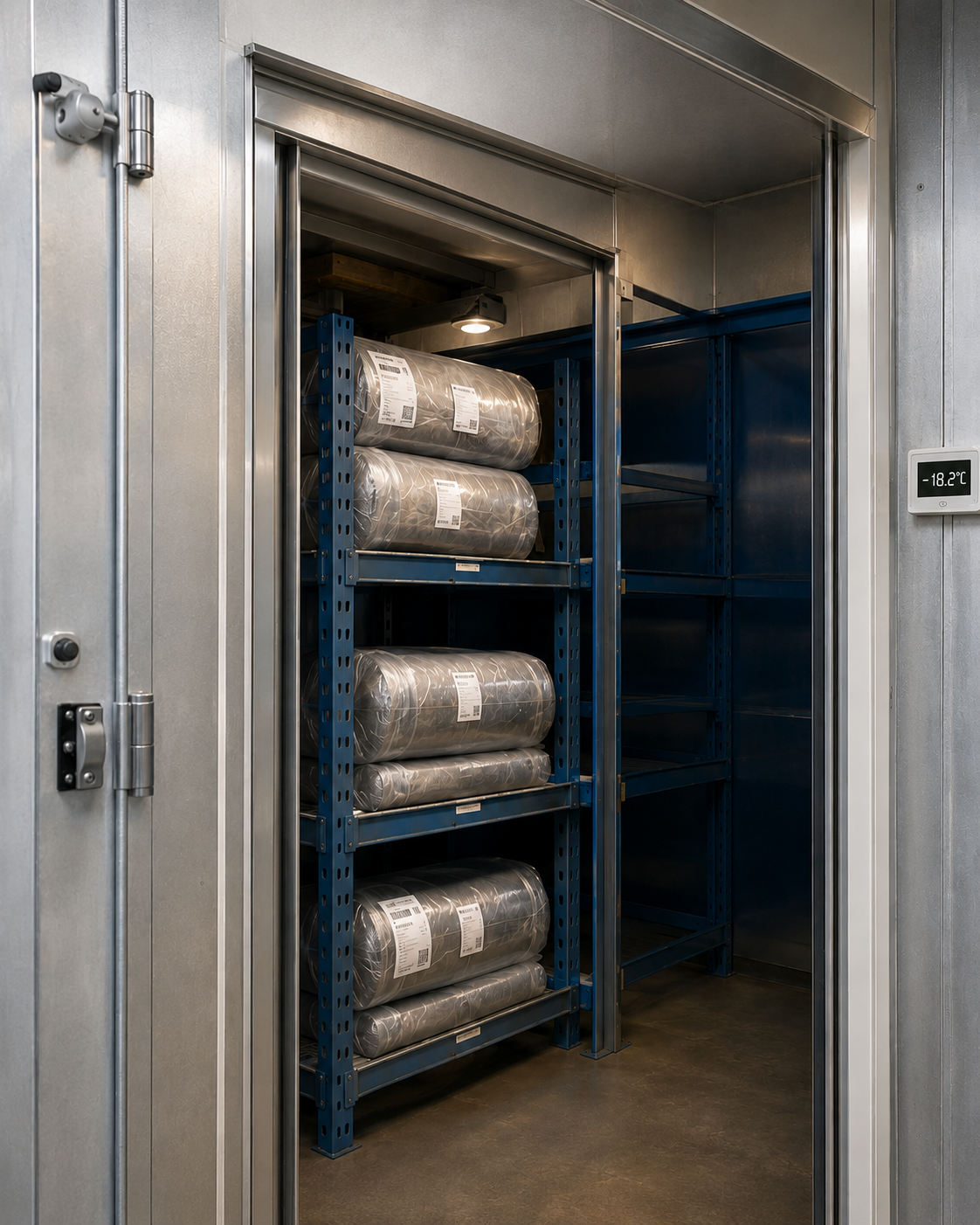
One composites manufacturer reported 99.8% inventory accuracy
An advanced composites manufacturer connected material identities and observed production movements to ERP and MES records. Within six months, the manufacturer reported 99.8% inventory accuracy and an 87% reduction in material search time.
One accountable team from the first read test to the ERP transaction.
Sector knowledge shapes the design, while the delivery model stays consistent. We test tags and read zones with your actual assets, select the sensing technology the workflow requires, integrate validated events with ERP, MES, WMS or EAM and support the system after go-live. Hardware, software and integration are owned by the same team, so accountability does not get lost between vendors.
Common questions about RFID by industry.
Practical answers for operations, quality and IT leaders evaluating RFID in their sector.
Which industries does FactorySense work with?+
Most of our work is in manufacturing: aerospace and defense, electronics, medical devices, automotive suppliers, industrial equipment and advanced composites. We design around the physical workflow, the records teams depend on and the operating consequences of missed movements. The linked customer case studies show specific deployments and results.
Does RFID work in metal-dense facilities?+
It can, when tags, mounting and read zones are engineered for the conditions. Metal can reflect RF energy and detune tags, while liquids can absorb energy. Performance depends on the object, tag placement, antenna layout and surrounding traffic. A site assessment with your actual assets tests whether the required movements can be captured reliably.
Can RFID support device history records?+
Yes. Validated RFID events can contribute item or carrier identity, observed location and movement timestamps to the manufacturing and quality systems that maintain device history records. Lot and serial relationships must be mapped correctly, with controls for missed reads, duplicate events and exceptions. Quality and validation teams define the evidence and record requirements. RFID supplies observations; it does not replace the approved quality process or release decision.
Where should an RFID project in our industry start?+
Start with one operating problem that has a measurable cost, such as search time, audit effort or gaps in WIP history. A site assessment or focused pilot tests the capture method with your own assets and workflow. Define the required event, the system update and the exception path before deciding what to scale.
How does RFID track prepreg out-time?+
RFID can identify material and record validated freezer exit and return events. Software uses those timestamps to accumulate time outside approved storage against the handling limits for the specific material. Cut pieces and kits need identities linked to their source lot and exposure history. Missed transitions need an exception process. Temperature history requires appropriate sensors or records; an ordinary RFID tag does not measure temperature.
Do we need a new ERP to use RFID?+
Usually, no. RFID can feed validated movement events into an existing ERP, MES, WMS or EAM through supported interfaces. The work includes mapping identifiers, defining accepted transactions and handling acknowledgements, retries and exceptions. The integration approach depends on the system version, available interfaces and IT requirements. FactorySense evaluates those constraints alongside the read-zone and software design.
Start with the operation you need to control.
Tell us about your facility, the objects that move through it and the record your teams depend on. We will help you decide what is practical to prove first.