
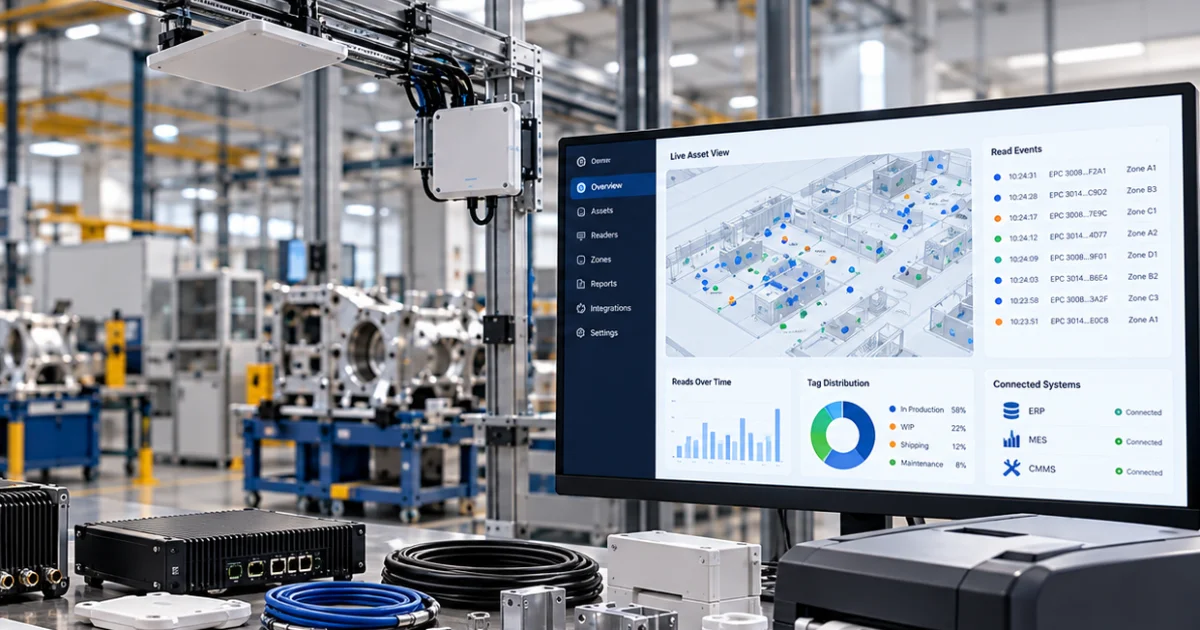

Know where critical assets are, who has them, and what happened last
FactorySense designs and deploys RFID asset tracking systems for tools, equipment, containers, work in process, and other high-value assets across factories, warehouses and multi-building campuses. Tags, readers, software, integration and field engineering are delivered as one production system.
Enterprise records are only useful when they reflect what is actually happening on the floor.
ERP, WMS, and other shop-floor systems can hold a valid record even after the physical asset has already moved. If a tool leaves a crib, equipment crosses into another building, a container is staged beside a cell, or work in process changes hands without anyone recording the transaction, RFID closes the gap by automatically seeing the movement and supplying your systems with reliable location, custody, and state events.
Tags + Fixed & Handheld Readers + Enterprise RFID Platform
Tags identify the asset. Fixed and handheld readers capture movement and help teams find it. FactorySense.io turns those observations into current location and status information.
RFID observations become operational events and enterprise records.
Tags
RFID tags give each asset a unique identity. Tag type and placement are selected for the asset, material and operating environment.
RFID observations become operational events and enterprise records.
Fixed + handheld readers
Fixed readers capture movement automatically at defined points. iOS and Android handheld readers support directed search, audits, and areas without permanent coverage.
RFID observations become operational events and enterprise records.
FactorySense.io platform
FactorySense.io interprets reader observations as location, movement, custody and status events, then passes those events to ERP, EAM, MES, WMS and other operating systems.
Choose the tracking approach around the operation, not the other way around.
Different assets call for different levels of visibility. In some applications, it is enough to know whether an asset crossed a doorway or entered a defined area. Others require zone-level location, custody, directed search, or continuous positioning.
FactorySense starts by defining what the operation actually needs to know. From there, we select the right combination of RFID, RTLS, handheld tools, and infrastructure without adding more cost or complexity than the application requires.
Presence or absence within a facility, storage area, crib or controlled zone.
A reliable transition event when an asset crosses a doorway, portal, process boundary or other controlled read point.
Custody: which person, team, crib or work center holds the asset now, and since when.
Operational state such as issued, staged, in calibration, in inspection, in rework or ready for the next job.
Last-seen location and handheld search reduce walking, phone calls and floor-wide searches.
A location, custody or state event written into ERP, EAM, CMMS, MES, WMS or another operating system.
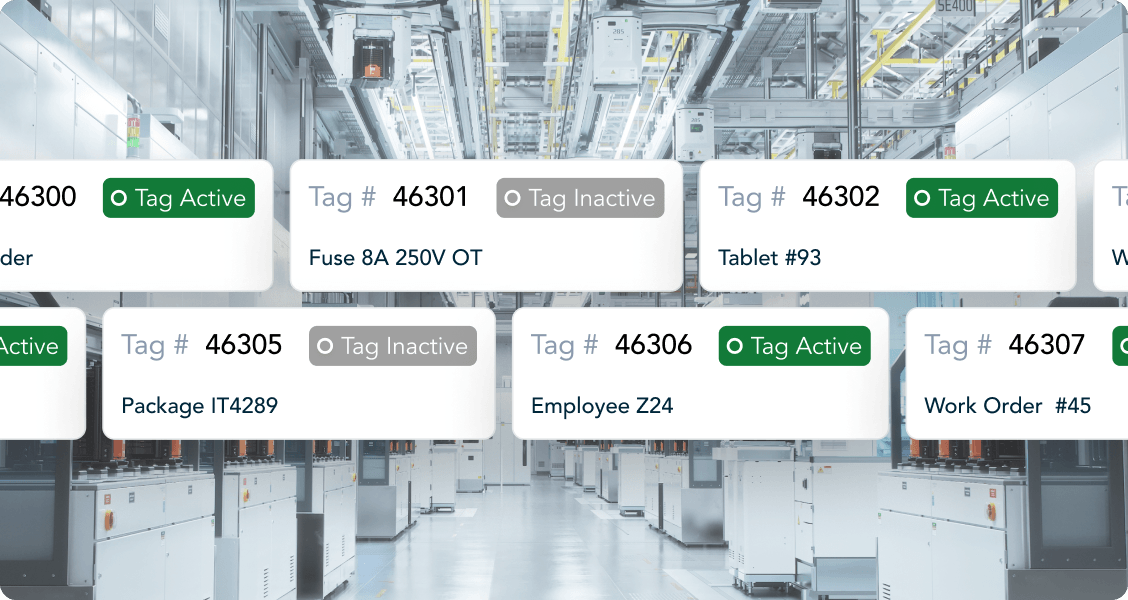
Use the least complex technology that answers the operating question reliably.
Passive UHF RFID, handheld search, BLE and UWB solve different location problems. FactorySense selects the architecture around the required event, location resolution, asset value, movement pattern and physical environment rather than forcing every deployment into one technology.
RFID observations become operational events and enterprise records.
Controlled transitions
Passive RFID at doors, portals, cribs and process boundaries is well suited when the important question is whether an asset moved from one known location or state to another.
RFID observations become operational events and enterprise records.
Zone-level location
Fixed RFID, BLE or other infrastructure establishes which operating area contains the asset so teams can narrow a search without instrumenting every square foot.
RFID observations become operational events and enterprise records.
Handheld search
A mobile RFID reader gives personnel a directed way to locate a specific tagged asset, reconcile a crib or perform rapid cycle counts alongside permanent infrastructure.
RFID observations become operational events and enterprise records.
Continuous RTLS
Active technologies such as BLE or UWB are appropriate when the operation genuinely needs repeated or high-resolution position rather than presence, transition history or last-seen location.
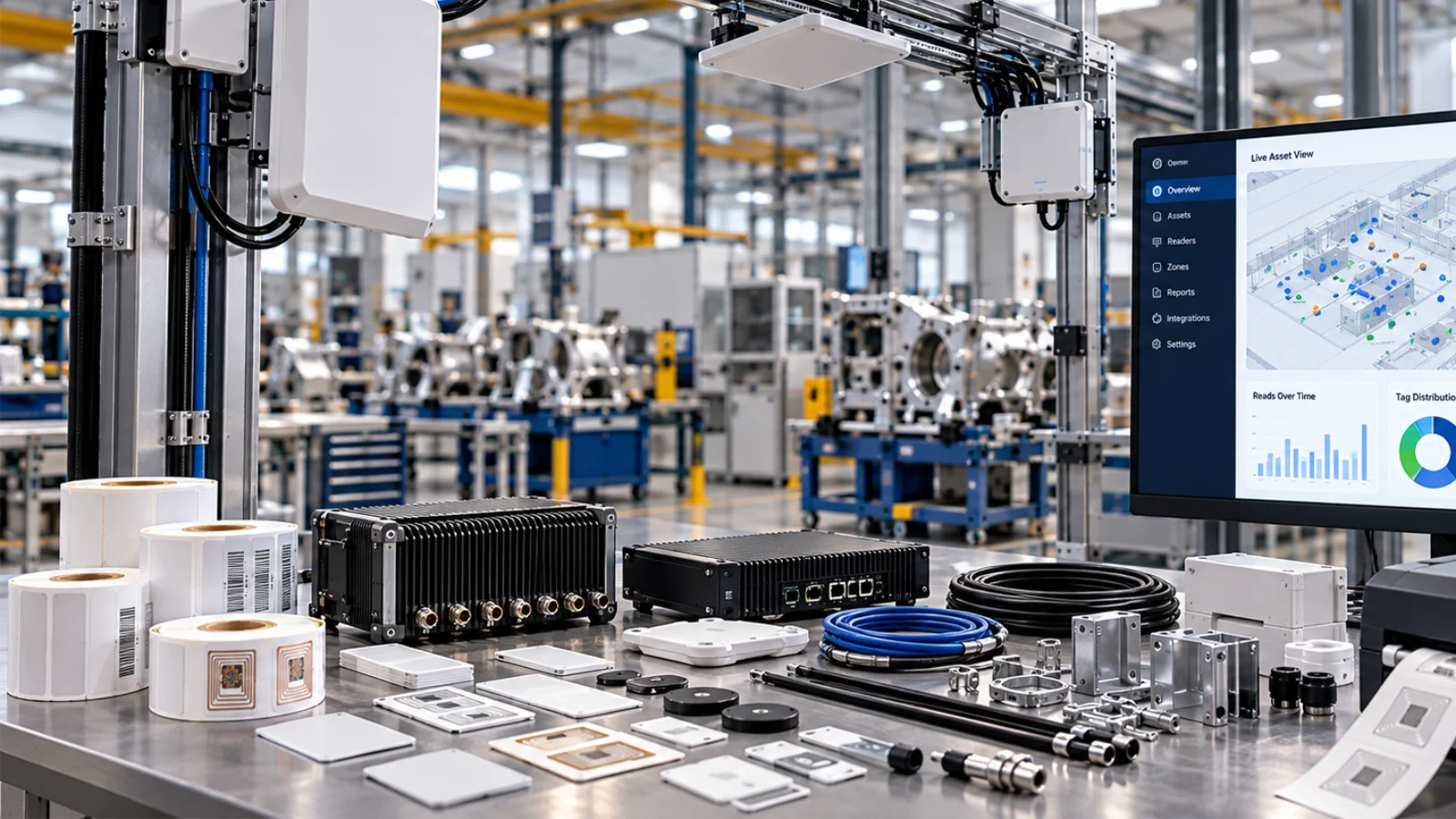
Not sure where to start? A site survey is typically our first step.
Metal changes RF behavior. Liquids absorb UHF energy. Tag orientation, mounting material, antenna geometry, and reader power settings all affect whether the right asset is observed at the right place without creating unwanted reads nearby. FactorySense engineers test the assets, materials and RF environment on site before the architecture is finalized.
From operating question to production asset tracking system.
The technology follows the requirement. Each stage narrows uncertainty before the next one begins, so the final system is engineered around the real assets, facility and enterprise workflow rather than a generic reader-and-tag specification.
Define
Clarify the assets in scope, the operating question, the required location resolution, exceptions and enterprise actions that matter.
Observe
Determine where movements, custody changes and states can be observed reliably in the actual physical process.
Prove
Test tags, materials, read zones and environmental conditions against the real assets before scaling.
Engineer
Design RF infrastructure, event logic, software behavior, networking and enterprise interfaces as one system.
Deploy
Install, configure, commission and validate the system against the workflows and acceptance criteria it must support.
Operate
Monitor, tune and support the production system as assets, workflows, facilities and business rules change.
Questions that usually come up before an RFID asset tracking project moves forward
The useful questions are usually about fit: what RFID can reliably observe, where it works well, where it does not, how it connects to existing systems, and what has to be proven on site before deployment.
What kinds of assets are a good fit for RFID tracking?+
RFID is a strong fit for assets that move often, are costly to search for or replace, or need a dependable movement history. Common examples include tools, fixtures, containers, returnable assets, equipment, test gear and work-in-process carriers. The economics improve when the same assets are handled repeatedly and manual transactions are easy to miss.
Do we need fixed readers everywhere?+
Usually not. Many successful systems use fixed readers only at the transitions that matter, then use handheld RFID for directed search, audits or areas where permanent coverage is unnecessary. The goal is not to blanket a facility with readers; it is to capture the movements that matter reliably.
Can RFID tell us an asset's exact location?+
Sometimes, but that is not always the right requirement. Passive RFID is very effective for presence, last-seen location and controlled transitions. If the operation truly needs continuous or high-resolution coordinates, an active technology such as BLE or UWB may be more appropriate. We choose the architecture around the location question rather than forcing one technology to do everything.
How does RFID connect to our ERP, EAM or CMMS?+
FactorySense turns reader observations into usable location, custody and state events before sending them into ERP, EAM, CMMS, MES, WMS or another operating system. That avoids creating a separate location database that people have to check manually.
What makes an RFID asset tracking system reliable?+
Reliability comes from the full design: the right tag on the real asset, enough RF margin, a read zone that sees what it should and excludes what it should not, sensible event logic, and integration that handles exceptions cleanly. Read rate by itself is not enough.
Will RFID work on metal tools and equipment?+
Yes, but the tag and mounting approach matter. Metal changes the RF environment, so industrial deployments often use on-metal tags, spacers or different placement rules. Those decisions should be tested on the actual asset rather than taken from a specification sheet.
What should be proven before a full deployment?+
Before scaling, we want to prove the tag on the real object, the intended read point, nearby unintended reads, the movement or custody event, and the system-of-record update. That gives the project measurable acceptance criteria instead of relying on a lab demonstration.
When is active RFID a better choice than passive RFID?+
Active technology is useful when assets need to be heard over larger areas, when location needs to update frequently, or when onboard sensing justifies a powered tag. Passive RFID is usually more economical for high-volume identification, controlled transitions and handheld search. Hybrid systems are common when different asset classes have different requirements.
How does RFID change asset audits?+
It reduces the amount of reconciliation that depends on someone seeing an item and recording it by hand. Fixed observations preserve movement history, while handheld RFID can speed physical counts and searches. The result is a better match between the physical asset population and the records used for operations, calibration or compliance.
Tell us what you need to track.
Tell us what you need to track, where visibility breaks down and which system needs the result. FactorySense can assess the environment, prove the read performance and design the complete deployment.