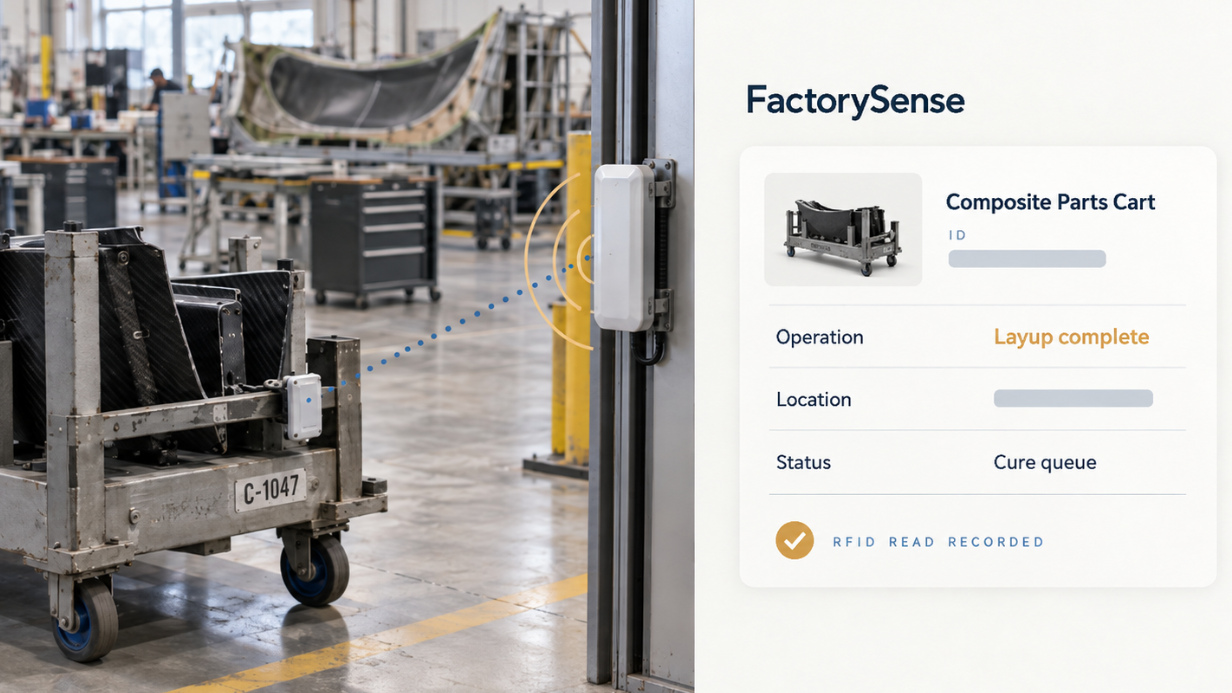
Composite Material Traceability: RFID from Receipt Through Production

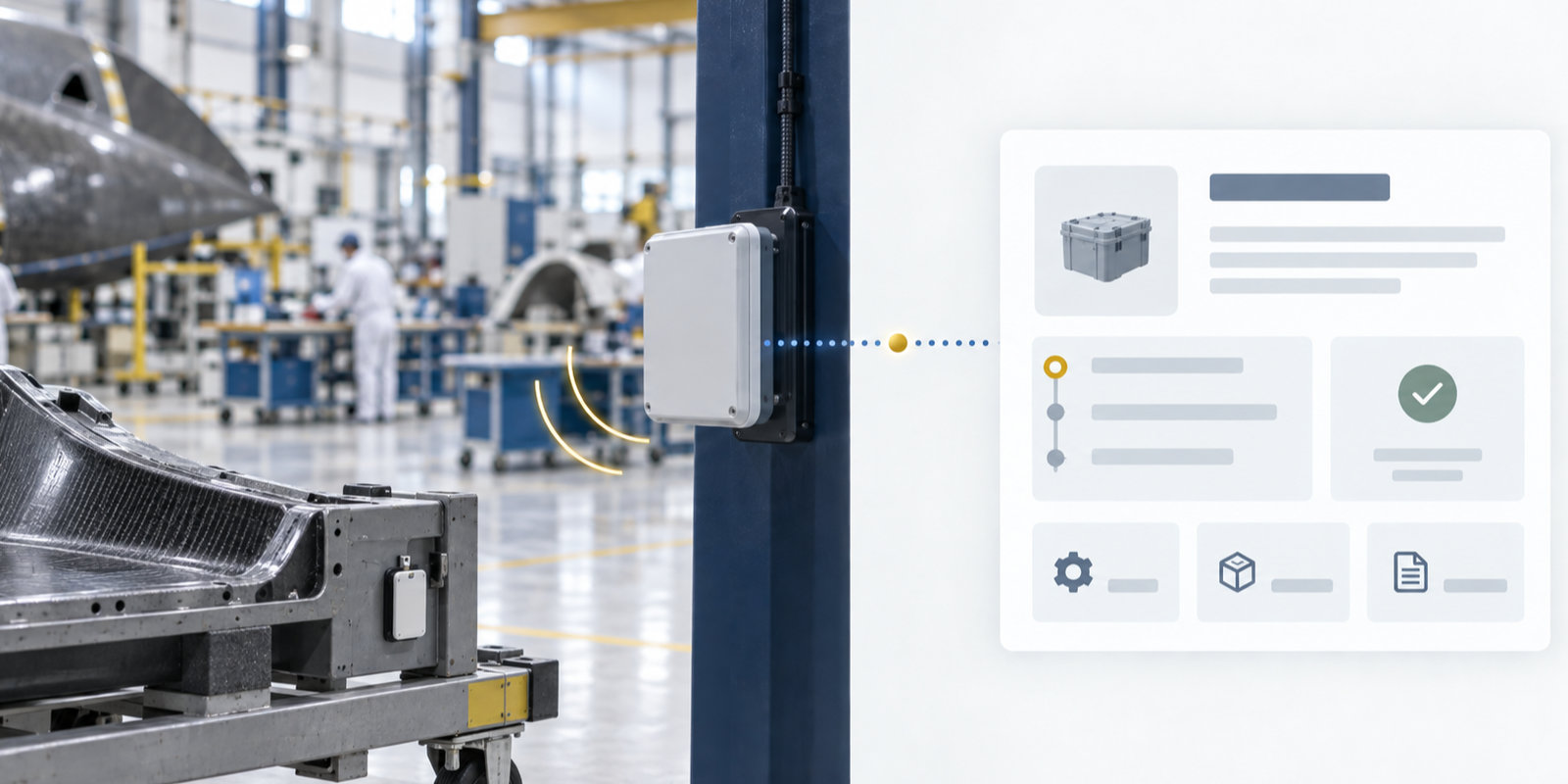
- The manufacturer reported 99.8% inventory accuracy and an 87% reduction in material search time after RFID was introduced across material and WIP movements.
- RFID events were integrated with ERP and MES records so material identity, movement and production context could be viewed together.
- The deployment shows that composite traceability depends on preserving identity and process history, not simply knowing that a tag was read.
Composite traceability starts before material reaches the layup table
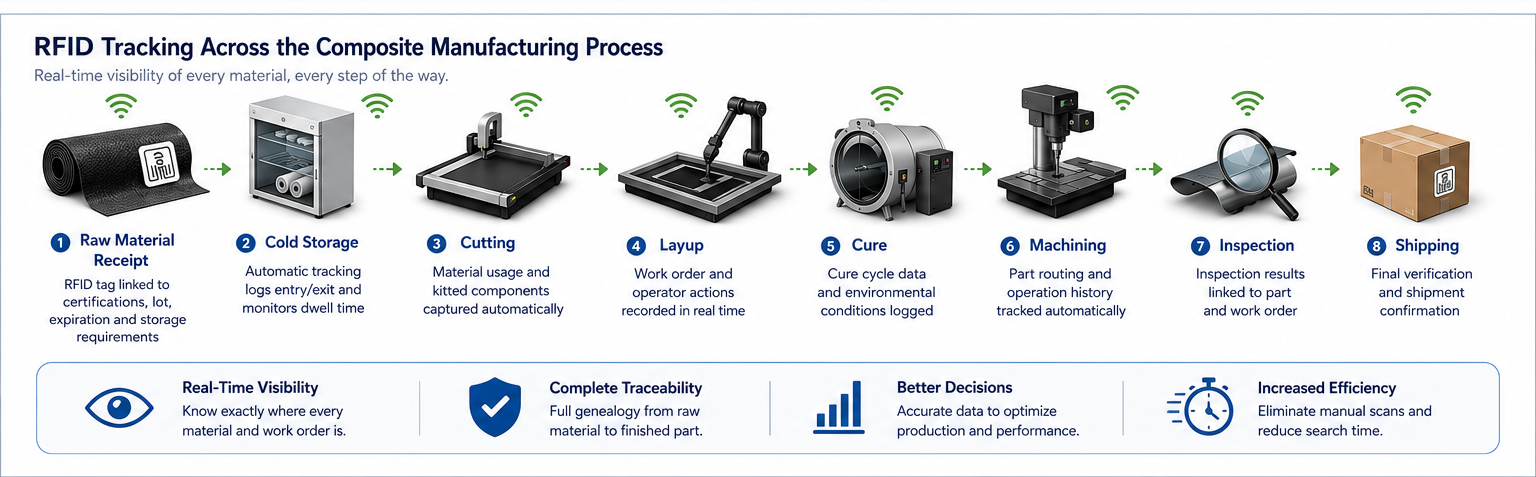
An advanced composites manufacturer was managing rolls of prepreg, cut kits and work orders across receiving, cold storage, cutting, layup, curing, machining, inspection and shipping. The company already had the underlying production records, but much of the physical movement between those steps still depended on barcode scans and paper travelers.
That created two related problems. Operators lost time locating material between departments, and quality teams had to reconstruct genealogy from records that were only as complete as the manual transactions behind them. As production volume increased, both problems became harder to absorb.
The RFID identity followed the material through production
FactorySense introduced RFID at the material and WIP level. Incoming material was associated with a digital identity that could be linked to information such as supplier certification, lot, storage requirements and the work order that later consumed it.
Readers were then placed at selected transitions so movement could be observed without requiring an operator to stop and scan every item. The goal was not to create a continuous coordinate for every roll or kit. It was to establish a dependable sequence of business events as material moved through the process.
The event history was connected to ERP and MES records
FactorySense integrated the RFID events with the manufacturer's existing ERP and MES environment. That allowed production and quality teams to see material movement in the same context as work orders, lots and process records rather than maintaining a parallel RFID database.
For composites, that relationship matters. An RFID tag can identify a roll or kit, but the enterprise systems still own the engineering and quality information that determines whether the material is appropriate for use. The tracking layer adds evidence about where the material was observed and when it moved.
Measured results
Within six months, the manufacturer reported substantial improvements in search effort, inventory control and reporting. The figures below are the customer's reported operating results from the deployment.
| Measure | Reported result |
|---|---|
| Material search time | 87% reduction |
| Inventory accuracy | 99.8% |
| Manual data entry | 81% reduction |
| Production throughput | 18% increase |
| Traceability report preparation | 3 hours to under 2 minutes |
| Annual inventory loss | 42% reduction |
| Production time recovered | 2,700+ hours annually |
Those numbers are useful because they show where the value came from. The project did not create value because a reader produced more tag reads. It reduced time spent searching and entering data, improved the completeness of the inventory record and made traceability information easier to assemble when quality teams needed it.
The customer described the change in practical terms
“Before FactorySense, finding the location of a material roll or work order often meant walking the production floor or checking multiple spreadsheets. Now we know exactly where every material is, who last handled it, and what production stage it's in without interrupting production.”
Operations Manager, Advanced Composite Manufacturer
What this deployment shows
Composite material control is not just an inventory problem. Material identity has to survive changes in form, location and process context as a roll becomes a kit and a kit becomes part of a work order. The tracking system is useful when that history remains connected rather than being recreated manually at each step.
Our article on composite material control goes deeper into prepreg out-time, material aging and genealogy. This deployment is the practical counterpart: it shows what the physical tracking layer can look like when that information has to follow material through production.
What problem was RFID solving in this composite manufacturing deployment?
The manufacturer needed a more reliable way to preserve material identity and movement history as rolls, kits and work orders moved through receiving, storage and production. The prior process depended heavily on barcode scans and paper travelers, which created search time and gaps in the production record.
Did RFID replace the ERP or MES?
No. FactorySense integrated RFID events with the manufacturer's existing ERP and MES environment. The enterprise systems continued to own the production and quality records, while RFID supplied evidence about when and where tagged material was observed.
What results did the manufacturer report?
Within six months, the manufacturer reported a 99.8% inventory accuracy rate, an 87% reduction in material search time, an 81% reduction in manual data entry and an 18% increase in production throughput.
Schedule a complementary working session with an RFID professional to discuss your floor or yard, your systems of record, and where the visibility gap between them is costing you.
Book a session