Composite Material Control: Managing Prepreg Out-Time, Scrap and Traceability

- Prepreg material life is an operating variable: freezer storage, accumulated out-time, moisture control and material aging can affect processability and finished-part quality.
- Composite scrap includes both geometry-driven offcuts and material that becomes unusable or difficult to disposition because storage or out-time limits are exceeded or cannot be demonstrated.
- RFID can automate identity and movement events for rolls and kits, but the material specification, quality system and engineering disposition remain authoritative.
Composite manufacturing has an unusual inventory problem: some of the most valuable material on the floor is chemically changing while it waits. Carbon and glass prepregs can require frozen storage to slow resin advancement, then accumulate a limited amount of allowable time at ambient conditions while they are thawed, cut, kitted, laid up and returned to storage. That makes material identity and material age part of production control, not simply warehouse data. When the record is incomplete, the consequence can be scrap, rework, engineering review, or uncertainty about whether a material lot is still acceptable for use.
The underlying issue is well established in aerospace materials practice. The FAA's AC 43-214A states that thermoset prepregs and structural adhesives are typically stored around 0°F (-18°C) to retard aging, and it requires approved procedures to track allowable accumulated out-time and the actual accumulated time outside the freezer. A NASA composite process specification similarly requires traceable out-time and shelf-life records where those limits apply. Those are quality-system requirements before RFID ever enters the discussion.
The manufacturing opportunity is to make that record easier to create and harder to lose. RFID can identify a roll, kit, container, tool or WIP traveler automatically as it crosses controlled points, allowing software to build a timestamped history of material movement without relying entirely on handwritten freezer logs or repeated barcode scans. The technology does not decide whether material is acceptable, and it does not replace the applicable material data sheet, specification, or engineering disposition. It gives the quality and production systems better evidence about where the material went and how long it was exposed.
Prepreg aging is a production variable, not an administrative date
Thermoset prepreg contains a resin system that is deliberately only partly advanced before final cure, which is why temperature history matters. A 2025 review in Composites Part B: Engineering summarizes how aging during freezer storage and room-temperature exposure changes conversion, glass-transition behavior, water uptake and viscosity, with downstream effects on tack, forming, cure behavior, porosity and mechanical performance. The practical implication is that material age is not merely paperwork attached to an otherwise unchanged roll. It is one of the variables influencing how the material processes.
That does not mean every prepreg becomes unusable the moment a nominal out-life is reached, nor does it justify extending a limit on the factory floor. Researchers often study material beyond the supplier's stated limit precisely to understand how properties evolve. NASA, for example, studied IM7/977-3 prepreg with a reported 30-day out-life and aged it for as long as 60 days to evaluate changes in cure behavior, viscoelastic properties and processability. Those experiments are evidence that out-time matters, not permission to ignore the approved material specification.
Different systems also age differently. A 2024 study in Materials and Manufacturing Processes examined an out-of-autoclave prepreg with a formal 28-day out-time at 23°C and 50% relative humidity and 24 months of frozen shelf life at -18°C, while noting that common autoclave systems often have shorter recommended out-time. Those figures are material-specific examples, not universal rules. An RFID implementation should therefore store or reference the requirements for the actual qualified material and lot rather than hard-code a generic "30 day" assumption.
Out-time can change the way material behaves during layup and cure
One of the more important findings in the literature is that aging affects processability before it necessarily appears as an obvious visual defect. Research in Composites Part A showed that room-temperature out-time changed the viscoelastic behavior and tack of a standard aerospace carbon/epoxy prepreg, enough that automated deposition parameters needed to account for the material state. Tack affects whether plies remain where placed and how well layers conform during automated or manual layup. That makes accumulated exposure relevant to both material control and process planning.
Out-of-autoclave systems make the relationship between aging and processing particularly visible because resin flow and air evacuation are critical to low-void consolidation. A 2013 study of room-temperature out-time found no significant tow porosity within the material's stated out-life, but porosity increased after the limit was exceeded as resin viscosity and degree of cure evolved. NASA has likewise reported that extended out-time in some out-of-autoclave materials can degrade composite quality and mechanical performance. The exact response is material- and process-dependent, which is another reason the history needs to remain tied to the specific material identity.
Surface quality can also depend on the interaction between material age and process conditions rather than on age alone. A Composites Part A study of vacuum-bag-only processing found surface porosity was influenced by vacuum quality, freezer history and out-time, with tack playing an important role in how air was trapped or evacuated at the tool interface. That type of result matters operationally because it resists a simplistic rule that "older is always worse" in every measurable respect. The production system needs an accurate material history so engineering and quality can apply the correct process knowledge to the actual material state.
Moisture and thaw handling are part of the control problem
The FAA's composite guidance specifically calls for frozen prepreg and adhesive materials to remain sealed while thawing so moisture does not condense on or absorb into the cold material. Older aerospace research available through the NASA Technical Reports Server also documents changes in prepreg appearance, cure behavior and laminate properties as a function of room-temperature aging and humidity. This is a useful reminder that an out-time clock is only one part of material handling. Temperature, humidity, packaging, thaw practice and contamination controls still have to be managed by the manufacturing process.
RFID cannot sense all of those conditions unless the system is paired with appropriate environmental sensors, and a passive tag on a roll is not a temperature logger by itself. What RFID can do is establish identity and custody around the controlled movements that matter: which roll left which freezer, when it left, which kit it became, which work order consumed it, and whether unused material returned to controlled storage. That event history can then be joined to freezer logs, environmental data or quality records rather than reconstructed later from separate spreadsheets.
Scrap comes from more than trim waste
Composite scrap is often discussed as a nesting problem because cutting plies from prepreg rolls inherently creates offcuts. A 2026 review in Composites Part B: Engineering identifies offcuts as a major form of prepreg waste, but it also describes expired prepreg and roll ends as part of the uncured waste stream. That distinction matters because improved nesting can reduce geometry-driven scrap while doing nothing about usable material that is discarded because its remaining life is uncertain or because its history cannot be demonstrated.
Research on reuse and upcycling makes the same point from another angle. Studies of aerospace prepreg scrap distinguish between cutter skeletons and material that exceeds defined tack life, out-life or frozen storage life. Once material moves beyond the approved limits, the production organization may face disposal, requalification or engineering-disposition costs even if the carbon fiber itself remains physically valuable. Better tracking cannot eliminate specification-driven expiration, but it can reduce avoidable uncertainty about which material actually accumulated which exposure.
This is where lot-level visibility becomes more useful than a freezer inventory count. Two rolls of the same material can have the same supplier expiration date and very different cumulative out-time because one has been issued and returned repeatedly while the other has remained frozen. If the system only knows quantity on hand, those rolls look equivalent when they are not. A material-life record allows planners to see remaining usable windows before they issue material, which creates the possibility of consuming the most constrained stock first rather than discovering the problem at layup.
Why manual freezer logs become fragile at scale
A paper or spreadsheet log can work when a small group handles a small number of rolls and everyone follows the same routine. The difficulty increases when materials are split into kits, moved between multiple freezers, staged for different jobs, returned partially used, or handled across shifts and buildings. The record then depends on every removal and return being identified correctly and timestamped against the right lot or kit. One missed event can force a conservative assumption because quality cannot safely infer time that was never recorded.
The FAA guidance is explicit about the need for cumulative out-time records, and NASA process specifications require traceable shelf-life and out-time records where limits apply. The interesting problem is therefore not whether records are necessary. It is how to create them with less clerical effort and fewer opportunities for a physical movement to occur without a corresponding digital record. That is the type of physical-data gap RFID is suited to address.
RFID can make each material movement an event
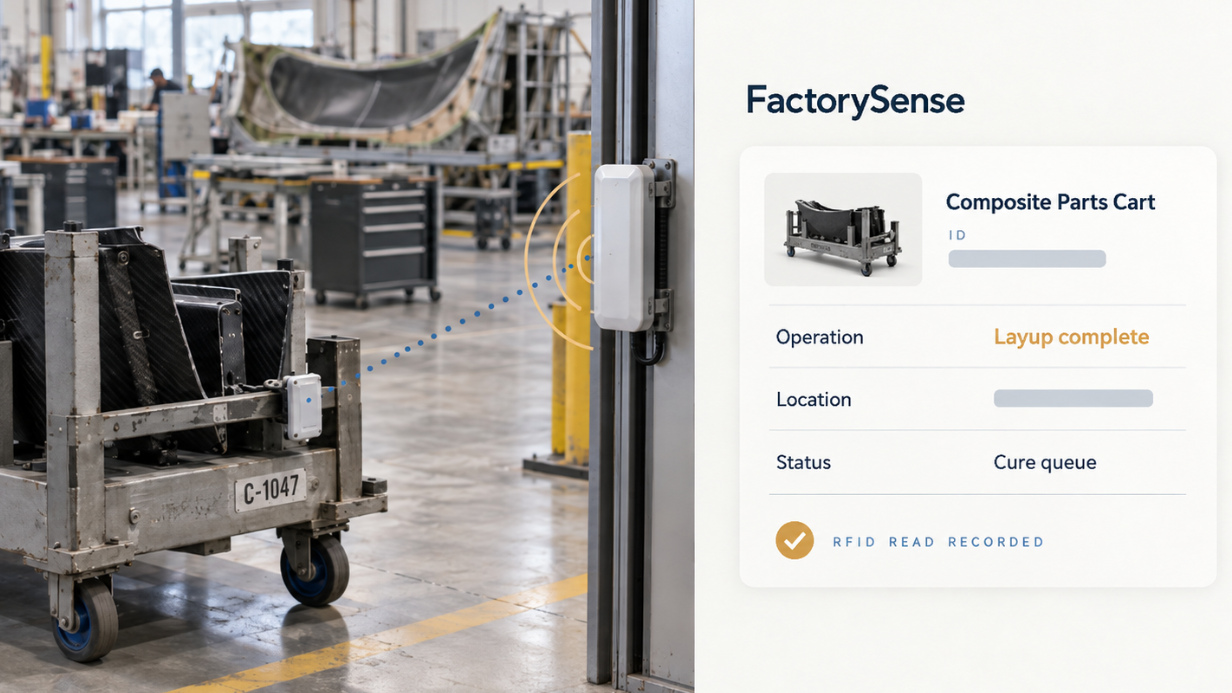
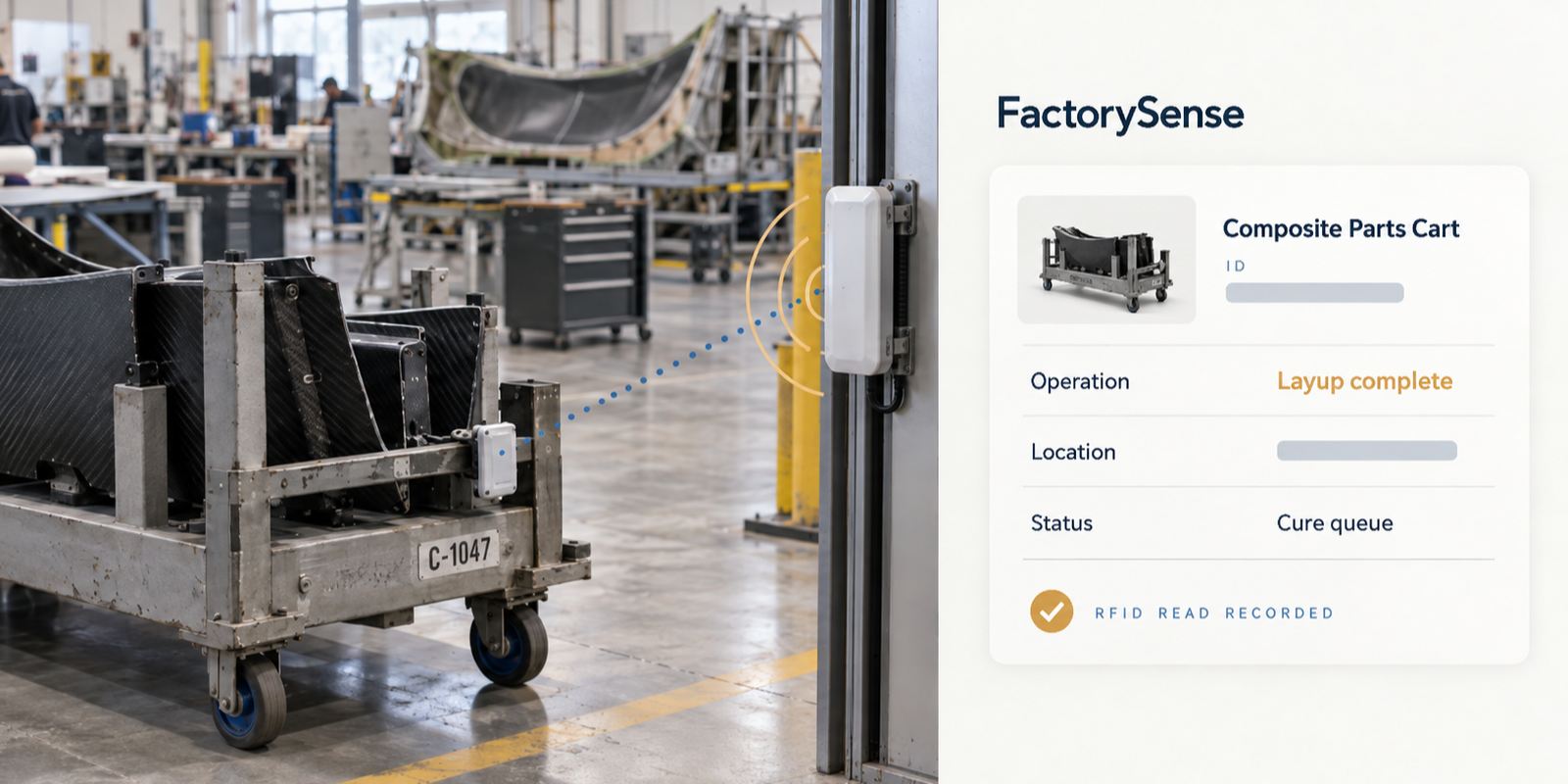
A passive RFID tag attached to a roll container, sealed bag, kit traveler or reusable carrier can identify that object as it crosses a controlled read point. A reader at the freezer or material-control boundary can record the exit and return automatically, while FactorySense Software resolves the tag to the material lot and updates the accumulated exposure record. The same identity can follow the material into kitting and production, provided the genealogy between parent roll, cut kit and work order is explicitly maintained. This is a different problem from simply showing a dot on a map.
The tracking architecture should follow the material process. A freezer doorway may need a controlled transition read, a kitting area may need an operator-assisted association between a parent roll and newly created kits, and a layup area may only need confirmation that the right kit reached the right job. Our RFID tracking guide explains the difference between presence, transitions, last seen and repeated location, while the RFID fundamentals guide shows how the reader, antenna, tag and software exchange works.
The important design rule is that the RF event must match the material-control event. A reader that sees rolls stored near a freezer door cannot automatically be treated as evidence that those rolls left controlled storage. The read zone needs enough physical separation to distinguish an actual crossing from nearby inventory, and the event logic needs to reject observations that do not support the movement. The pre-installation guide describes how to validate that kind of read point before it is trusted for production data.
The parent-roll-to-kit relationship is where traceability gets harder
Tracking a full roll is relatively straightforward because the physical object and material identity remain together. Kitting changes the problem because one parent roll can become many cut plies or kits, each of which may accumulate its own exposure history after separation. A useful system needs to preserve genealogy from supplier lot to roll, from roll to kit, and from kit to the work order or serial-controlled structure that consumes it. RFID can automate parts of that chain, but the split transaction itself still has to be deliberately modeled.
This is also why putting an RFID tag on every individual ply is usually not the right starting point. The smallest tracking unit should be the smallest unit the quality or production process needs to distinguish independently. That may be a sealed kit, a bag, a roll, a reusable tray or a traveler rather than each piece of carbon prepreg. The system should reduce transaction burden, not create a more complicated identity problem than the material-control requirement demands.
Material control should connect to the ERP, MES and quality record
A separate RFID dashboard is not enough if the authoritative material status remains somewhere else. The material master or quality system should still own the specification, expiration rules, approved extensions and disposition state, while the RFID layer contributes observed movement events and calculated exposure intervals. FactorySense Software can present the operational status and exceptions, but the integration should make it clear which system owns the final business decision. Our RFID integration guide covers that separation between observations, business events and system-of-record transactions.
This architecture also makes exception handling more defensible. If a roll has an unexplained gap in its history, the system should not silently invent a return time because doing so would make the record look more precise than the evidence supports. The correct behavior may be to flag the material for review, quarantine it, or require a quality decision depending on the manufacturer's procedures. Good automation makes uncertainty visible instead of converting it into a confident but unsupported status.
Composite tooling and WIP create a second visibility problem
Material life is not the only place composite operations lose time. Layup tools, molds, fixtures, caul plates, vacuum hardware, inspection equipment and reusable carriers can move between programs and work areas, while partially built structures may wait between layup, cure, trim, inspection and assembly. When the facility has poor visibility into those objects, material can be ready but the correct tool or job is not. RFID can use the same physical-event architecture to track those durable assets and WIP independently from the prepreg material-control record.
That distinction is useful because the event semantics differ. A prepreg roll leaving a freezer starts or resumes a controlled exposure interval, while a tool leaving a crib changes custody or availability and a WIP traveler entering inspection changes process state. One RFID platform can observe all three, but the software should not treat them as the same event. The WIP guide explains how process-state tracking works once the concern shifts from material life to production flow.
Where RFID can reduce scrap without overclaiming
RFID will not improve resin chemistry, eliminate cutter offcuts, or make expired material acceptable. It can reduce a narrower category of waste: material discarded or held because its identity, location or accumulated exposure cannot be established confidently, and material that expires because planners could not see which roll or kit had the shortest remaining usable window. Those savings depend on the manufacturer's current process and should be measured rather than assumed. A facility with disciplined electronic material control may have little to gain in this area, while one relying on fragmented logs may have a much larger opportunity.
The pilot should therefore baseline the actual failure modes. How much material is scrapped because it genuinely reaches its specification limit, how much is scrapped because the exposure record is missing or disputed, how often operators spend time reconciling freezer logs, and how often kits wait because material status cannot be confirmed quickly? Those questions turn "reduce scrap" into measurable operating categories. They also prevent the RFID project from claiming credit for waste that comes from nesting, engineering changes or unavoidable process trim.
What a composite-material RFID pilot should prove
A useful pilot begins with one material family and one controlled storage area. Tag the roll or kit at the level the existing quality procedure recognizes, integrate the material identity with the relevant master record, and instrument the freezer or controlled boundary so exit and return events can be distinguished from nearby inventory. Then compare the automated history against the approved manual or electronic control process long enough to capture repeated removals, returns, partial consumption and at least a few exceptions. The goal is not to demonstrate that RFID can read a tag in a freezer doorway.
The acceptance criteria should be operational. The system should identify the correct material, capture the relevant movement without fringe reads, preserve cumulative exposure across multiple cycles, show unresolved gaps instead of hiding them, and provide the event to the system that owns material status. If kits are created, the pilot should also prove the genealogy transaction from parent roll to child kit. These are the same principles described in our RFID pre-installation guide, applied to the much more specific controls of composite material handling.
The competitive advantage is control, not a prettier dashboard
Composite manufacturing places unusual value on knowing not only what material exists, but what has happened to it. Aging, thaw cycles, environmental exposure, cutting, kitting and consumption all sit between supplier receipt and the cured structure, and some of those events directly affect whether material may be used. The literature and aerospace guidance make the need for disciplined material-life records clear. The opportunity for RFID is to capture more of that history from the physical movement itself.
That changes the conversation from "Where is the roll?" to "What is this material, how much approved life remains, which kit inherited it, and which job consumed it?" When those answers are current, production can schedule with better information, quality can investigate with a stronger event trail, and operators spend less time reconstructing history that the system could have captured automatically. The result is not that RFID makes composites simple. It makes one of the hardest parts of composite manufacturing, maintaining trustworthy physical material history, more manageable as volume and complexity grow.
Sources and further reading
- FAA AC 43-214A, Repairs and Alterations to Composite and Bonded Aircraft Structure. Storage, thaw handling, accumulated out-time and recordkeeping requirements.
- NASA, Study of Out-Time on the Processing and Properties of IM7/977-3 Composites. Experimental study of room-temperature aging beyond the material's reported out-life.
- Composites Part B, A review on aging effects of thermoset prepregs. Review of aging effects on resin state, processability and laminate quality.
- Composites Part A, Adaptation of material deposition parameters to account for out-time effects on prepreg tack. Relationship between out-time, viscoelastic behavior and tack in aerospace prepreg.
- Composites Part A, Effect of room-temperature out-time on tow impregnation in an out-of-autoclave prepreg. Study of out-time, resin evolution and tow porosity.
- Composites Part A, Surface porosity during vacuum bag-only prepreg processing. Study of vacuum, freezer history, out-time, tack and surface porosity.
- Materials and Manufacturing Processes, Evaluation methods of out-of-autoclave epoxy prepreg working life used in aerospace application. Material-specific study of working life and aging characterization.
- Composites Part B, Management strategies for uncured thermoset and thermoplastic prepreg waste. Review of offcuts, expired prepreg and other uncured prepreg waste streams.
Why does prepreg need freezer and out-time tracking?
Thermoset prepreg resin continues to age before final cure. Material specifications therefore define storage and allowable exposure conditions, and aerospace guidance requires traceable shelf-life and accumulated out-time records where those limits apply.
Can RFID determine whether prepreg is still acceptable for use?
No. RFID can provide identity, movement timestamps and calculated exposure history. The applicable material specification, quality procedure and engineering disposition determine whether material is acceptable.
How can RFID reduce composite material scrap?
RFID can reduce waste associated with missing or disputed material history and can help planners see which rolls or kits have the least remaining usable window. It does not eliminate cutting offcuts or make expired material acceptable.
Should every prepreg ply receive an RFID tag?
Usually not. The best tracking unit is the smallest unit the process needs to distinguish independently, such as a roll, sealed kit, bag, tray or traveler. Parent-to-child genealogy should preserve the material history when a roll is split into kits.
Schedule a complementary working session with an RFID professional to discuss your floor or yard, your systems of record, and where the visibility gap between them is costing you.
Book a session