RFID Tool and Calibration Tracking at a Global Equipment Manufacturer

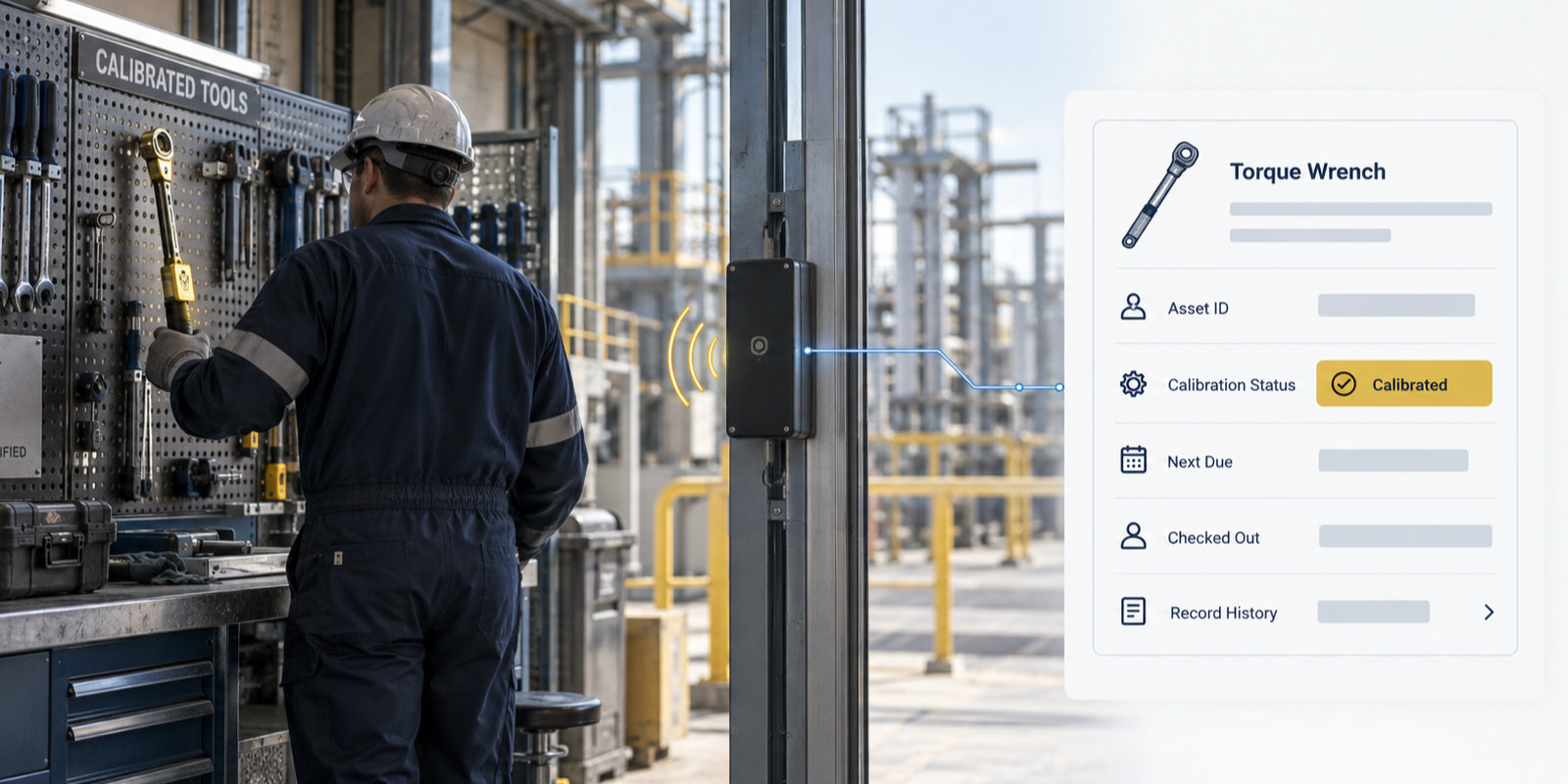
- The manufacturer reported a 73% reduction in tool retrieval time after introducing RFID-assisted location and search.
- Calibration compliance improved by 64% as location history and calibration status were brought into the same operating workflow.
- A two-week pilot expanded into a broader multi-site program, replacing a separate calibration-management platform while standardizing asset control.
The problem was not simply finding tools
A global heavy equipment manufacturer was managing a large population of calibrated assets, including torque tools, gauges and other equipment used directly in production. The existing process relied on barcode scans, spreadsheets and a separate calibration-management application. Each system covered part of the problem, but operators still lost time searching for tools and quality teams still had to reconcile location with calibration status.
That separation mattered. A tool can be physically present and still be unusable if its calibration has expired. Conversely, a tool can be fully in calibration and still stop a job if nobody can find it. The project therefore had to solve location and calibration as one operating problem.
The pilot combined passive RFID, BLE and handheld search
FactorySense started with a two-week pilot at the manufacturer's largest U.S. plant after security and IT approval. Assets were tagged according to how they moved and how precisely they needed to be located. Passive RFID supported automatic observations at defined transitions, while BLE was used where broader presence information was useful.
Fixed readers were installed around locations such as tool cribs, calibration areas and work zones. Handheld RFID readers added a second mode: when a specific asset was missing, staff could use directed search rather than walking the floor shelf by shelf.
Location and calibration were brought into the same record
FactorySense software associated each tool with its movement history, current observed location and calibration information. Alerts could be driven by approaching calibration dates or by movement into areas where the asset should not be used. The system also connected with the manufacturer's enterprise asset-management environment so RFID events did not have to be maintained in a separate operational database.
This allowed the company to retire its third-party calibration-management platform. More importantly, technicians no longer had to consult one system to determine whether a tool was compliant and another process to determine where it was.
The measured results supported expansion
The manufacturer reported a 73% reduction in tool retrieval time and a 64% improvement in calibration compliance. Production-floor downtime fell by 8%, and the company reduced software cost by consolidating the calibration workflow into the same platform used for asset visibility.
Those results gave the business enough confidence to expand the approach to additional sites. The rollout standardized tag conventions, asset records and calibration workflows rather than allowing each facility to create its own variation.
What this deployment shows
Calibrated-tool tracking is a good example of where location alone is not enough. The operational question is not merely, "Where is the tool?" It is, "Where is the correct tool, and is it approved for use right now?" Combining those two answers in the same workflow removes a surprising amount of search and administrative work.
For manufacturers evaluating a similar use case, our calibrated tool management material goes deeper into the system design and the role of passive RFID, BLE and handheld search.
What was the manufacturer trying to solve?
The company needed to reduce time spent locating calibrated tools while also improving confidence that the tool found was currently approved for use.
What RFID technologies were used?
The pilot combined passive RFID at selected transitions, BLE where broader presence information was useful, and handheld RFID search for locating specific assets.
What results did the manufacturer report?
The manufacturer reported a 73% reduction in tool retrieval time, a 64% improvement in calibration compliance and an 8% reduction in production-floor downtime.
Schedule a complementary working session with an RFID professional to discuss your floor or yard, your systems of record, and where the visibility gap between them is costing you.
Book a session