Harnessing RFID for Work-in-Process in Manufacturing

- WIP is usually the largest and least accurately counted category of inventory in a plant, because it moves constantly and is recorded by hand.
- RFID records the movement itself rather than relying on someone to report it, so production status reflects the floor rather than the last shift report.
- WIP tracking is harder than asset tracking: higher volume, shorter life and changing identity, which makes read-point design and tagging level the decisions that matter.
Ask a plant manager where a specific work order is right now and the answer usually involves walking somewhere to look. That is not a failure of the people or the ERP. It is what happens when the record of production depends on someone remembering to report it.
Work in process is some of the hardest inventory to keep accurate. It is high in volume, moves constantly, and changes identity as it is transformed. It is also, in most plants, the largest category of inventory on the balance sheet. That combination is why WIP is where many RFID and BLE visibility projects tend to start.
What poor WIP visibility actually costs
Work in process covers everything between raw material and finished goods: components, sub-assemblies and partially completed units at every stage of production. When the record of where those items are is updated by hand, three costs follow:
- Production waits on material that is somewhere on site. The item is not lost, nobody can say where it is, and the time spent finding it is absorbed into the shift rather than reported.
- Bottlenecks are discovered at shift change rather than while they are forming, by which point the decision that would have prevented them is no longer available.
- Safety stock is held against a WIP number nobody trusts, which if increased ties up working capital to hedge against an accuracy problem.
What RFID changes
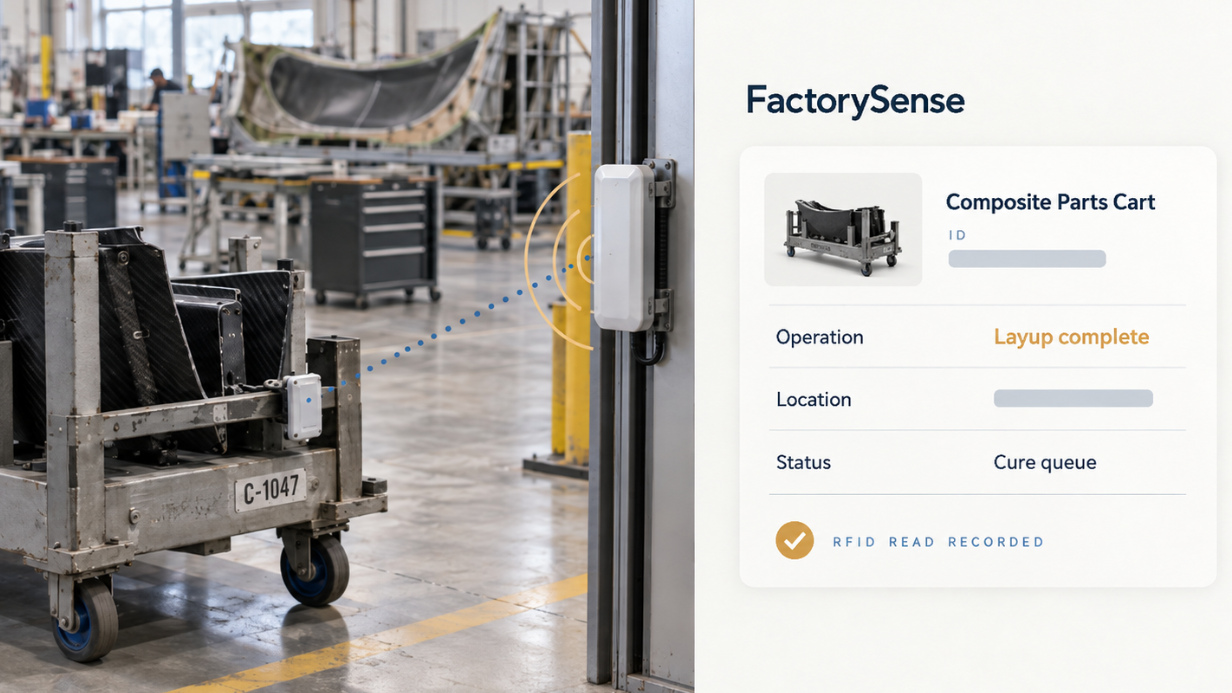
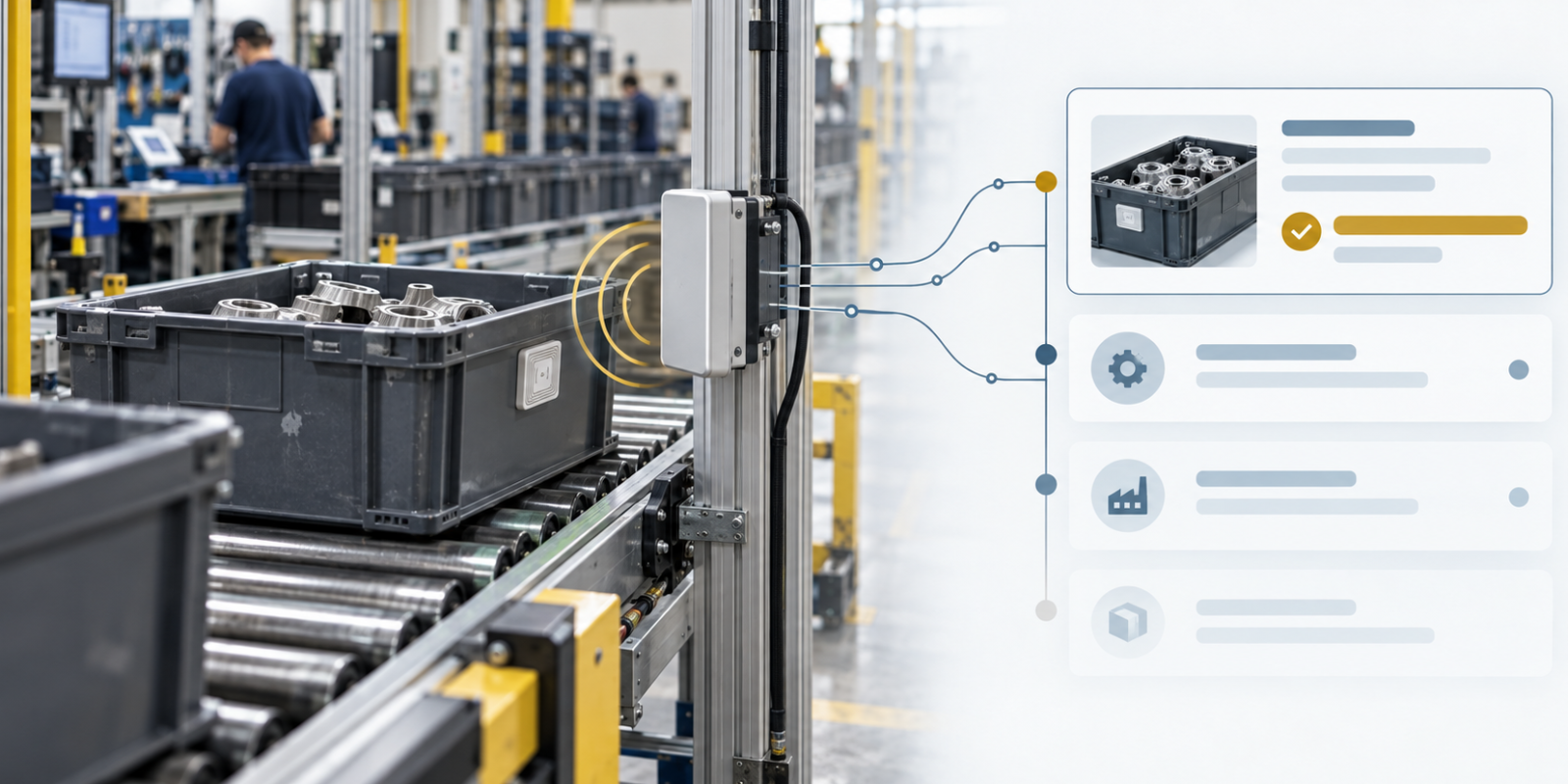
RFID records the asset's location and movement. A tagged item passing a read point generates an event without anyone scanning anything or filling anything in, which means the production record reflects what happened rather than what somebody reported. When it's time to take WIP from one process to the next, this means that operators can "go get" instead of "go find."
In practice, this keeps the ERP much closer to the physical state of production. A supervisor can see work accumulating at a station while it is still accumulating, rather than at the end of the shift. Procurement can investigate an upstream delay the day it appears. And a specific work order can be located without walking the floor, which is the question that starts most of these conversations.
It also changes what the ERP is working from. A read that becomes a transaction means the planning system and the floor agree, which is the gap most digital transformation programs are actually trying to close. How that connection is built, and where the work really sits, is covered in how to integrate your existing systems with an RFID infrastructure.
What this looks like in practice
CAES Systems, a Honeywell company, revitalized RFID for work in process tracking with FactorySense. That deployment is written up in full, including what was tracked and what changed, in our CAES Systems by Honeywell case study.
It is a more useful reference than a generic industry example because the environment is comparable: regulated, high-mix, and running alongside systems that were already in place.
Why WIP is harder than asset tracking
Teams that have run an asset tracking pilot sometimes assume WIP is the same exercise at greater volume. It is not, and the differences are worth knowing before scoping.
- Identity changes. An asset is the same object throughout its life. A WIP item becomes part of something else. The tagging strategy has to survive that transformation, or the history breaks at the point it becomes interesting.
- Volume is an order of magnitude higher. That affects tag cost, read density and the filtering rules in the software layer far more than it affects the reader hardware.
- Read points carry more meaning. In asset tracking a read usually means the item is here. In WIP a read frequently means an operation has completed, which is a business event with downstream consequences, so where a reader sits is a process decision rather than a coverage decision.
The tagging level is the decision that follows from all three. Tagging at carrier, pallet or kit level is often enough to answer the operational question and is cheaper and more durable than tagging individual parts. The right level is the smallest unit you actually need to make a decision about, which is usually larger than teams first assume.
Where to start
Ask your team which areas of the plant they do not trust the numbers for and they will name them immediately. Those answers are consistent enough across sites to be predictive, and they are usually where a WIP deployment should start.
Scope the first phase to one of those areas and one question worth answering. Define how you will measure the answer before anything is tagged. A phase that proves reads happen but never writes to the system of record has not tested the part that carries the risk. If you are working through what a first deployment involves end to end, our complete guide to the RFID tracking pre-installation process sets out the sequence.
For the wider operating picture of WIP and how it connects to flow and control, see what work in progress is in manufacturing and how RFID improves visibility, flow and control.
The next step
WIP read points are decided by how material actually moves through your plant, which is not something that can be specified from a diagram. We walk the area your team distrusts, trace the movement against what your systems believe, and come back with the read points, the tagging level and the first measurable question written down.
Book a Facility Visibility Assessment and we will scope it against your floor.
What counts as work in process?
Everything between raw material and finished goods: components, sub-assemblies and partially completed units at any stage of production. It is usually the largest category of inventory a plant holds and the least accurately counted, because it moves constantly.
How is WIP tracking different from asset tracking?
Assets are relatively few, long-lived and move between known locations. WIP is high-volume, short-lived and changes identity as it is transformed. That makes read-point placement and the rules for what a read means considerably harder, which is why WIP deployments are rarely a simple extension of an asset pilot.
Do we need to tag every item?
Not necessarily. Tagging at the carrier, pallet or kit level is often enough to answer the operational question, and it is cheaper and more durable than tagging individual parts. The right level depends on the smallest unit you need to make a decision about.
Schedule a complementary working session with an RFID professional to discuss your floor or yard, your systems of record, and where the visibility gap between them is costing you.
Book a session