
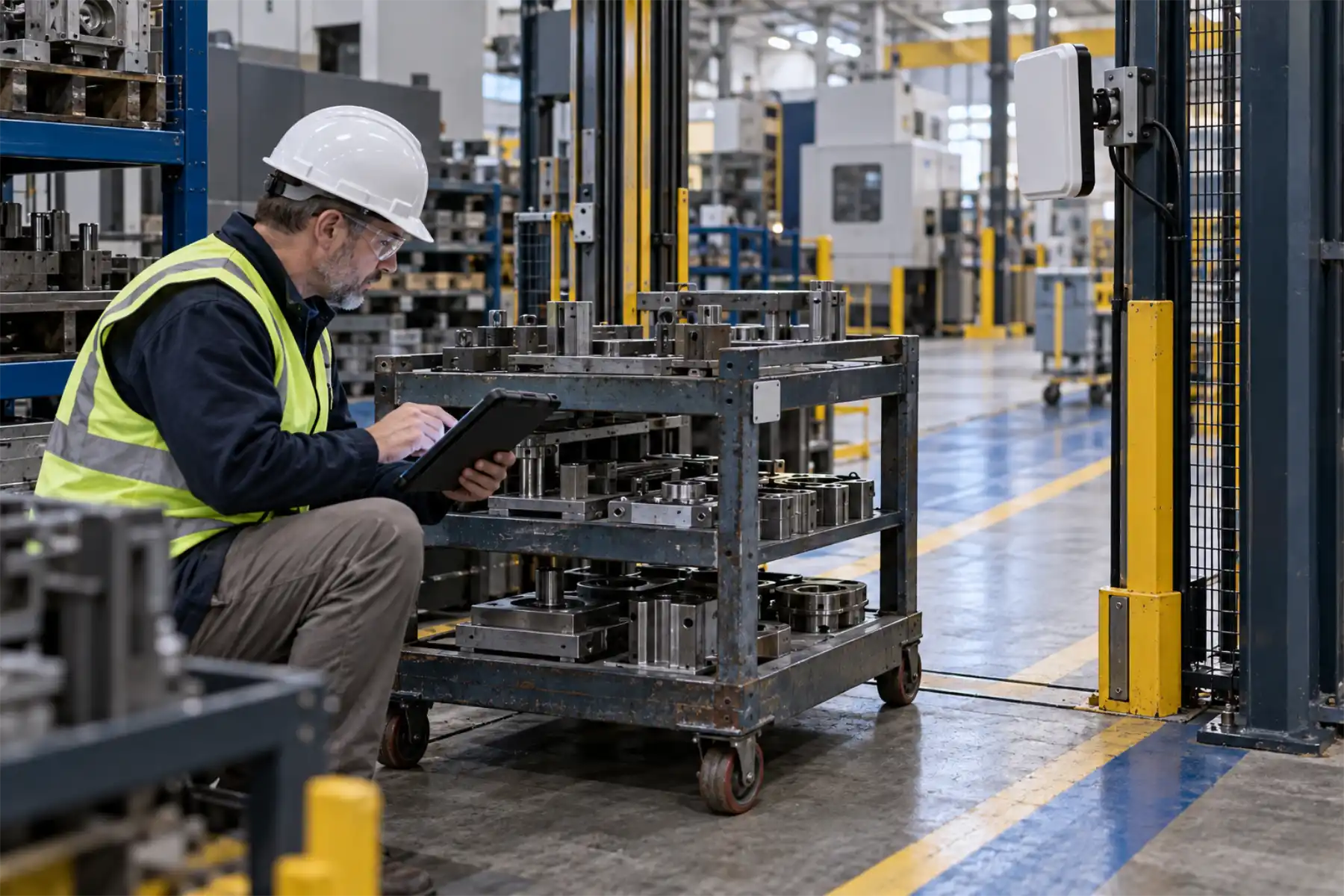

Geofencing that turns asset movement into action.
FactorySense designs and deploys geofencing solutions for industrial facilities, connecting RFID and RTLS coverage, alerting rules, and enterprise systems through one accountable team.
RFID detection and location rules turn movement into alerts.
Geofencing sets virtual boundaries around physical areas, such as a stockroom, production line, or staging area. RFID readers detect tagged assets at monitored locations, and software checks their movements against the rules you define. Alerts notify the right people when equipment leaves an assigned area, material arrives in the wrong place, or a handoff takes too long. These alerts can also trigger updates in your business systems, helping your team respond sooner and keep records current without relying on someone to spot and report every movement.
Define the movement that needs a response.
Use zone rules where a location change has a clear operating consequence. Start with the assets, permitted areas, and exceptions your team needs to manage.
Detect when tagged tools, fixtures, or equipment cross a monitored boundary. Check the movement against the asset's assigned area or approved transfer, and notify the responsible team about exceptions.
Compare a detected arrival with the expected storage, staging, or production location. Flag a mismatch for review before the material moves to the next process.
Track elapsed time from a confirmed arrival and flag an overdue handoff. Show the last observation and any coverage gaps so the team can distinguish a missed exit from an asset still waiting in the zone.
Connect confirmed arrivals and departures to asset, container, and work-order records. Define which movements update status, which require acknowledgment, and which need review.
Where personnel or visitor tracking is in scope, compare badge observations with permitted zones and route exceptions to the designated team. Coverage, identity handling, and privacy requirements are agreed as part of the deployment.
Choose the right coverage for each zone.
Passive RFID detects tagged assets at monitored doorways, portals, and read zones. Tracking location within an open area may require RTLS or another sensing method. We assess the location detail, update frequency, infrastructure, and cost your application requires, then test the proposed coverage with your assets in your facility.
Track composite out-time at the freezer door.
Our composite material tracking solution uses RFID read points at the freezer boundary to detect material leaving and returning. Confirmed removal and return times drive the cumulative out-time record, with approaching limits flagged for review. Our published composites case study documents related material traceability and enterprise integration at an advanced composites manufacturer.
Send movement updates to your enterprise systems.
FactorySense brings RF engineering, hardware, FactorySense.io software, integration, and deployment support into one program. We define how reader observations become confirmed movements, which rules trigger an alert, and which updates reach ERP, MES, WMS, EAM, and other systems. The workflow also handles duplicate reads, uncertain movements, failed updates, and recovery.
Test the movements and alerts in your facility.
We test whether the system detects the movements that matter and delivers the expected alerts and system updates within your required response time.
Define the operating rule
Agree on the assets, zones, permitted movements, dwell thresholds, escalation owners, and systems involved. Establish what an exception means and what action it should produce.
Engineer and test coverage
Test tags, antennas, and read points on representative objects and movements. Account for metal, liquids, orientation, speed, adjacent zones, and unmonitored routes.
Validate event quality and response
Measure missed movements, false alerts, direction accuracy, and end-to-end response time against agreed targets. Test duplicate observations, network outages, failed updates, and recovery.
Commission and maintain
Verify production workflows, train responsible teams, and monitor event and interface health. Revalidate coverage and rules when layouts, assets, or operating processes change.
What to establish before deployment.
What is RFID geofencing?+
It is a way to apply location rules to tagged assets. A confirmed entry, exit, or period in a zone can trigger an alert or an update to another system.
Can passive RFID track exact location continuously?+
Passive RFID typically identifies presence or movement at engineered read points and zones. A reader observation does not by itself establish an exact coordinate or continuous movement history. Workflows that need location within an open area may require RTLS or another sensing method.
How quickly will a geofencing alert arrive?+
Response time depends on reader coverage, movement checks, network availability, processing, and the destination system. We agree on the required response time and measure the complete path from detection to delivery under representative conditions.
How do you reduce false alerts and missed movements?+
We test tag placement, antenna coverage, direction logic, adjacent-zone reads, and the actual movement paths. Event rules can distinguish repeated observations from a new movement and flag ambiguous evidence. Changes to the physical environment require review and, where necessary, revalidation.
Can geofencing replace access control or a safety system?+
Location observations can support monitoring and investigation, but they do not by themselves authorize access, prevent entry, or establish a safety-rated function. Door or equipment actions require a separately engineered and approved control interface, with the relevant system owner retaining authority.
Can geofencing events update our enterprise systems?+
Yes, where the interface and transaction rules are defined with the system owner. We map confirmed movements to the appropriate asset, material, or work-order record and define acknowledgment, duplicate handling, exception routing, and recovery for failed updates.
Which equipment movements can trigger a geofencing alert?+
Rules can flag equipment leaving an assigned area, entering a restricted zone, arriving at the wrong destination, or remaining in staging beyond an agreed time limit. A tool-crib exit can also be checked against its checkout record where that system is integrated. The alert depends on monitored coverage, a confirmed movement, and the rules configured for that equipment.
Talk to us about geofencing.
Tell us what you need to track and which movements your team needs to know about. We'll review your facility, explain the options, and help you decide where geofencing would be useful.