How Defense Contractors Can Improve Production Throughput with RFID

- Defense production is constrained by supplier lead times, workforce and physical capacity as well as internal flow. RFID addresses selected information and coordination delays, not the entire capacity problem.
- RFID is most useful where a physical handoff can create a trustworthy production event, such as WIP entering inspection, a controlled tool leaving a crib or a serialized kit reaching the work area.
- Throughput improves only when the event reaches the ERP or MES in time to affect the next production decision; raw reads or a separate dashboard are not enough.
Defense manufacturers are being asked to produce more complex systems at higher rates while working inside supply chains that are already under strain. The Department of Defense's National Defense Industrial Strategy identifies resilient supply chains and workforce readiness as two of the central requirements for increasing industrial output, and recent GAO work has documented long lead times for critical components across weapons programs. Those are structural constraints that no tracking system can solve by itself. A missing circuit card that now takes nearly three years to arrive is still a missing circuit card, no matter how good the factory's RFID coverage is.
The more useful question is what happens after the required material, labor and machine capacity are available. Inside a defense plant, throughput can still be lost because work is waiting in the wrong place, the correct tool or fixture cannot be found, an inspection handoff was not posted, a component is physically present but the system still shows it upstream, or production control cannot tell whether a delayed order is actually blocked or simply invisible. These are information and coordination losses rather than raw capacity shortages. RFID is relevant when it can make those physical handoffs observable automatically and keep the production record closer to what is actually happening on the floor.
That distinction matters because defense production problems are easy to overgeneralize. The Department is investing in additional production capacity, supplier resilience, advanced manufacturing, workforce development and modernization of aging industrial facilities. RFID belongs much farther down in that stack. It is a way to remove selected transaction and search delays from the operation once the broader production system has the capacity to do the work.
The defense industrial base has a capacity problem and a flow problem
The broader capacity problem is well documented. The National Defense Industrial Strategy calls for resilient supply chains, workforce readiness and a modernized industrial ecosystem capable of meeting production demand. GAO's 2024 review of weapons replacement efforts found that long lead times for supplier parts and raw materials were affecting many programs, including one missile program where lead times for electronic parts such as circuit card assemblies had increased from 19 months to 34 months in two years. Those are upstream constraints and should not be confused with an internal tracking problem.
At the same time, the Department is investing heavily in new lines, facilities and advanced manufacturing because production capacity only becomes useful when work can flow through it. The Army's Organic Industrial Base modernization plan spans facilities, tooling and processes, workforce, networks and energy across depots, arsenals and ammunition plants. The Department of the Navy's 2024 Advanced Manufacturing Strategy similarly treats manufacturing modernization as an enterprise capability rather than a single technology purchase. RFID fits into the tooling, process and data layers of that modernization rather than replacing them.
This is why a defense contractor should separate two questions during a throughput review. The first is whether the facility has the supplier material, qualified labor, equipment and process capacity needed to build more product. The second is whether the work that capacity could process is moving through the plant with a current and trustworthy digital record. RFID only addresses parts of the second question.
High-mix production makes stale WIP data expensive
Defense production often combines low or moderate volumes with high configuration complexity, serial control, inspection requirements, rework loops and long routings. In that environment, the next unit is not always moving through the same straight-line sequence as the unit before it. A job may wait for a nonconformance disposition, return to an earlier operation, move to a secure area, or sit in a queue because a specific component or test asset is not yet available. Production control needs to know which of those conditions is true before it can make a useful scheduling decision.
When movement is recorded manually, the MES may lag the floor by minutes, hours or an entire shift. The result is not simply an inaccurate dashboard. Schedulers can release work into an already constrained area, supervisors can search for assemblies that have already moved, and material handlers can expedite something the receiving or inspection team physically has but has not yet posted. Our WIP tracking guide covers the general manufacturing problem, while this article focuses on why the cost of those gaps is amplified in defense production.
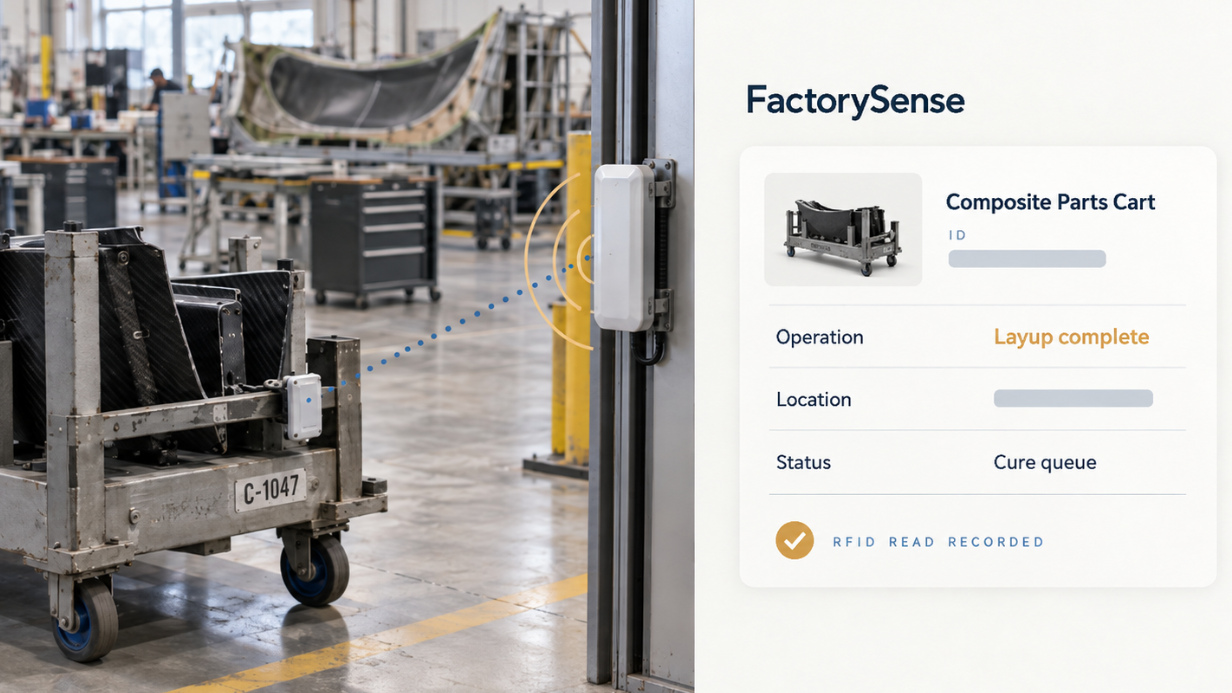
RFID is useful when the production state can be tied to a physical transition. A tagged traveler or carrier crossing from machining into inspection can create evidence that the work moved. A controlled reader at a secure crib can record a tool issue or return. A receiving or material-control read can confirm that the serialized kit the schedule is waiting for actually reached the area. None of those observations should become a transaction automatically unless the event logic is strong enough to distinguish the intended movement from nearby activity.
Search time is a symptom of missing operational state
A person walking the floor to find a fixture or assembly is visible waste, but the search itself is not the deepest problem. The deeper problem is that the organization lacks a current, trusted answer to a question the schedule depends on. If a supervisor has to call three departments to learn whether a job is still in machining, waiting at inspection, or already moved to rework, the digital production record is not doing enough operational work.
RFID can reduce that uncertainty in two ways. Fixed readers can create location or transition history at high-value process points, while handheld readers can help a worker search the last known area when fixed coverage would not justify the cost. The RFID tracking guide distinguishes those patterns because "track this assembly" can mean a transition event, a last-seen location, or an active search rather than a continuously moving dot.
The same approach applies to tooling and calibrated assets. A defense manufacturer may have enough equipment in total but still lose productive time when the required tool is not at the operation that needs it or its calibration status is unclear. Our article on defense asset accountability covers that problem directly. In a throughput program, the key question is whether tool availability is constraining work and whether better location and custody data would shorten that wait.
Inspection and rework loops deserve their own visibility
Quality processes are often where a simple routing becomes a network. A unit may enter inspection, be accepted, move to another test, wait for review, or return to a prior operation for rework. If the system records only the planned route, production control can see what should happen next without knowing what physically happened last. That is where queues become difficult to distinguish from lost work.
RFID can help if the inspection handoffs are observable at controlled points and the software knows which state each read is allowed to create. Entering an inspection area may justify a location update but not an acceptance transaction. Leaving the area in one direction may mean accepted, while leaving through another controlled path may mean rework. The event model needs to match the real quality process rather than infer quality status merely from proximity to a reader.
This distinction is especially important in regulated and traceable production. RFID can strengthen the movement history and make records easier to reconcile, but it does not itself create compliance or prove that a required inspection occurred. Our defense compliance article covers that boundary in more detail.
Better WIP data makes bottlenecks easier to see, but it does not remove them
A queue can exist for a good reason. A heat-treat furnace has finite capacity, an inspection process may require scarce specialized labor, or a test cell may be the deliberate production constraint. Better tracking does not create more hours in the furnace or another qualified inspector. What it can do is show the queue as it forms, distinguish waiting work from missing work, and make the age and sequence of the queue visible without a manual census.
That distinction is important because throughput programs often confuse visibility with optimization. If RFID shows twelve jobs accumulating before inspection, the system has identified where work is waiting. Operations still has to determine whether the cause is staffing, machine uptime, release policy, rework, missing documentation, or another constraint. The value of the event history is that the investigation begins with better evidence about what actually moved and when.
NIST's work on the digital thread for smart manufacturing makes the broader case for linking information across design, manufacturing and quality so downstream activities can reuse trustworthy product and process data. RFID is only one possible observation layer in that thread. Its role is strongest where a physical event is otherwise missing, late, or expensive to capture.
The ERP or MES has to receive the event while it is still useful
Production visibility becomes operationally valuable when the event reaches the system that drives the next decision. A read that only appears on a separate RFID dashboard may help someone investigate later, but it does not necessarily change the schedule, inventory state or production routing. A read that becomes a well-defined transaction in the ERP or MES can change what the business does next. Our RFID integration guide explains why the hard part is usually mapping observations to business events rather than connecting an API.
The event layer also has to be conservative. A reader may see the same tag many times while an assembly sits near a doorway, and raw reads should not be interpreted as repeated movements. Software needs the reader, antenna, time, known identity, prior state and process context before deciding that a movement occurred. This is why RFID projects that focus only on "read rate" can look successful during a demonstration and still produce poor operational data.
The RFID failure diagnosis guide separates these layers deliberately. A system can have excellent RF performance and still fail because its event logic does not match the process, or because the downstream system does not know what to do with the event. Throughput depends on the whole chain.
Defense logistics and production are related but not the same problem
Supply chain visibility matters to production because late material can stop a line, but tracking inbound shipments is different from tracking the work after it reaches the plant. Our defense logistics article focuses on handoffs across warehouses, transportation, maintenance and broader supply networks. The production problem begins when the facility has to convert those materials and components into completed work while preserving status, configuration and traceability.
GAO's 2025 review of the defense industrial base notes that DOD depends on a supplier network of more than 200,000 companies and still lacks sufficient visibility into much of that network. That is a reminder that the plant floor is only one layer in a very large system. A contractor should not attribute a production miss caused by a 34-month supplier lead time to poor WIP tracking, and it should not dismiss internal search and transaction delays merely because the supplier network is difficult. Both can be true at once.
Modernization programs increasingly depend on better production data
The Army, Navy and DOD are all investing in modernized manufacturing infrastructure, digital engineering and advanced manufacturing. Army work on modernizing ammunition plants uses systems modeling and digital engineering to baseline existing production and identify process improvements, while the Navy's advanced manufacturing strategy emphasizes adoption of modern manufacturing capabilities across the department. Those initiatives are broader than RFID, but they share a dependency on accurate information about production state.
NIST's digital-thread research describes the goal as linking data across engineering, manufacturing and quality so information can be reused throughout the product lifecycle. The factory version of that problem is straightforward: the digital thread is incomplete if the system knows what the work order is supposed to do but not where the physical work actually is. RFID can fill selected gaps where an automatic physical observation is more reliable or less burdensome than another manual transaction.
This does not mean every station needs a reader. Instrumenting every possible movement can create more data than operational value. The better design is to identify the few handoffs whose uncertainty actually delays production, then place read points where an observation answers a real scheduling, search, accountability or quality question.
What a defense production pilot should measure
A useful pilot should start with an area where the production team already distrusts the status. That might be a WIP queue between machining and inspection, a controlled tool crib, a kitting area, or a high-value assembly that moves across several buildings. The baseline should measure how often the current record is stale, how much time is spent locating work or tools, how long transactions lag the physical movement, and how often production is delayed because the next item cannot be found or its state cannot be confirmed.
The pilot should then prove one event chain end to end. Tag the relevant traveler, carrier or asset, validate the RF environment, define what counts as a legitimate transition, and write the resulting event into the system of record. The RFID pre-installation guide explains that validation sequence, including why the read zone has to reject nearby items rather than simply maximize range.
Success should be measured against the baseline rather than against a generic RFID accuracy percentage. The useful outcomes are operational: fewer minutes spent searching, shorter transaction lag, fewer status discrepancies, faster identification of a growing queue, or fewer jobs waiting because tool availability is unknown. If none of those changes, the RFID system may be technically impressive and operationally irrelevant.
Where RFID can improve throughput without overselling it
RFID does not make a machining center cut faster, add a qualified inspector, shorten a supplier's semiconductor lead time, or create capacity in a constrained test cell. It can make the work around those constraints easier to coordinate. A supervisor can know which assemblies are actually waiting, a material handler can find the next job without walking the building, and a scheduler can work from a production state that is closer to the physical floor.
That is a modest claim, but it is also the one that matters. Defense production is complex enough that small information delays can accumulate around expensive labor and equipment. Removing those delays does not replace investment in capacity, workforce or supplier resilience. It helps the capacity that already exists spend more time producing and less time reconciling where the work went.
Sources and further reading
- U.S. Department of Defense, National Defense Industrial Strategy overview. Resilient supply chains, workforce readiness and industrial modernization priorities.
- GAO-24-106649, Ukraine: Status and Challenges of DOD Weapon Replacement Efforts. Long supplier lead times and production-capacity investments across weapons programs.
- GAO-25-107283, Defense Industrial Base: Actions Needed to Address Risks Posed by Dependence on Foreign Suppliers. DOD supplier-network scale and supply-chain visibility challenges.
- NIST, Digital Thread for Smart Manufacturing. Integration and traceability of information across design, manufacturing and product support.
- NIST, Enabling the Digital Thread for Smart Manufacturing. Information exchange between engineering, manufacturing and quality functions.
- Department of the Navy, Advanced Manufacturing Strategy. Enterprise modernization and advanced-manufacturing adoption.
- U.S. Army Acquisition Support Center, Leveraging Digital Engineering to Modernize Munition Production. Digital engineering and production-process modernization in ammunition plants.
Can RFID actually speed up defense manufacturing?
RFID can reduce selected delays caused by stale WIP records, search time, manual movement transactions and uncertainty about tool or material location. It does not increase machine capacity, solve supplier lead times or replace skilled labor.
What should defense manufacturers track first?
Start where production already loses time because the physical state is uncertain. Common candidates include WIP queues, serialized kits, controlled tools, fixtures and high-value assemblies moving between major process areas.
Does RFID replace MES or ERP?
No. RFID should provide physical observations and business events to the systems that already own production state. The ERP, MES or quality system remains the authoritative system of record.
How should an RFID throughput pilot be measured?
Measure operational outcomes such as search time, transaction lag, status discrepancies, queue visibility and delays caused by unknown tool or WIP location. A generic read-rate percentage is not enough to prove production value.
Schedule a complementary working session with an RFID professional to discuss your floor or yard, your systems of record, and where the visibility gap between them is costing you.
Book a session