How RFID Helps Defense Contractors Meet Compliance Regulations


- RFID supports compliance controls; it does not make an organization compliant with ITAR, DFARS or contract-specific requirements by itself.
- The strongest compliance use cases preserve a defensible sequence of identity, movement and process events rather than relying on a current-location field.
- Sensitive context usually belongs in controlled backend systems, with the tag serving primarily as an identifier unless the security design requires more.
RFID is often described as a compliance technology. That description is too broad. RFID does not make a defense contractor compliant with ITAR, DFARS, contract-specific requirements or any other regulatory framework simply because a tag is attached to an asset. What it can do is improve the evidence behind controls that already exist: identity, movement, chain of custody, inventory state, process history and the timing of physical events.
That distinction is important in defense manufacturing because audits rarely fail for lack of policy language. The harder problem is proving what actually happened on the floor. A procedure may require a serialized component to remain in an approved area, a calibrated tool to be used within its valid period, or material to move through defined process steps. If the record depends on manual scans and later data entry, the control is only as complete as the transactions people remembered to make.
Compliance begins with the requirement, not the RFID system
The first question should always be what must be controlled or demonstrated. Different contracts, programs and regulatory regimes impose different obligations, and some defense data should never be written to a tag at all. RFID architecture has to follow the governing requirement, the organization's security boundary and the classification of the information involved.
In many deployments the tag contains only an identifier. The sensitive context remains in an authorized backend system, where access controls, retention policies and other security measures can be managed appropriately. The RFID event says, in effect, “this identifier was observed here at this time.” The business system determines what that identifier represents and what the observation means.
This is a safer and more useful model than treating the RFID tag as a portable database. It also makes integration central to the design. A read has limited compliance value until it is resolved against the authoritative record for the asset, material, work order or process.
Traceability is a sequence of evidence
Traceability is not a current-location field. It is the ability to reconstruct a relevant history. That framing is consistent with the GS1 Global Traceability Standard, which treats traceability as an interoperable supply-chain system rather than a single scan or database field. For a serialized component, that may mean receipt, storage, issue to production, movement through work centers, inspection and final disposition. For a tool, the important history may include custody, location, calibration status and return; our article on defense tool accountability and asset loss covers that operational problem in more detail. For controlled material, the required record may include lot identity and which process or assembly consumed it.
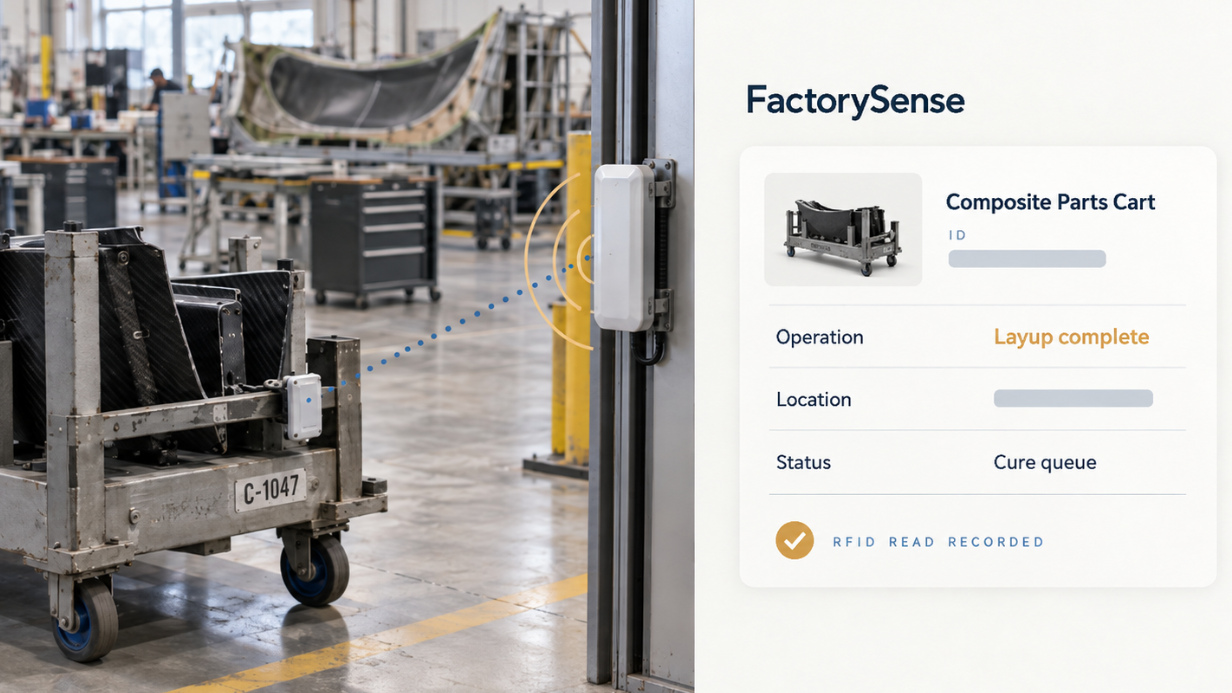
RFID can make parts of that history less dependent on manual transactions. A component passing a controlled read point can create an observation automatically. Software can associate that observation with the expected workflow and either create the appropriate event or flag an exception. The result is not perfect traceability by default; it is a more reliable stream of physical evidence from which the traceability record can be built.
This is one reason read-zone design matters. A system that reads everything near a doorway but cannot distinguish what actually crossed the doorway may produce more data and less evidence. The engineering objective is to create observations that have a clear process meaning.
Chain of custody is where identity and process meet
Defense programs often need to know not only that an item exists, but whether it remained inside the process intended for it. When those custody boundaries span suppliers, depots and transportation nodes, the related defense logistics architecture becomes part of the control design. RFID can support that control by recording movement through approved locations and by generating exceptions when an item appears where it should not, leaves a controlled area unexpectedly or fails to appear at the next expected step.
Those events can also be joined to other forms of identity. An RFID read may establish the movement of the physical item; a user login, badge transaction or work-order assignment may establish who was responsible for the process. The appropriate combination depends on the requirement. RFID should not be asked to prove something it did not observe.
The same caution applies to product authentication. A conventional RFID identifier can strengthen serialization and chain-of-custody records, but it does not, by itself, prove that a component is genuine. Authentication depends on the tag technology, credential design, backend verification and the security of the issuance process. For many defense applications, the practical value of RFID is that it makes substitution or unexplained movement easier to detect because the item has a persistent identity tied to an auditable history.
Inventory control can become an audit-control issue
Inventory accuracy is usually discussed as an operations metric, but in defense programs it can also affect accountability. When the system says an asset or serialized component is in one location and the physical item is somewhere else, every downstream control that relies on the system record becomes harder to defend.
RFID helps by reducing the number of movements that depend on a person creating a separate transaction. Receiving, issue, transfer and return events can be captured closer to the moment the physical movement occurs. Where full automation would create too much risk, RFID can instead propose the transaction and route exceptions for confirmation.
This is often the right approach early in a deployment. Compliance-sensitive workflows should not become autonomous merely because automation is technically possible. The level of automation should reflect the consequence of an incorrect transaction and the maturity of the read process.
Auditability depends on the event trail
A useful audit trail answers more than “where is it now?” It preserves when the item was observed, which read point saw it, what business event the software inferred and what happened next. That history gives operations, quality and program teams a common factual record when something does not reconcile.
It also makes investigations narrower. Without a movement history, a missing asset becomes a search across an entire facility. Without a material history, an unexpected component becomes an argument about which transaction was missed. With a credible event trail, the team can focus on the interval where the record stopped matching the physical process.
FactorySense deployments in regulated manufacturing often combine RFID identity with ERP, MES or quality-system data for exactly this reason. The useful record is not “reader 12 saw EPC X.” It is “serialized item X was observed moving from this controlled process state to the next one at this time.” Our integration article explains how those observations are resolved into system events.
Security architecture still matters
Defense RFID systems need the same disciplined security design as the systems they connect to. NIST SP 800-98 remains a useful platform-independent reference for RFID security and privacy risk, even though specific implementations and standards have continued to evolve. Network segmentation, access control, encryption in transit, credential management, logging and the treatment of sensitive data should be defined by the organization's security architecture and applicable contract requirements. The fact that RFID communicates by radio does not make the system inherently insecure, and the use of RFID does not remove the need for conventional security controls.
Tag choice also matters when the application requires stronger assurance than a basic EPC can provide. Some applications may justify cryptographic tag features or other authentication mechanisms; others are better served by keeping the tag simple and performing authorization in the backend. The right answer depends on the threat model and the information being protected.
How to evaluate an RFID compliance use case
A productive evaluation begins with one control that is currently difficult to prove. Identify the physical event behind that control, how it is recorded today and where the record is most likely to break. Then ask whether RFID can observe that event reliably enough to improve the evidence without introducing a new ambiguity.
The next questions are operational: which system owns the authoritative record, what data may be associated with the identifier, who can see it, how long it must be retained and what happens when the RFID observation conflicts with the expected workflow. Those decisions should involve operations, quality, IT/security and the program owner rather than being left to the reader installer.
Used this way, RFID is not a shortcut around compliance work. It is a way to make selected physical controls easier to demonstrate because the evidence is captured as part of the process instead of reconstructed later.
Does RFID make a defense contractor ITAR or DFARS compliant?
No. Compliance depends on the applicable requirements and the organization's controls. RFID can improve the evidence supporting selected physical controls and traceability processes.
Should sensitive defense data be stored on an RFID tag?
Not by default. Many systems keep the tag identifier simple and store sensitive context in an authorized backend system. The appropriate design depends on the security boundary and governing requirements.
Can RFID prove that a component is authentic?
A basic RFID identifier alone does not prove authenticity. Authentication requires an appropriate credential and verification design. RFID can strengthen serialization and chain-of-custody records that make substitution easier to detect.
Schedule a complementary working session with an RFID professional to discuss your floor or yard, your systems of record, and where the visibility gap between them is costing you.
Book a session