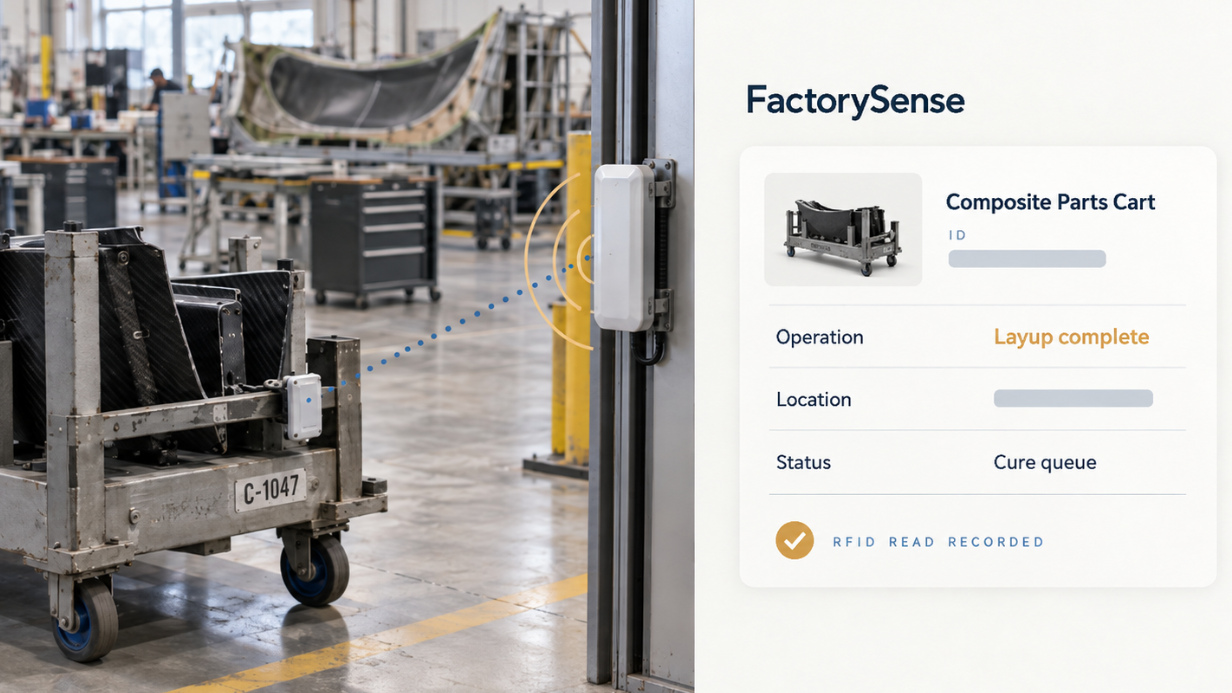
How RFID Tracking Scales Across Sites and Operations


- RFID scale is primarily an architecture and operating-model problem, not a raw tag-volume problem.
- Standardize identity, event definitions and validated read-point patterns while allowing local RF engineering where facilities differ.
- Enterprise scale requires centralized device and integration governance, clear exception ownership and site-specific business-case validation.
An RFID system can be technically successful and still be difficult to scale. A pilot works at one doorway, one tool crib or one production line. The read zone is tuned, the operators understand it, and the integration has been made to work. Then a second site asks for the same capability and the team discovers how much of the first deployment was specific to that one location.
That is the real scalability question. It is not whether an RFID reader can process a large number of tags. Modern passive UHF systems are already designed for dense tag populations. The harder question is whether the operating model can expand without creating a different architecture, data model and support process every time another department or facility comes online.
A scalable RFID program therefore looks less like a collection of reader installations and more like shared infrastructure. The tag identity, event model, integration pattern, device management and ownership rules need enough consistency that new use cases can reuse what already exists.
Scale the event model before you scale the hardware
The most important thing to standardize is what an RFID event means. A reader may observe an EPC at a dock door, production cell or crib entrance, but the enterprise needs a common way to express the resulting business event: received, transferred, issued, returned, staged, shipped or some other state that the system of record understands.
If every site invents its own event names and logic, enterprise reporting becomes difficult even when the hardware is identical. The same physical movement may be represented differently in two plants, and downstream integrations begin accumulating site-specific rules.
For organizations that need a common visibility-event model across applications or business units, GS1 EPCIS is one established standard for capturing and sharing event data. Not every RFID deployment needs EPCIS, but the design principle matters: separate the raw reader observation from a normalized business event that can survive changes in hardware or local process.
Our RFID integration guide goes deeper into that layer.
Use a common identity strategy
Scale becomes much harder when the same physical item has a different identity in every system. A tag EPC might be associated with an internal asset number at one site, a serial number at another and a work-order identifier somewhere else. Those relationships can all be legitimate, but the enterprise needs a consistent way to resolve them.
The goal is not necessarily to force every application to use one identifier. It is to maintain a reliable mapping between the tag identity and the identifiers used by ERP, WMS, MES, maintenance and other systems. That becomes increasingly important when assets or containers move between facilities and the receiving site has to understand the tag without recreating the record manually.
Passive UHF interoperability is supported by GS1 EPC UHF Gen2, which defines the reader/tag air interface. At enterprise scale, however, hardware interoperability is only the first layer. Identity and event consistency are what allow the operational data to remain coherent.
Standardize patterns, not every physical installation
Two facilities rarely have identical RF environments. One may use metal rack, another open floor storage; one doorway may have adjacent staging inventory, another may be physically isolated. A scalable program should not require every read point to look exactly the same.
What can be standardized is the design pattern. A receiving portal can have a defined purpose, preferred antenna approach, configuration baseline, event logic, commissioning test and support documentation even if the final mounting geometry differs by site. The same is true for tool cribs, production transitions, handheld search and other recurring use cases.
This approach keeps local engineering where it belongs while reducing reinvention. The enterprise can establish a small number of validated patterns, then require each new deployment to demonstrate that the local implementation meets the same functional acceptance criteria.
The implementation guide describes how those patterns should be proven before they are repeated.
Do not confuse tag volume with system scale
Articles about RFID scale often focus on how many tags can be read at once. That matters in dense inventory environments, but it is only one constraint. A system tracking ten thousand assets across several buildings may be easier to operate than one tracking a few hundred items through poorly defined processes.
The larger constraints usually appear elsewhere: reader fleet management, network connectivity, event throughput, identity resolution, integration load, alert volume, reporting, user permissions and support. If every new read point requires a custom integration or every exception generates a notification, the system becomes operationally expensive long before the RF protocol reaches a meaningful limit.
The better measure of scale is how much incremental complexity is added by the next site, process or asset class. A mature architecture should make the next deployment easier because the enterprise already has an identity model, device-management approach, event logic and integration pattern to reuse.
Centralize what benefits from consistency
At multi-site scale, some capabilities benefit from being managed centrally: device inventory, configuration baselines, software versions, certificates, event schemas, user roles, integration endpoints and monitoring. Centralization makes it easier to identify drift and support the system without relying on institutional knowledge at every site.
That does not mean every operational decision belongs at headquarters. Local teams still understand their process, physical environment and exceptions better than a central platform team will. A workable model usually combines central standards and platform ownership with local process ownership.
The distinction is similar to other industrial systems. IT may manage network and security standards, while operations owns what a production event means. Engineering may approve physical changes, while the application team owns event processing. Scale works when those boundaries are explicit.
Design for exceptions before they multiply
A small pilot can tolerate manual reconciliation. At enterprise scale, it cannot. If one read point produces five ambiguous events a day, the operations team may handle them easily. Multiply that behavior across one hundred read points and the exception process becomes its own workload.
This is why scaling should include thresholds for false positives, missed events, unresolved identities, device outages and integration failures. The platform should make it possible to see where the system is unhealthy without requiring someone to inspect every reader individually.
Exceptions should also have an owner and a resolution path. A tag that cannot be resolved may belong to data stewardship. A reader that stops reporting may belong to IT or field support. A recurring false read may require RF engineering. A transaction rejected by the ERP may belong to the integration team. Without those distinctions, every problem becomes “an RFID problem” and the system becomes harder to operate as it grows.
Multi-site expansion changes the security and support model
Adding sites also expands the number of networked devices, credentials, certificates, software versions and users that need to be managed. Security architecture should therefore scale with the deployment rather than being added later. NIST SP 800-98 remains a useful general reference for RFID security and privacy considerations, while the enterprise's current policies should govern segmentation, access control, logging, patching and credential management.
Support needs to be standardized for the same reason. If a reader fails at a remote site, the local team should know what can be checked safely, what evidence to collect and when to escalate. Remote diagnostics, configuration history and logs become much more valuable when the subject-matter expert is not physically present.
Scale the business case by use case, not by multiplying pilot savings
A common planning mistake is to take the ROI from one successful pilot and multiply it by the number of sites. The next facility may have a different baseline, different labor rates, different process discipline or a much smaller problem. The technical pattern may scale while the economics do not scale at the same rate.
We prefer to preserve the measurement framework and re-baseline each expansion. The organization can reuse the same categories—search time, count labor, transaction effort, production delay, asset loss, reconciliation—but should measure the local starting point before claiming the same benefit.
Our RFID ROI article covers how to build that case without assuming that every site begins with the same amount of waste.
Large deployments are usually built from smaller proven patterns
FactorySense's deployment at Northrop Grumman's Space Park illustrates this well. The campus covers approximately 1.5 million square feet across 46 buildings. At that scale, the useful design question is not how to create one enormous read zone. It is how to create repeatable visibility patterns across many controlled areas and make those observations resolve to a coherent asset record. The case study describes the deployment in more detail.
The same principle applies in smaller enterprises. Scaling from one line to five lines, or from one warehouse to three, should be treated as replication of validated patterns with local engineering—not as a fresh RFID project every time.
What scalable RFID looks like operationally
A scalable system does not feel larger merely because more readers and tags have been added. The operational model remains understandable. New sites can adopt known patterns. The same identifiers and event definitions continue to work. Devices can be monitored centrally. Integrations do not have to be rewritten for every facility. Exceptions have owners.
That is the point where RFID becomes infrastructure rather than a collection of projects. The technology itself may be distributed across buildings and processes, but the rules that make the observations useful remain coherent.
If a pilot is still being engineered, the priority should be proving the process rather than designing for hypothetical global scale. Once that process works, the scaling question becomes concrete: which parts should be standardized, which parts must remain local, and how much additional complexity will the next deployment actually introduce?
How many assets can an RFID system track?
There is no single practical asset-count limit that defines scalability. The larger constraints are usually architecture, event processing, integrations, device management, identity and support rather than the number of asset records alone.
Should every RFID site use identical hardware layouts?
No. The useful approach is to standardize functional patterns and acceptance criteria while adapting antenna placement and RF design to the local physical environment.
How should RFID be scaled from one successful pilot to multiple sites?
Reuse the proven identity model, event logic, integration pattern, configuration baseline and support process, then revalidate RF performance and the local business case at each expansion.
Schedule a complementary working session with an RFID professional to discuss your floor or yard, your systems of record, and where the visibility gap between them is costing you.
Book a session