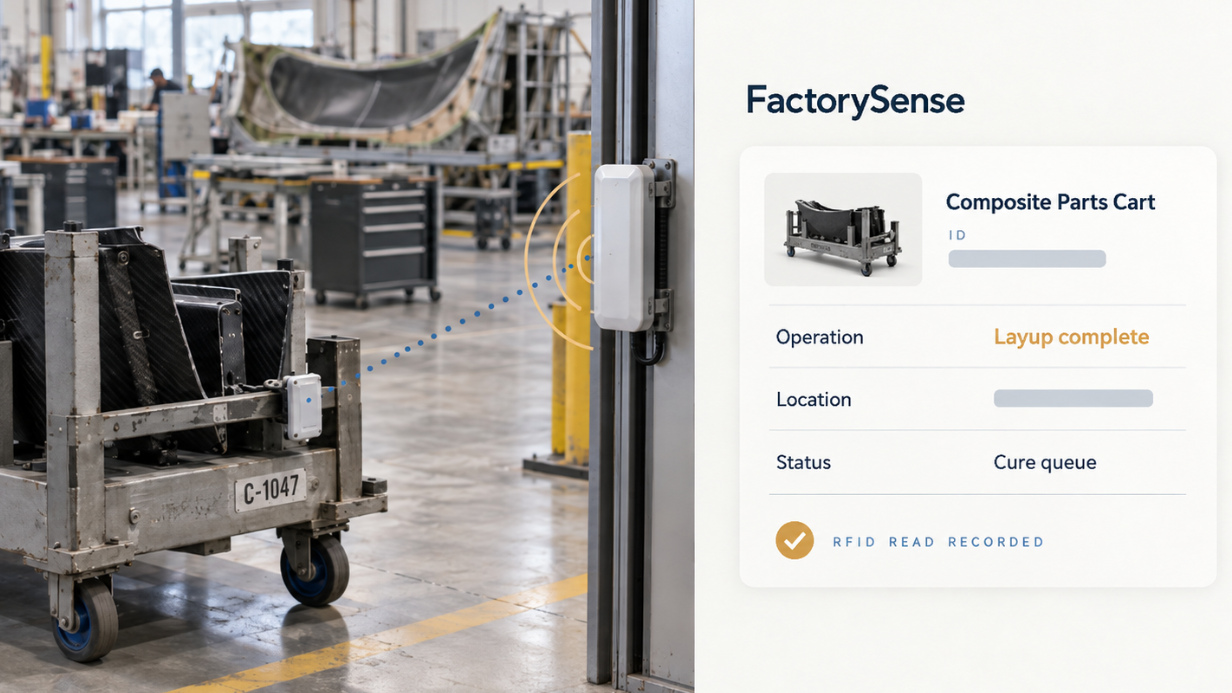
The Beginner's Guide to How RFID Systems Work

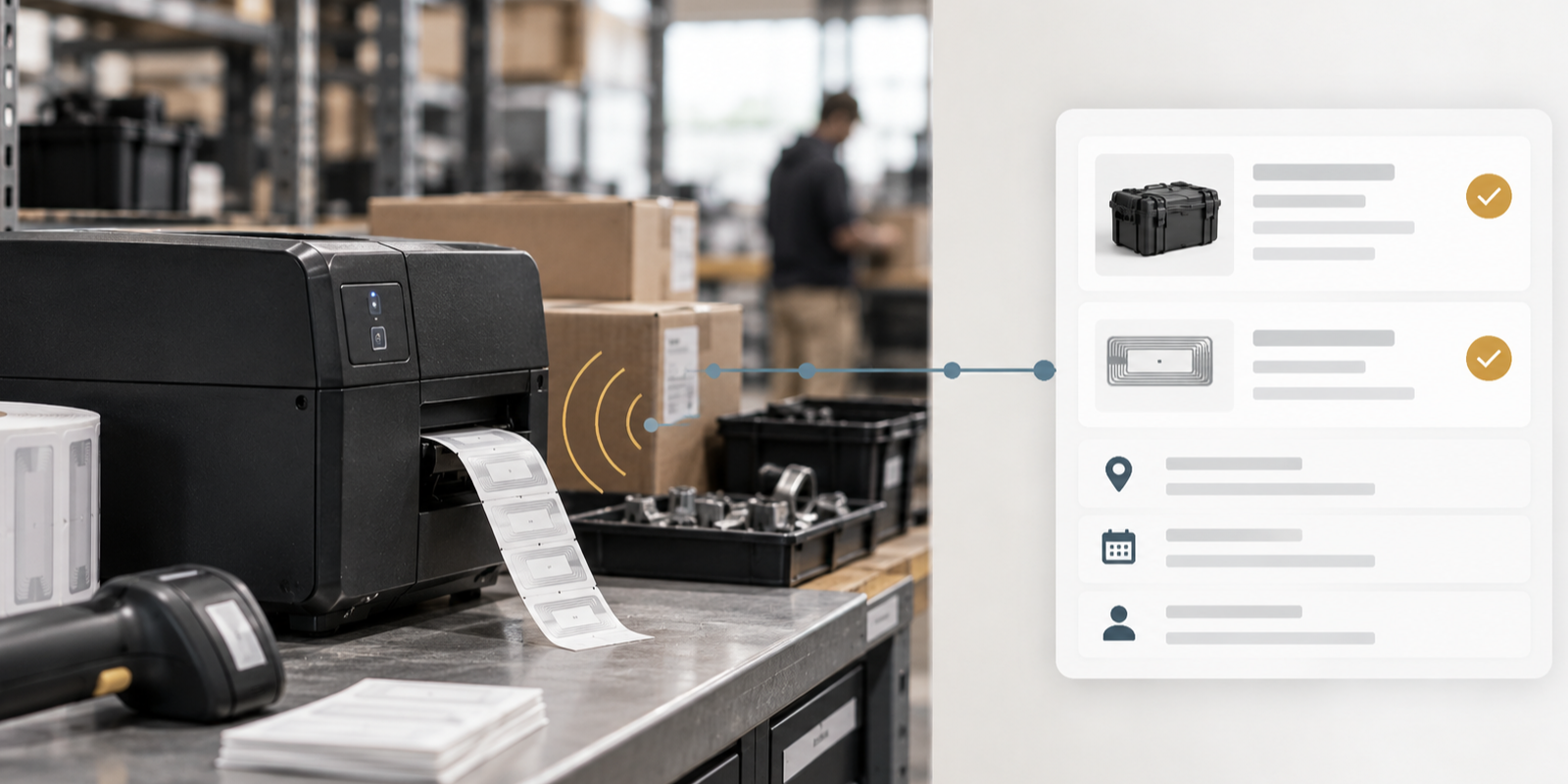
- An RFID system is a physical-to-digital chain: object and tag, reader and antenna, event logic, and the enterprise system that owns the business record.
- Reliable read-zone design is about margin and separation, not maximum range. The system must capture intended movement while excluding nearby tagged objects.
- Raw reads should be converted into business events before ERP, MES, WMS, or another system of record is updated.
Once you understand what RFID is, the next useful question is how a real system is put together. The answer is more involved than attaching a tag to an object and mounting a reader nearby, because a production RFID system has to connect four things that live in different worlds: the physical object, the radio environment, the software that interprets what the reader saw, and the business system that ultimately owns the record. When those layers are designed together, RFID can become quiet infrastructure. When they are designed separately, even good hardware can produce data that operators do not trust.
This guide focuses on that system architecture. It does not repeat the tag physics covered in What is RFID and How Does It Work?, where the interactive diagram walks through Reader to Antenna to Tag and back through FactorySense Software to the ERP. If you want the deeper electromagnetic explanation, Understanding How RFID Works Without Power covers energy harvesting and backscatter in more detail. Here, the question is how all of those pieces become one dependable operational system.
The system starts with the physical process
Before choosing a tag or reader, the design team needs to understand what is physically happening and what event the business wants to observe. A pallet arriving at receiving, a traveler entering inspection, a tool leaving a crib, and a fixture moving between buildings are different process events even if they all use the same family of RFID hardware. The item being tagged matters because its material, geometry, orientation, movement and surrounding environment all influence the RF design. The process matters because the reader must be positioned where an observation has enough meaning to support a business decision.
This is why a site survey should begin with the workflow rather than a specification sheet. The team should see where material actually waits, which routes people use when the normal path is congested, where nearby tagged objects might create ambiguity, and what the operator expects to happen after the read. Our RFID pre-installation guide goes deeper into that discovery and pilot process. The important architectural point is that every downstream layer depends on defining the physical event correctly at the beginning.
The tag is part of the RF system, not a sticker added at the end
A passive UHF tag usually contains a chip connected to an antenna, but its useful behavior depends heavily on what it is attached to. Metal can detune an ordinary label antenna, liquid-rich materials can absorb UHF energy, and a tag placed in a poor orientation can lose much of the margin it appeared to have during a bench test. That means tag selection, tag position, object material and reader geometry have to be evaluated together. Our article on what blocks or disrupts RFID explores those environmental effects in more detail.
The identity carried by the tag also needs a deliberate design. The EPC or other identifier should resolve to a business object the company already understands, such as an asset, serial number, pallet, container or work order. GS1 separates the air interface from the data standards for exactly this reason: the radio protocol explains how the reader and tag communicate, while the identity model explains what the data means. The GS1 EPC UHF Gen2 standard defines the passive UHF air interface, while the broader GS1 standards repository includes the EPC data standards used to represent identifiers.
The reader controls the exchange, but the antenna shapes the observation
The reader is the radio and protocol engine. It drives one or more antennas, receives tag replies, applies low-level settings such as session and power, and passes observations to software. The antenna is what shapes where those observations can occur, which is why antenna placement often matters more than simply buying a more powerful reader. Fixed antennas can be mounted around doorways, conveyors, work cells, cabinets, benches or other process points, while handheld readers are designed for mobile inventory and search workflows.
That distinction explains why a fixed portal and a handheld can both be part of the same system without doing the same job. The portal may capture ordinary movements automatically, while a handheld is used only when someone needs to search for an item or perform an audit. Our RFID Tracking guide separates those tracking patterns and shows when presence, transition, last seen, handheld search, or repeated location is the actual requirement. The architecture becomes much easier to choose once the observation pattern is clear.
A read zone is an engineered boundary
One of the most common beginner mistakes is assuming that maximum read range is the goal. In a production system, the reader needs enough margin to see the intended object reliably while avoiding objects that should not be interpreted as part of the event. A dock door system that reads a pallet crossing the threshold but also sees every pallet staged beside the door can create worse inventory data than a shorter-range system. The useful design target is therefore controlled separation, not the largest possible RF bubble.
This is also why RF tuning should be measured against the process rather than a raw read count. Increasing power may solve a missed read while creating fringe reads somewhere else, and changing antenna orientation may improve one product while making another less reliable. FactorySense approaches these systems by validating the actual tagged population and the events the software is expected to create. If an installed system behaves inconsistently, our guide to why RFID systems fail and how to diagnose them provides a layered way to separate tag, RF, reader, event, identity and integration problems.
Raw reader data is not the application
A fixed reader can report the same tag many times while it remains in range. That observation stream is useful for RF diagnostics, but an ERP does not want hundreds of transactions for the same physical movement. The event layer filters repeated observations, considers which antenna or read point saw the tag, resolves the EPC to a known item, applies timing and process logic, and decides whether the evidence supports a business event. The interactive raw-read-to-event diagram in Understanding RFID Tracking shows that conversion step visually.
This software layer is also where uncertainty should be handled honestly. A clean doorway crossing may justify an automatic location update, while a weak or ambiguous observation may deserve no action or an exception for review. The system becomes more trustworthy when it can distinguish those cases rather than turning every read into a fact. That is one reason FactorySense treats reader management, event logic and operational software as part of one architecture rather than independent products.
The system of record still owns the business state
RFID software usually should not become a second ERP. It should observe the physical process, resolve the event, and send the relevant update to the system that already owns inventory, production, maintenance or asset state. That may be an ERP, WMS, MES, CMMS or another application depending on the use case. Our RFID integration guide covers identity mapping, event design, middleware, retries and transaction ownership in more detail.
Where visibility events need to move between applications or organizations, GS1 EPCIS provides a standard model for describing what happened, when it happened, where it happened and the relevant business context. An organization does not have to adopt EPCIS to understand the design principle: reader observations should be normalized into business events before they are treated as enterprise data. That separation also makes the system more maintainable because reader hardware can change without forcing every downstream application to understand low-level RF details.
Fixed readers and handhelds belong to different workflows
A fixed reader is appropriate when the business wants an event to occur automatically at a known process point. Receiving, shipping, WIP handoffs, tool crib boundaries and conveyor transitions often fit that model. A handheld is more appropriate when a person needs to search, audit or inventory a changing area without installing permanent reader coverage. Many mature systems use both, because normal process capture and exception handling are different operational jobs.
That hybrid architecture is especially useful in warehouse RFID and asset tracking. Fixed readers preserve the ordinary movement history, while handhelds allow a worker to close the gap when an item is not where expected. The system does not need to instrument every square foot simply because somebody occasionally needs to find something.
Passive RFID and RTLS are architecture choices, not upgrade levels
Passive UHF is well suited to checkpoint and inventory problems because tags have no battery and can be deployed at large scale. Active RFID, BLE and other RTLS technologies use powered devices or denser infrastructure to provide repeated presence or location observations. The second architecture is not automatically more advanced; it answers a different question and introduces different costs, maintenance and precision tradeoffs. Our RFID and RTLS guide is the right place to compare those approaches.
A system can also use more than one technology. Passive RFID may track thousands of WIP travelers and containers while active tags are reserved for a smaller population of expensive mobile equipment. The software can resolve both against the same enterprise identity model, allowing the user to think about the asset or process rather than the radio technology that observed it. This is another reason the software and data architecture should be designed above the individual reader layer.
Security and operations belong in the design from the beginning
RFID readers are networked devices, so they should be managed with the same discipline applied to other industrial technology. Network segmentation, device credentials, certificates, software access, logs, patching and support ownership all matter once the system becomes part of daily operations. NIST's RFID security guidance provides a useful platform-independent framework, although a modern deployment should still follow the organization's current cybersecurity architecture and controls.
Operational ownership matters just as much. Someone needs to know who responds when a reader stops reporting, who owns a tag identity that cannot be resolved, who investigates repeated false movements, and who handles transactions rejected by the ERP. Our RFID implementation guide covers the transition from pilot into production because successful commissioning does not eliminate the need for monitoring, change control and support.
How to judge whether the system is working
The right acceptance criteria are process-specific. A doorway may need to capture every tagged pallet that actually crosses while ignoring tagged pallets staged beside it. A WIP transition may need to assign the correct process state and update the MES within an agreed time. A handheld search workflow may need to reduce the time required to locate a class of assets below a practical threshold. Those criteria are much more useful than asking whether the reader achieved a particular maximum range.
The broader RFID implementation guide explains how to move from a defined problem through pilot acceptance and production rollout. Once a system pattern is proven, the RFID scaling guide shows why identity, event logic, device management and support standards matter more than simply adding additional readers. A good architecture makes the next deployment easier because the organization is reusing a proven physical-to-digital pattern instead of inventing another isolated RFID project.
The system works when the technology disappears into the process
A well-designed RFID system should not require the operator to think about antennas, Gen2 sessions or read filtering during normal work. The tagged object moves through the process, the relevant event is observed, the software interprets it, and the correct system of record changes. Engineering detail still matters behind the scenes, but the operation experiences a dependable workflow rather than a collection of radio devices.
That is the useful mental model for RFID systems: not tag plus reader, but physical object plus RF infrastructure plus event logic plus enterprise integration. If you want the broad technology overview, continue with The Complete Beginner's Guide to RFID Technology. If you already understand the components and want to know whether RFID fits a specific process, the pre-installation guide is the better next step.
What are the main parts of an RFID system?
A production RFID system includes the physical object and tag, reader and antenna infrastructure, event-processing software, an identity model, and integration with the system of record.
What is an RFID read zone?
A read zone is the physical area in which the system is designed to observe tags. Good design provides enough margin for intended tags while excluding nearby tags that should not create the event.
Why is RFID software necessary?
Readers can produce many repeated observations. Software filters those observations, resolves the tag to a known item, applies process context, and creates the business event sent to ERP, MES, WMS, or another application.
Should I use fixed or handheld RFID readers?
Fixed readers are useful for automatic events at known process points. Handhelds are useful for search, audit, inventory, and exceptions. Many systems use both.
Schedule a complementary working session with an RFID professional to discuss your floor or yard, your systems of record, and where the visibility gap between them is costing you.
Book a session