How to Implement RFID in Manufacturing: A Six-Step Approach


- Start with a measurable operating problem and define the physical event before selecting hardware.
- RF performance, event logic and enterprise integration should be validated together; a reader demonstration is not a production pilot.
- Scale by standardizing a proven read-point and event pattern rather than extending coverage blindly.
RFID projects tend to become expensive when the technology is allowed to define the project. A team starts with readers, tags and antennas, then works backward toward a process that might justify them. The better sequence is the opposite: decide which physical event the business cannot observe reliably today, determine what that uncertainty costs, and only then design the RFID system around it.
That sounds obvious, but it is the difference between an RFID deployment that becomes infrastructure and one that remains a pilot. The hardware is rarely the hardest part. The harder work is agreeing on the operational event, proving that the event can be captured reliably, deciding what the software should do with it, and integrating the result into the system people already use.
The six steps below reflect how we approach manufacturing deployments in practice. They are not a procurement checklist. They are a way to reduce the number of assumptions that survive long enough to become expensive.
1. Start with an operational problem that has a measurable cost
A useful RFID project begins with a specific failure in the current process. Tools are taking too long to find. Work orders disappear between operations. Receiving is delayed because material has arrived physically but not digitally. Inventory is being counted repeatedly because nobody trusts the system record. Those are project statements. “We want real-time visibility” is not.
The first step is to establish the baseline well enough that operations and finance agree on what is happening today. Depending on the use case, that may be search time, cycle-count labor, number of manual corrections, dock-to-stock time, WIP age, mis-shipments or the frequency with which a production team has to stop and ask where something is.
This also prevents the business case from being reverse-engineered after the pilot. Our RFID ROI guide goes deeper into how to separate measurable operating costs from benefits that are merely plausible.
The scope should remain narrow enough that success can be observed. A single receiving lane, one product family, one tool crib or one WIP handoff is often a better first deployment than “the warehouse.” A focused project makes the engineering easier and the result harder to argue with.
2. Map the physical process before designing the RFID process
RFID records physical movement, so the design team has to understand how the process actually behaves rather than how the procedure says it behaves. We want to see where material waits, where people improvise, what happens when the line is busy, which paths are used after hours and which transactions are routinely entered later.
This is where many projects change shape. A team may believe it needs continuous location when the real question is whether a cart moved from fabrication to inspection. It may believe it needs readers throughout a warehouse when three controlled transitions account for most of the uncertainty. Conversely, a process that looks like a simple doorway read may turn out to involve adjacent staging areas that make the read zone much harder to isolate.
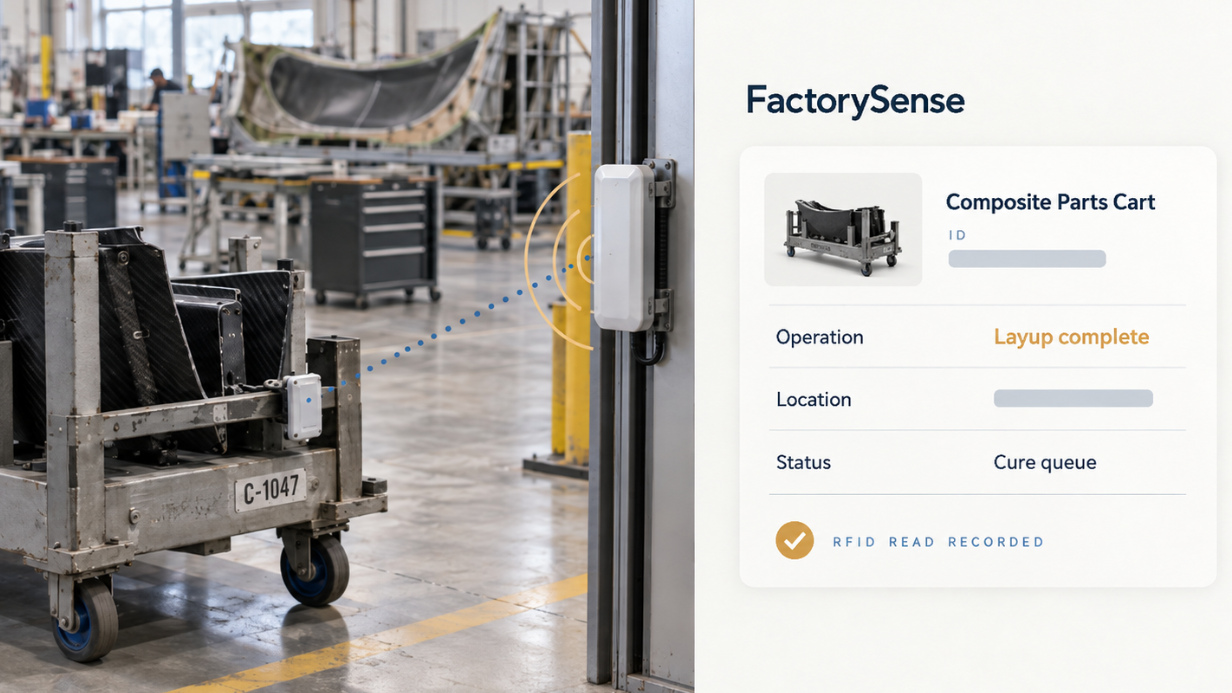
For work-in-process, each RFID event should correspond to a production state that matters. Our WIP tracking article shows why a read is useful only when the business can say what changed because that read occurred.
The same mapping exercise should include the data path. Which application owns the identity? Which system owns location or production status? Which transaction should follow the observation? If the answers are unclear before installation, adding readers will not make them clearer afterward.
3. Prove the RF design on the real object and in the real environment
Tag and reader performance cannot be selected confidently from a specification sheet alone. The object being tagged, tag placement, surrounding materials, orientation, reader geometry and nearby inventory all matter. A passive UHF label that performs well on a carton can become nearly unreadable when placed directly on metal or near liquid.
The relevant passive UHF air interface is standardized by GS1 EPC UHF Gen2, but standards compliance does not eliminate application engineering. It tells us that compliant equipment can communicate; it does not tell us whether a particular tag, mounted in a particular location, will provide enough margin inside your process.
That is why we prefer controlled testing against actual parts, containers, racks and movement patterns. The goal is not simply to make the tag read. It is to establish useful separation between what should be captured and what should not. A doorway system that reads every pallet sitting twenty feet away may have excellent raw read performance and terrible business performance.
The pre-installation guide covers this phase in more detail, including site survey, read-point selection and pilot acceptance criteria.
4. Design the event and integration layer before the rollout
Readers produce observations. Manufacturing systems need events. That distinction should be part of the implementation plan from the beginning.
A reader may report the same EPC hundreds of times. Software still has to decide whether the item entered a zone, remained present, left, returned, moved in the wrong direction or should be ignored. It has to resolve the EPC against the asset, pallet, component or work order that the business knows. Then it has to determine whether the observation should update the ERP, WMS, MES or quality system, create an exception, or wait for another piece of evidence.
For organizations that exchange visibility data among applications or enterprises, GS1 EPCIS provides a standard event model for this kind of information. Not every project needs EPCIS, but the underlying idea is important: physical observations need context before they become useful business records.
Our article on RFID integration with ERP, WMS and MES systems goes deeper into the architecture. In implementation planning, the important point is to avoid treating integration as the final task after the hardware works. If the event has no agreed destination, the project is not yet designed.
5. Pilot the complete workflow, not just the hardware
A useful pilot answers two questions at the same time: can the system observe the physical process reliably, and does that observation create enough operational value to justify expanding it?
That means the pilot should include the same chain that a production deployment will depend on: real tags on real objects, realistic movement, reader and antenna configuration, event logic, identity resolution, integration, exceptions and operator interaction. A bench demonstration that proves a reader can see a tag is valuable during engineering, but it is not a business pilot.
The acceptance criteria should also be written before testing begins. “High accuracy” is too vague. A better criterion might be that every tagged WIP traveler crossing a particular transition is assigned the correct process state while material staged next to the transition is not. Another might be that a handheld search reduces the median time to locate a class of tools below an agreed threshold.
When a pilot underperforms, the result should be diagnosable. Our guide to why RFID systems fail and how to diagnose them separates tag, RF, event, identity, integration and process failures so teams do not simply replace hardware and hope for a better outcome.
A real implementation example is the FactorySense work with CAES Systems, now part of Honeywell, where an earlier active-RFID approach was replaced with a passive system for WIP and asset visibility. The case study is useful because the project began with a system that had already failed to earn trust; the recovery depended on redesigning the full process rather than swapping one reader for another.
6. Scale by repeating a proven pattern, not by extending coverage blindly
Once the pilot works, scaling should be a replication exercise wherever possible. Standardize the tag family, read-point pattern, event logic, naming conventions, monitoring and support model before expanding across departments or facilities. The more each site invents its own version, the harder the system becomes to operate and audit later.
This is also the point where ownership needs to become explicit. Operations owns the process. IT owns network and enterprise-system concerns. Engineering or facilities may own the physical installation. Quality may own traceability requirements. Somebody must own the RFID event model and the ongoing health of the system, or small configuration differences will accumulate until nobody is sure which behavior is intentional.
Security should be treated the same way. RFID is part of the broader information system, not an isolated appliance. NIST SP 800-98 remains a useful hardware-independent reference for RFID security and privacy considerations, while the organization's current security architecture should govern network segmentation, credentials, logging, software access and data handling.
Scaling also creates a useful discipline around change control. New product materials, packaging, racks, work-cell layouts and neighboring RF systems can affect read performance. A design that worked during the original pilot should be revalidated when the physical assumptions change.
What successful RFID implementation looks like
A successful implementation is not the one with the most readers or the largest number of tag reads. It is the one where operations stops thinking about RFID because the relevant physical event simply appears in the system when it should.
That usually requires less technology than people expect and more process work than they expect. The project has to define what matters, prove that the event is observable, translate that observation into the right business state, and give operators a reasonable way to handle exceptions.
If those pieces are in place, scaling becomes much less dramatic. The organization is no longer experimenting with RFID. It is repeating a physical-to-digital pattern that has already been proven.
What is the first step in implementing RFID in manufacturing?
Define a specific operating problem and measurable baseline. The project should be able to state which physical event needs to be captured and what business outcome will improve if it is captured reliably.
Should RFID integration wait until after the hardware pilot?
No. Integration and event logic should be designed early enough that the pilot can test the complete physical-to-digital workflow rather than only reader performance.
How should an RFID pilot be evaluated?
Use pre-agreed process-level acceptance criteria: intended items captured, unintended items excluded, the correct business event created, and the expected operational metric improved.
Schedule a complementary working session with an RFID professional to discuss your floor or yard, your systems of record, and where the visibility gap between them is costing you.
Book a session