How RFID Data Improves AI-Driven Supply Chain Decisions


- AI does not require RFID; RFID matters when an important decision depends on physical-state data that existing systems do not capture reliably.
- Useful AI inputs are normalized business events, not raw reader observations.
- Measure the operational problem first, establish trustworthy event data, and add AI only where a specific decision benefits from additional analysis.
Artificial intelligence can make a supply chain more responsive, but it does not have a special ability to know what is happening physically. It reasons from the data available to it. If inventory is recorded late, a pallet moved without a transaction, or work-in-process is sitting somewhere the ERP does not know about, the model is working from an incomplete picture.
That is where RFID can be useful. Not because AI requires RFID, and not because every RFID read should be fed into a model. RFID is valuable when an important supply-chain decision depends on a physical event that the existing systems do not capture reliably enough. The technology can make that event observable with less manual intervention, and the resulting data can then support forecasting, exception detection, replenishment, scheduling or other forms of decision support.
The distinction matters. Plenty of AI applications work well without RFID because the underlying data is already good. Demand forecasting may depend primarily on orders, seasonality and commercial data. Transportation optimization may rely on carrier and route information. RFID becomes relevant where the missing variable is the current physical state of material, inventory, assets or work moving through the operation. For the broader operational visibility problem, see From Complexity to Control.
The AI problem often starts before the model
Industrial AI discussions tend to focus on model choice, algorithms and compute. In practice, the quality and representativeness of operational data can be just as important. NIST has emphasized this repeatedly in its work on industrial AI, including the need for manufacturing data to reflect real-world conditions and the problems created by incomplete data and large gaps. Its industrial AI data guidance is a useful starting point.
The same issue appears in supply chains. A planning system may know that 500 units were received last week and that 350 were issued to production, but that does not necessarily tell it where the remaining inventory is right now, whether some of it is sitting in staging, whether a container was moved without a transaction, or whether a work order has physically reached the next operation.
Those are not AI problems. They are data-capture problems. Asking a more sophisticated model to infer around them may produce a better estimate, but it does not make the missing event real.
NIST's 2026 workshop report on AI in supply-chain management makes the broader point: AI offers meaningful opportunities in planning and operations, but deployment still depends on integration, interoperability and the quality of the underlying information environment.
What the research says about where AI is being used
AI is already moving into operational supply-chain functions. In MIT Center for Transportation & Logistics' 2026 survey of 647 supply-chain professionals, respondents reported the highest AI impact in customer experience, demand forecasting, warehouse management and inventory management. The relevance here is not that RFID caused those results. It is that two of the highest-impact functions—warehouse and inventory management—depend heavily on the quality of physical-state data.
What RFID contributes that transactional systems may not
An ERP or WMS is very good at recording transactions that are entered into it. The gap appears when physical movement and system transactions do not occur at the same time. A pallet moves before the transfer is posted. A tool changes work areas without a checkout. A container is returned but not scanned. A production traveler advances to the next step while the system still shows the previous state.
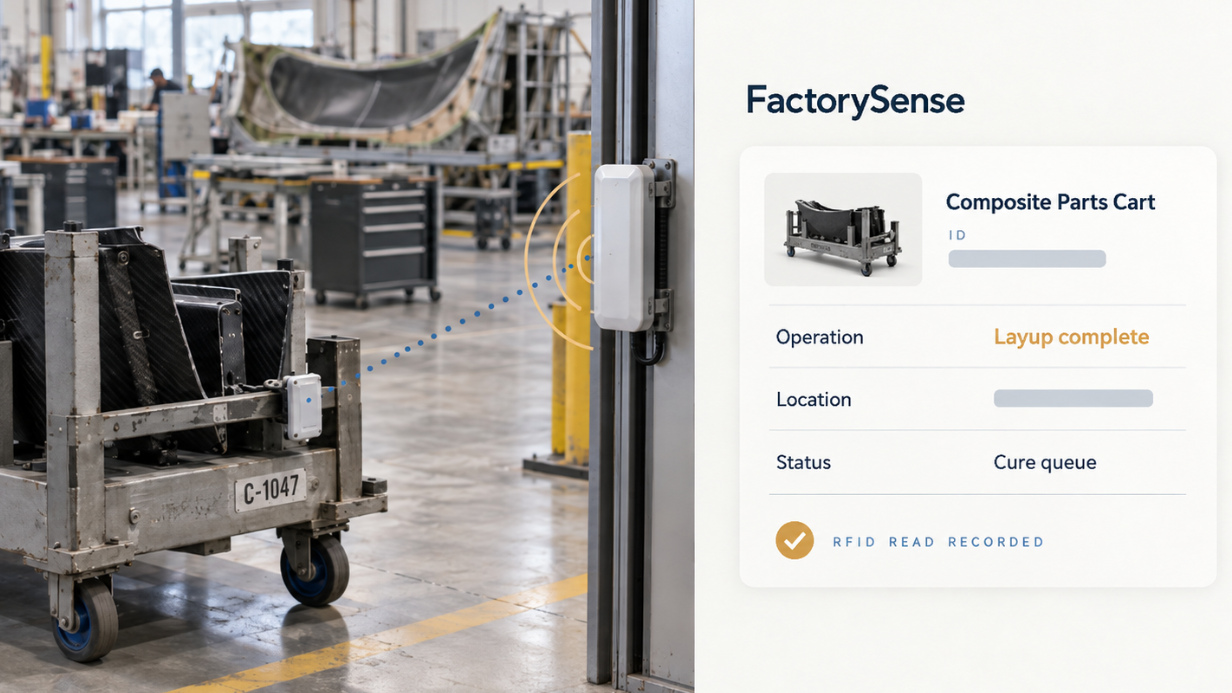
RFID can reduce some of those gaps by observing movement at defined points. A tagged object passes a reader; the software establishes the identity, location and timing of that observation; and business logic decides whether it represents a meaningful event. The result can then be sent to the ERP, WMS, MES or another system that owns the business state.
That architecture is described in more detail in our guide to integrating RFID with existing systems. The important point for AI is that the useful input is not the raw tag read. It is the resolved business event: this pallet arrived, this asset entered this zone, this work order moved into inspection, this container returned to inventory.
Where organizations need a standardized way to represent and exchange those events, GS1 EPCIS provides an established model for describing what happened, when and where it happened, and the business context around the event.
Better physical-state data changes some decisions more than others
RFID data is most useful to AI when the decision depends on current or historical physical state. Inventory optimization is an obvious example; our inventory-management guide covers the underlying RFID use case without assuming an AI layer. A replenishment recommendation is more useful when the system has confidence that the on-hand quantity reflects the warehouse rather than a sequence of transactions that may have been delayed or missed.
The same applies to work-in-process. A model looking for bottlenecks can learn much more from reliable transition histories than from scheduled routing alone. If actual movement between operations is captured consistently, the system can distinguish between a queue that is growing, a work order that is physically stuck, and a transaction that simply has not been entered yet.
Asset utilization is another case. A model may identify underused equipment based on checkout records, but that conclusion is questionable if equipment is regularly moved without being checked out. RFID can make location or movement history more complete, which gives the analytical layer a better basis for deciding whether the asset is truly idle, misplaced or simply unrecorded.
These are examples of decision support, not automatic proof that AI will create savings. The operational value still depends on whether the improved decision changes something meaningful: less expediting, lower search effort, fewer stockouts, better scheduling, reduced buffer inventory or faster exception handling.
RFID does not make every dataset “real time”
One of the claims I would avoid is that RFID automatically creates continuous real-time visibility. Passive RFID normally tells us that a tag was observed when it entered a reader's field. If a pallet is last seen leaving receiving and there is no reader at the next location, the system has a useful event history, but not continuous location.
That can still be enough. Most operational decisions do not require a coordinate for every object every second. They require confidence about the last meaningful state transition. If the business needs broader presence or continuous zone-level monitoring, active technologies, BLE or another RTLS architecture may be more appropriate.
The data strategy should therefore begin with the decision being made, then work backward to the event frequency and location precision actually required. Collecting more data than the decision needs creates cost and noise without necessarily improving the answer.
AI should work from business events, not reader noise
A fixed RFID reader can generate a very large number of observations. Feeding that stream directly into an AI model is usually the wrong abstraction. Duplicate reads, antenna-level observations and transient detections are useful for engineering and diagnostics, but most business decisions need a cleaner event layer.
The event-processing software should decide when a movement is credible, resolve the identity and attach the context the analytical system needs. Depending on the use case, that may include product, lot, work order, asset class, location, process state and timestamp. Only then does the data become comparable across readers, sites and workflows.
This separation also makes AI models easier to maintain. A change in reader hardware or antenna placement should not force the analytical model to relearn the meaning of every low-level observation. The physical capture layer can change while the normalized event model remains stable.
Where AI can add value after the data is trustworthy
Once the physical events are reasonably reliable, AI and statistical methods can help in several ways. They can identify unusual dwell times, flag movement patterns that differ from normal process flow, compare actual consumption with expected consumption, detect recurring exception patterns or prioritize which inventory discrepancies deserve attention first.
Forecasting and optimization can also benefit when current operational state is one of the variables that matters. If a plant knows not only what material was ordered but what has physically arrived, moved into staging and been consumed, planning models have a stronger basis for short-term recommendations.
None of this requires an autonomous system. In many industrial environments the right first use of AI is to rank or explain exceptions for a human operator. The model can say, in effect, “these five conditions are unusual and worth checking,” while the operator remains responsible for the action. That is often easier to validate and safer than allowing a model to create ERP transactions or production decisions automatically.
What not to assume about AI savings
The old versions of several articles in this cluster tried to answer how much money AI and RFID would save in percentage terms. I do not think that is a defensible way to approach the question. The savings depend on the baseline process, the cost of the problem, the quality of the RFID implementation, the decision being improved and whether the organization actually acts on the resulting information.
If search time is already negligible, better location data will not produce a meaningful labor benefit. If inventory records are already highly reliable, RFID may not justify itself for that use case. If the model identifies a production constraint that operations cannot change, the insight may be accurate and still have little economic value.
The business case should therefore measure the underlying operational problem before assigning value to either RFID or AI. Our RFID ROI guide explains how we prefer to baseline those costs rather than importing generic industry percentages.
A practical sequence for combining RFID and AI
The most reliable path is usually less dramatic than the marketing version. First, identify a decision that is being made poorly because the physical state is uncertain. Then determine whether RFID can improve the relevant event data with enough reliability to change that uncertainty.
Next, connect those events to the systems that already own inventory, orders, production or assets. Use the data operationally before adding an AI layer. If the organization cannot trust the RFID event in a normal workflow, there is little reason to train or tune a model around it.
Once the event history is stable, analytical methods can be tested against a defined outcome: earlier exception detection, better prioritization, improved short-term forecasts, reduced dwell time or another measurable decision. Compare the model's recommendation with the existing process and keep the human decision visible until the organization understands where the model performs well and where it does not.
NIST's 2026 roadmap for AI and machine learning in smart manufacturing is useful context here. It treats data management, heterogeneous sensing and trustworthy operation as foundational issues rather than assuming the analytical layer can be separated from the industrial system around it.
The useful relationship is simpler than the hype
RFID and AI are complementary when the business has two separate problems: it does not observe an important physical event reliably enough, and it has a decision that could improve if that event were available as structured data.
RFID addresses the first problem. It can make selected movements and identities easier to observe automatically. AI may help with the second by finding patterns, prioritizing exceptions or making predictions from that event history. Neither technology removes the need to understand the process, and neither creates value merely by being present.
For many companies, the right order is therefore straightforward: improve the operational data first, use it in the systems people already trust, and introduce AI where there is a specific decision that benefits from additional analysis. That is a slower story than “AI transforms the supply chain,” but it is a much more useful way to decide where either technology belongs.
Does AI need RFID to work in a supply chain?
No. Many AI applications use demand, order, transportation or other data that does not come from RFID. RFID is useful when the missing information concerns the current or historical physical state of inventory, assets or work-in-process.
Should raw RFID reads be sent directly to an AI model?
Usually not. Reader observations should first be filtered, resolved to known identities and converted into business events with useful context such as location, process state and time.
How do RFID and AI create savings?
Neither technology guarantees savings. Value depends on the baseline problem and whether better event data and better analysis change a measurable operating outcome such as search effort, exception handling, inventory accuracy or production flow.
Schedule a complementary working session with an RFID professional to discuss your floor or yard, your systems of record, and where the visibility gap between them is costing you.
Book a session