


Turn physical activity into information your enterprise systems can use
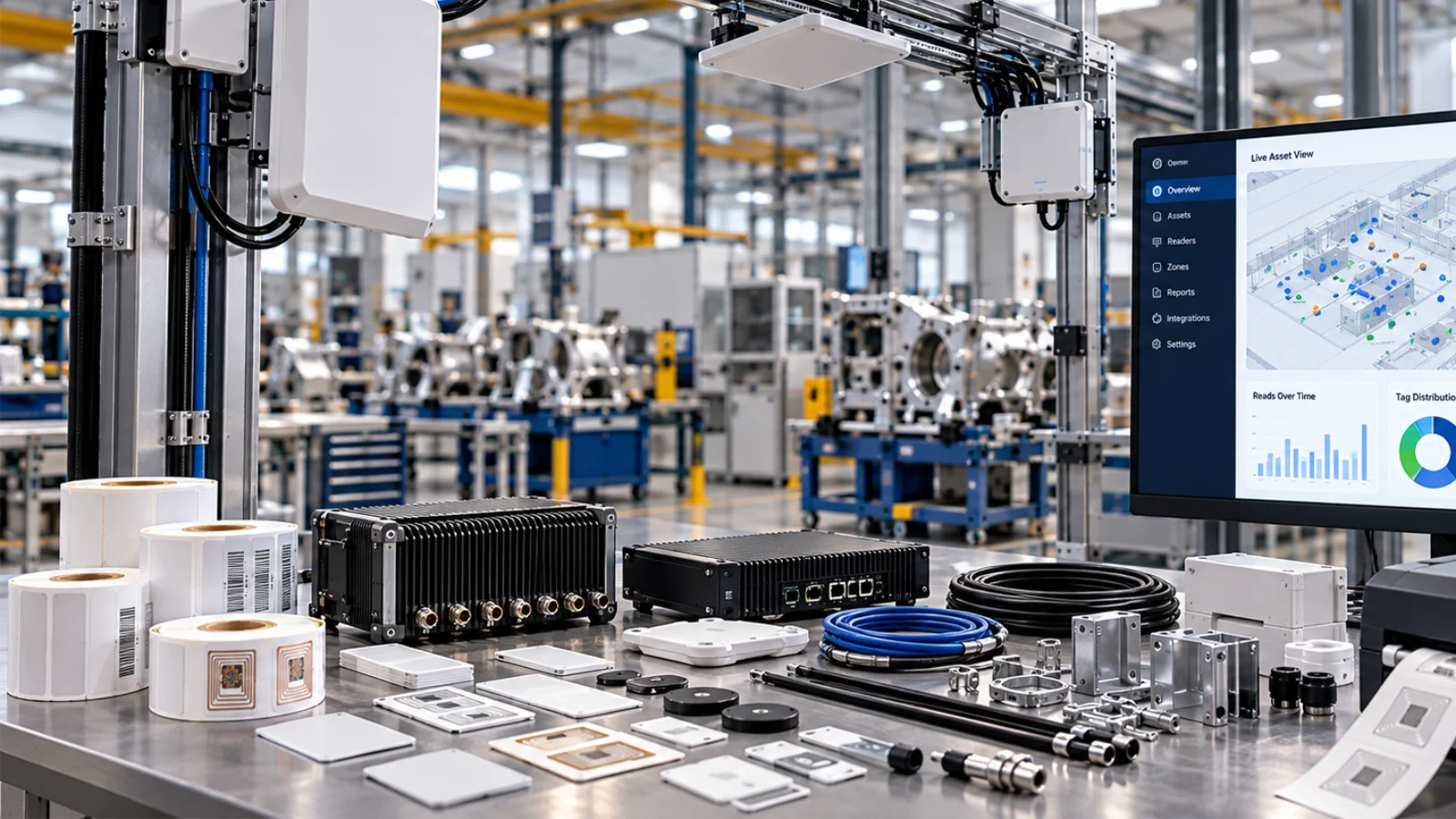
FactorySense turns RFID reads into reliable asset locations, movement events, operational state and workflows, then connects that information to your ERP and other systems. We deliver a complete solution, including software, consulting, RF engineering, hardware, integration and customization, deployment, and ongoing support.
Lost time + Lost assets = Lost revenue
Your systems know where assets should be. FactorySense helps you know where they actually are so you can turn go-finds into go-gets. With FactorySense asset tracking technology, your ERP, WMS, and other shop floor tools can maintain accurate records even after an asset has moved, changed hands, or been staged somewhere unexpected.
From the factory floor to your ERP: FactorySense.io turns RFID and IoT observations into operational events.
FactorySense connects what happens on the factory floor to the systems that run the business. The platform captures RFID and IoT signals, resolves them into meaningful location, status, and movement events, and delivers those events to ERP, WMS, MES, and other enterprise systems in real time.
Tagged assets are read by fixed readers, the FactorySense platform turns those reads into events, and the events are written into ERP, WMS and shop floor systems.
FactorySense connects the movement of assets into discrete events your systems can consume
Enterprise asset tracking that standardizes what matters without ignoring how each site operates.
Facilities within the same organization often differ in systems, processes, products, and physical environments. FactorySense establishes a common enterprise asset tracking architecture while tailoring each deployment to the operating requirements of the site. That balance allows organizations to scale consistently without forcing every facility into the same implementation, while providing a clear basis for measuring ROI and business impact.
Presence or absence within a facility, storage area or controlled zone.
A reliable transition event when an asset crosses a doorway, crib, process boundary or other controlled read point.
Zone-level location across departments, buildings, yards or other operating areas.
Custody. Which team, crib or work center holds the asset now, and since when.
State. Whether the asset is issued, staged, in calibration, in inspection or ready for the next job.
A location, custody or state event written into ERP, WMS, MES, or other shop floor application.
Different assets need different kinds of visibility.
FactorySense works with your team to select the architecture around the tracking requirements rather than forcing every problem into one technology. Passive RFID, BLE, UWB, handheld search and hybrid approaches each come with different trade-offs and solve different types of location problems.
RFID observations become operational events and enterprise records.
Controlled transitions
Passive RFID scanning is implemented at doors, portals, tool cribs, and process boundaries when the important question is whether an asset moved from one known state or location to another.
RFID observations become operational events and enterprise records.
Zone-level location
RFID, BLE or other infrastructure establishes which operating area contains the asset for rapid location-finding. Passive RFID often reduces cost at scale.
RFID observations become operational events and enterprise records.
Handheld search
A mobile RFID reader gives personnel a directed way to find a specific tagged asset and perform cycle counts working in tandem with permanent infrastructure.
RFID observations become operational events and enterprise records.
High-resolution RTLS
Active technologies such as UWB are appropriate when the operation genuinely needs much finer position rather than presence, transition history or zone-level location.

FactorySense consulting teams work with our hardware and software engineers to design customized solutions for your operations.
Metal changes RF behavior. Liquids absorb UHF energy. Tag orientation matters. Mounting material matters. Reader power changes not only whether a tag can be seen, but also where it can accidentally be seen. As part of our integrated approach, FactorySense provides the engineering, consulting, hardware, and software expertise to ensure solutions are turnkey and performant, even in your most challenging environments.
Add the key sentence from the clip.
Name, title, company
Add a caption that says what the viewer is looking at.
From operating question to production system.
The technology follows the requirement. Each stage narrows uncertainty before the next one begins, so the final deployment is engineered around the real assets, facility and enterprise workflow rather than a generic specification.
Define
Clarify the operating question, assets in scope, location resolution, exceptions and enterprise actions that matter.
Observe
Determine where those movements or states can be observed reliably in the actual physical environment.
Prove
Test tags, materials, read zones and environmental conditions against the real assets before scaling.
Engineer
Design the RF infrastructure, event logic, software behavior, networking and enterprise interfaces as one system.
Deploy
Install, configure, commission and validate the system against the workflows it is expected to support.
Operate
Monitor, tune and support the production system as assets, workflows and facilities change.
Frequently asked questions
Answers to questions that are often asked during our first interactions with enterprise users.
How does RFID asset tracking work?+
A tag carries an identifier. Fixed readers or handheld devices observe that identifier at defined points, and software turns those observations into events an operator or an enterprise system can act on. The tag supplies identity. The design of the read point and the event logic supplies the meaning.
Can RFID provide real-time asset location?+
It depends what real time has to mean. Passive RFID is well suited to presence, transitions and last-seen location. Continuous coordinates across an open area usually require an active RTLS technology, which carries different cost and maintenance. Define the requirement before selecting the technology.
What is the difference between RFID asset tracking and RTLS?+
RFID establishes that a tagged object was observed at a known point. RTLS estimates where an object is at a given moment, usually continuously. Many deployments combine the two, using passive RFID at controlled transitions and active technology only where repeated location justifies the cost.
Can RFID track assets across multiple buildings?+
Yes, provided the architecture matches the movement. Campus deployments usually combine fixed readers at the transitions that matter with handheld search inside buildings rather than attempting continuous coverage everywhere. A standard tagging strategy and a single software layer keep the record consistent across sites.
Can RFID integrate with ERP or EAM systems?+
Yes. FactorySense filters raw reads into meaningful business events and delivers them to ERP, EAM, CMMS, MES, WMS or a customer application. The objective is to improve the systems already running the operation rather than to add another database people have to check.
How accurate is RFID asset tracking?+
Accuracy is a property of the system, not the tag. A well-engineered read point can be highly reliable for the event it was designed to capture, while a poorly engineered one produces confident but misleading location data. Accuracy should be specified per event, tested against real assets and real movement, and accepted on that basis.
Does RFID work on metal equipment?+
Yes, with the right tags and mounting. Metal changes RF behavior, so on-metal tags, standoff mounting and antenna geometry have to be engineered for the actual object. This is one of the main reasons an RF survey uses the real assets in the real environment rather than samples on a bench.
Can an existing RFID system be improved rather than replaced?+
Often yes. A deployment the floor does not trust has usually failed in a specific layer: tag selection, read-zone coverage, event logic, integration or the way operators were asked to use the result. Diagnosing those separately costs far less than replacing everything, and it is how the Honeywell Aerospace program was recovered.
Let's talk about what you need to track.
Whether you are trying to locate high-value assets, track tools and equipment, monitor movement across multiple buildings or improve an existing RFID system, FactorySense can help determine the right approach and deliver the complete solution.