RFID Warehouse Management: How RFID Changes Warehouse Operations

- Warehouse RFID is most useful when it captures physical movements that otherwise depend on a person remembering to scan or enter a transaction.
- Passive RFID usually provides event and zone visibility rather than continuous exact location; the right architecture depends on the operational question.
- Reliable warehouse deployments depend on read-zone design, software filtering and integration with the WMS or ERP, not simply installing more readers.
Warehouse RFID projects usually start with an inventory question, but inventory is rarely the whole problem. The harder issue is that the warehouse management system and the physical warehouse drift apart during the day. Material is received but not yet posted. A pallet is moved to make room and the location update comes later. A picker finds an empty slot even though the system says stock is available. By the time somebody reconciles the difference, the original movement that created it may be impossible to reconstruct.
That is the part RFID can change. It gives the operation a way to capture selected physical movements automatically, so the system record is updated closer to the moment the work happens. The useful result is not simply that a reader saw a tag. It is that the business can establish, with reasonable confidence, that a particular pallet crossed receiving, entered a storage zone, moved into staging or passed through shipping.
Where RFID fits in warehouse operations
A warehouse already has systems for orders, inventory, locations and transactions. RFID does not replace those systems. It improves the way certain events reach them. In a barcode process, the event exists only when somebody deliberately scans it. In an RFID process, the event can be generated by the movement itself, provided the read point has been designed to recognize that movement reliably.
That distinction matters in high-volume or interruption-prone workflows. A forklift operator moving three pallets through a doorway may have no difficulty making three barcode scans when the pace is moderate and the process is tightly controlled. At a busy dock, however, those scans become one more thing that can be skipped, delayed or performed against the wrong item. RFID is most useful where the business wants the physical process to create the transaction without asking the employee to stop and create it manually.
The common warehouse applications are familiar: receiving confirmation, put-away, internal movement, staging, cycle counting, picking verification, shipping confirmation and returnable-container tracking. They should not all be approached the same way. A dock-door read is a controlled transition between two states. Locating a pallet somewhere inside a large storage area is a different technical problem. One may be solved with passive UHF readers at a chokepoint; the other may require handheld search, zone logic, active technology or a different process entirely. The common passive UHF air interface is defined by GS1's EPC UHF Gen2 standard.
Receiving is often the first place to look
Receiving creates the initial warehouse record, which means errors there tend to travel. If material physically arrives but the system is updated later, downstream teams are making decisions from an incomplete record. Production may expedite material that is already on site. Purchasing may call the supplier. Warehouse staff may spend time searching the dock because the ERP says the shipment has not arrived.
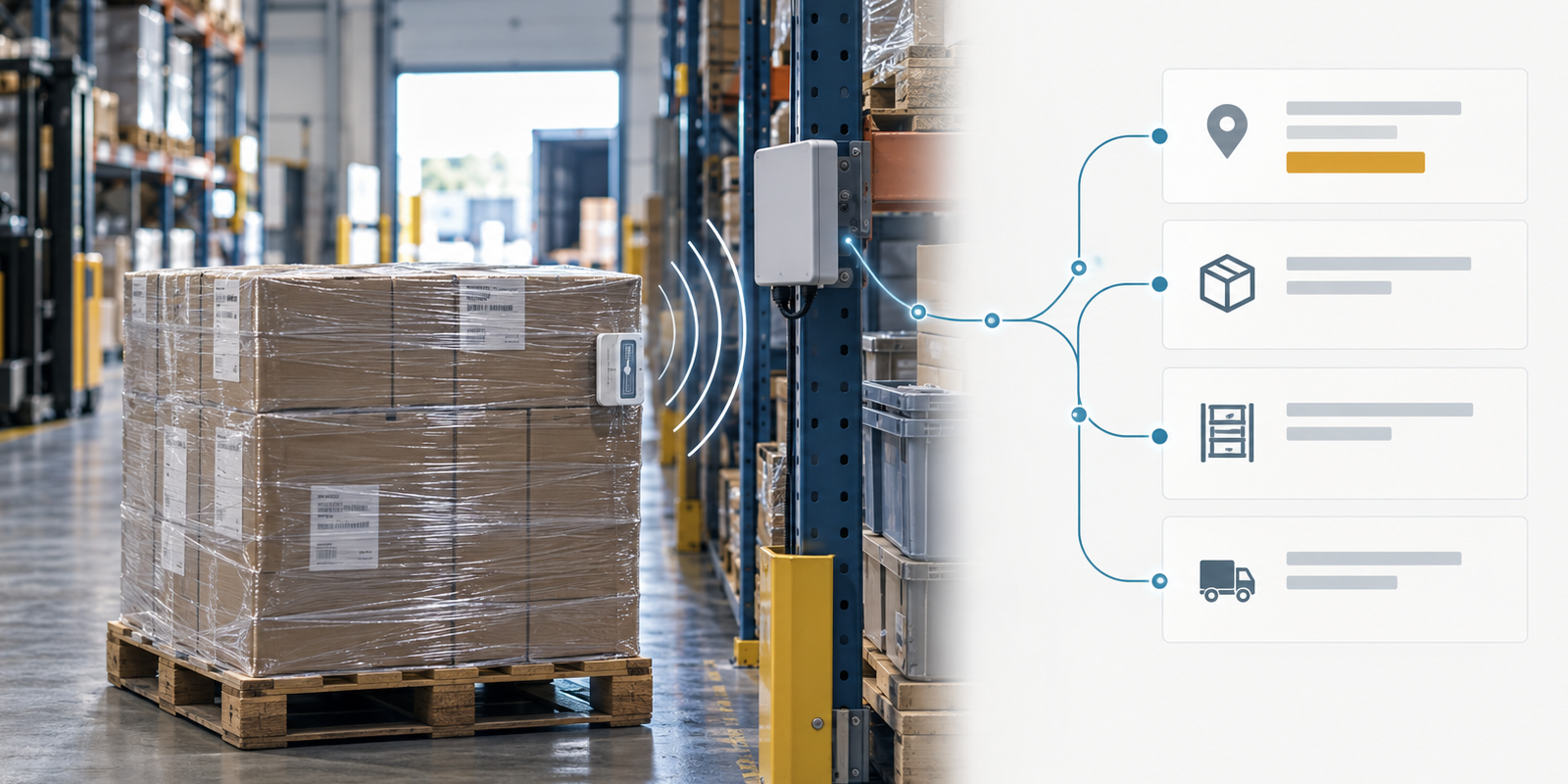
RFID can make receiving more automatic when the incoming unit can be identified reliably. A tagged pallet or container passes a defined read point; the software resolves the tag identity against the expected shipment; and the resulting event can be presented to the WMS or ERP as a receipt, an exception or a request for confirmation. The system does not have to blindly accept every radio read. In a well-designed implementation, software decides which observations are meaningful enough to become business events.
This is one reason the integration layer matters as much as the hardware. Readers are very good at producing observations. Warehouse systems need transactions. The work in between is where duplicate reads are filtered, direction is inferred, identities are resolved and exceptions are separated from ordinary movement. Our article on integrating RFID with existing systems goes deeper into that distinction.
Storage visibility is more nuanced than “real-time location”
Warehouse RFID is sometimes described as if every passive tag continuously reports an exact location. That is not how most passive UHF deployments work. Passive tags respond when energized by a reader, so the location information comes from where and when the tag was observed. A system may know that a pallet entered aisle 12 because it crossed a monitored point, or that it was last seen leaving receiving. That is valuable, but it is different from a continuous coordinate.
For many warehouses, the operational question is not “Where is this item to the nearest foot?” It is “Which zone, aisle, staging area or process step was it last confirmed in?” That level of visibility can remove a great deal of search time without instrumenting every square foot of the building. Where finer location is required, handheld search, additional fixed read points, BLE or another RTLS technology may be added deliberately rather than assuming one technology should solve every location problem.
This also changes how we think about misplaced stock. A location history does not have to be perfect to be useful. If the system shows that a pallet was received at 10:12, moved through a doorway at 10:26 and never recorded at shipping, the search area is already much smaller. The value is often in narrowing uncertainty, not creating a magical map of every object at every second.
Cycle counting and inventory accuracy
Cycle counts are a good example of work that exists largely because the software does not fully trust its own record. A warehouse may have a sophisticated WMS and still devote substantial labor to proving that the physical inventory agrees with it. RFID can reduce that burden by making more movements observable and by making physical counts faster where tagged inventory can be read in bulk.
The improvement is not automatic. Tag readability depends on the object, packaging, orientation, surrounding material and the way the count is performed. Metal shelving, liquids and dense storage can all change performance. A warehouse that begins with unreliable counts will often have significant room for improvement; a tightly controlled operation with disciplined barcode execution may see a smaller gain. The baseline matters, which is why we treat inventory accuracy as something to measure before the project rather than a benefit to assume.
Handheld RFID also deserves a place in this discussion. Fixed infrastructure is useful for automatic transitions, but handhelds are often the simplest way to perform rapid audits, search for an item that has gone missing or validate an area without permanently instrumenting it. In practice, strong warehouse systems often use both. The fixed readers capture predictable movement; the handheld covers exceptions and ad hoc questions.
Picking and shipping are about preventing the wrong event
Shipping errors are expensive partly because they are discovered late. Once the wrong pallet is on a trailer, the cost is no longer the few seconds required to verify it. It becomes freight, customer-service work, schedule disruption and sometimes an emergency replacement shipment.
A controlled RFID read at staging or a dock door can compare what is physically moving with what the order says should move. That makes the read useful as an exception-control mechanism. The normal shipment passes without adding another manual step; the mismatch is what receives attention. This is a better use of automation than simply collecting more read data and asking somebody to watch a dashboard.
The same principle applies to kitting and production staging. If a job requires a defined set of components, the system can compare the identities that arrive in the staging area with the expected material. The warehouse team does not need another screen telling them that tags were read. They need an exception when the physical set is incomplete or wrong.
The read environment decides whether the design works
Warehouses look simple on a floor plan and complicated at radio frequency. Steel rack, dock doors, forklifts, liquids, stacked product, changing pallet geometry and people moving through the read zone all influence what a passive UHF system sees. The same reader and tag can perform very differently when the tagged item is moved from a cardboard carton to a metal component or from an open aisle into dense racking.
That is why we do not treat tag selection or reader placement as catalog decisions. The objective is to create a read zone that detects the intended movement while rejecting nearby activity that should not become a transaction. More read range is not always better. At a dock door, excessive range may allow the system to see inventory sitting beside the door and confuse it with inventory crossing through it.
A site survey and pilot are useful because they expose these conditions before the business builds process assumptions around them. Testing should use the actual products, racks, containers, forklifts and movement patterns whenever possible. A demo performed with a clean cardboard box in an empty room proves very little about a metal-dense warehouse in production. If an existing deployment is already producing missed reads, stray reads or events the floor no longer trusts, our guide to diagnosing failed RFID systems covers the troubleshooting sequence in detail.
Connecting RFID to the WMS or ERP
Warehouse visibility becomes operationally important when the RFID event changes the system of record. A read that only populates an RFID dashboard may be interesting, but the warehouse still has to perform the original transaction somewhere else. That is why the integration design should be discussed early: which physical events should create or propose transactions, which system owns location, how exceptions are handled and what happens when an expected read does not occur.
Not every event should be fully autonomous on day one. Some warehouses begin with a confirmation workflow where RFID proposes a receipt or movement and an employee approves exceptions. As confidence improves, routine transactions can become more automatic. The right level of automation depends on the consequence of being wrong. Missing a pallet movement is inconvenient; automatically shipping the wrong serialized component may be much more serious.
Good integrations also preserve a history that can be investigated later. For organizations that need to share visibility events across applications or trading partners, GS1 EPCIS provides a standard model for recording and exchanging those events. When operations, IT and finance disagree about what happened, an event trail is much more useful than a current location field. It lets the team see when an item was observed, by which reader, at what process point and what transaction followed.
What to measure before and after deployment
The most useful warehouse RFID business cases usually begin with work the organization is already paying for: search time, reconciliation, cycle counts, shipping errors, manual receipt transactions, misplaced material or buffer inventory held because nobody fully trusts the count. Those costs are often spread across labor, freight, purchasing and production rather than labeled as an inventory-visibility problem.
Before a pilot, we prefer to establish a small set of measures that the operation already understands. Depending on the project, that may include inventory-record accuracy, time spent searching, receiving transaction time, count labor, mis-shipments, dock-to-stock time or the number of manual corrections made to warehouse records. The purpose is not to manufacture an ROI story. It is to determine whether the problem is large enough and measurable enough to justify the system.
After deployment, the same measures provide a more useful picture than reader statistics alone. Read rate matters during engineering, but the business ultimately cares whether fewer people are searching, fewer transactions are being corrected and material is moving with less uncertainty.
RFID is useful when it removes a transaction the warehouse should not need
The strongest warehouse projects are usually easy to explain in operational terms. Material moves through a process, the business needs to know that it moved, and today somebody has to stop what they are doing to tell the software. RFID gives the system a chance to observe that event for itself.
That does not mean every barcode should be replaced or every aisle should be covered with readers. Barcode is still inexpensive, standardized and perfectly good when a person is already handling an item and the scan is an acceptable part of the work. RFID earns its place where automatic capture changes the economics of the process: high volume, repeated movement, expensive search, difficult reconciliation or errors that are costly enough to prevent at the point of movement.
A warehouse implementation should therefore begin with a process map, not a hardware list. Identify the places where the physical warehouse and the system record most often diverge, decide which of those events are worth capturing automatically, and then design the read points around those decisions. The technology is much easier to evaluate once the operational question is specific.
Does RFID replace a warehouse management system?
No. RFID is a data-capture layer. The WMS or ERP still owns inventory, orders and transactions; RFID helps selected physical events reach those systems automatically.
Can RFID show the exact location of every pallet?
Not necessarily. Passive RFID most often establishes where an item was observed or which zone it entered. Exact continuous location may require additional infrastructure, handheld search or another RTLS technology.
Where should a warehouse start with RFID?
Start where physical movement and the system record diverge in an expensive way: receiving, search-heavy storage, cycle counts, staging or shipping verification. Measure the current process before selecting hardware.
Schedule a complementary working session with an RFID professional to discuss your floor or yard, your systems of record, and where the visibility gap between them is costing you.
Book a session