RFID Tracking in Aerospace: WIP, Tooling, Parts and Traceability


- Aerospace RFID is not one use case. WIP, tooling, campus assets, controlled materials and installed aircraft components require different tracking architectures and controls.
- RFID is strongest when it captures identity and movement while MES, ERP, QMS, calibration and maintenance systems remain authoritative for process status, acceptability and lifecycle records.
- FactorySense deployments at Northrop Grumman and CAES Systems by Honeywell show two distinct patterns: large-campus asset visibility and high-mix WIP visibility.
Aerospace manufacturers have a visibility problem that does not fit neatly into one tracking category. The broader defense logistics, asset-loss prevention and compliance use cases overlap with aerospace, but production traceability introduces additional quality and lifecycle boundaries. A serialized assembly may move through machining, inspection and test, while a calibrated tool circulates among work areas and a composite kit carries storage and material-life constraints. RFID can support all of those workflows, but the useful system design is different in each case.
The most important boundary is between observation and authority. RFID can establish that an identified object was observed at a controlled point, help a worker search for a missing asset, and automate selected movement history across a facility. It does not, by itself, prove that a part is airworthy, an inspection passed, a tool is within calibration, or a material remains acceptable for use.
That distinction matters because aerospace traceability sits inside formal quality and lifecycle controls. The IAQG 9100 quality-management framework is used throughout aviation, space and defense supply chains, while FAA guidance separately addresses receiving inspection, part identification, maintenance records and RFID use on aircraft. RFID is most useful when it adds physical evidence to those systems rather than pretending to replace them.
Aerospace RFID is several applications, not one
WIP tracking, tooling, campus asset visibility, controlled materials and aircraft-installed RFID are related only at a high level. A production read point may be designed around a handoff between operations, while an asset system may care primarily about last-seen location and search. A permanently affixed tag on airborne equipment carries a different engineering and regulatory burden again.
The technology choice should follow the question the operation needs answered. Passive UHF RFID is often effective when an object moves through a controlled checkpoint, handheld RFID can help locate an item inside a known area, and active technologies can support repeated zone-level visibility across a wider campus. Our RFID tracking guide explains the difference between presence, transitions, last seen, handheld search and repeated location.
WIP visibility is one of the clearest aerospace fits
Aerospace production often combines long routings, serialized assemblies, inspection gates, rework loops and constrained resources. A job can physically move while the digital production record remains one transaction behind, leaving schedulers and supervisors to reconstruct the floor state manually. RFID can reduce that gap when a physical transition has a clear process meaning and the resulting event is written back to the system people already use.
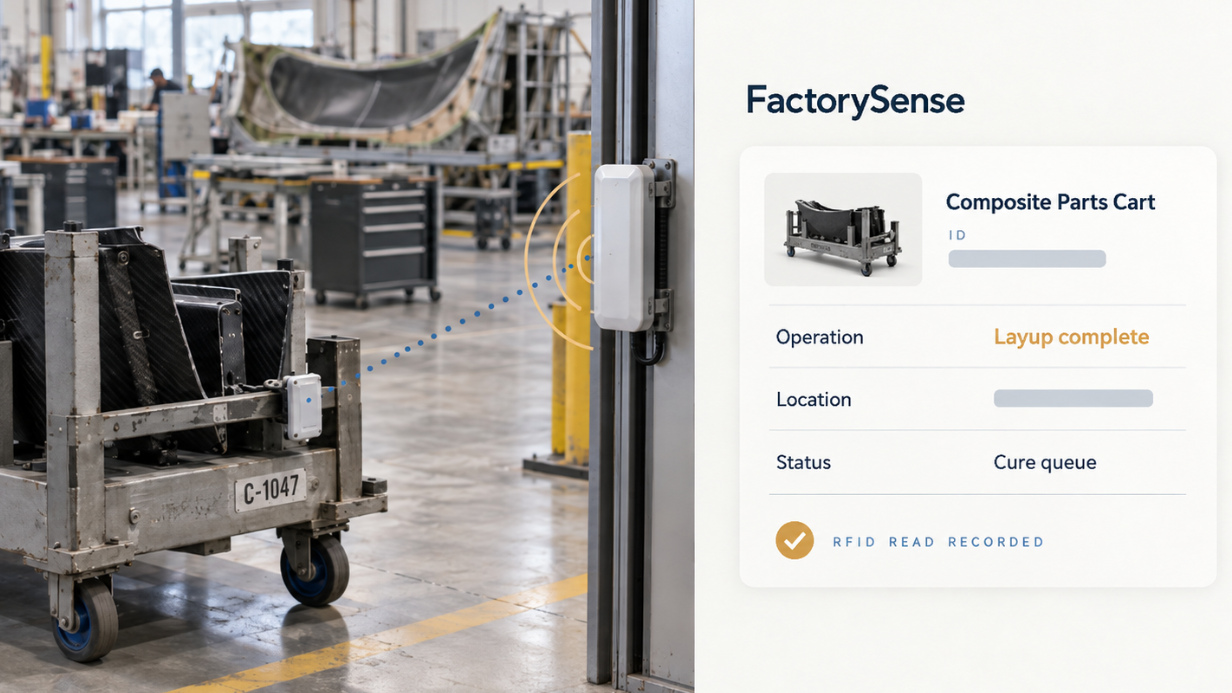
A tagged traveler, carrier or assembly can be observed leaving one operation and entering another without requiring an additional scan. Software can filter repeated reader observations into one meaningful event and then update the MES or ERP. The FactorySense WIP guide covers the broader architecture, including tagging level, read-point design and enterprise integration.
The important limitation is that movement should not be confused with completion. An assembly entering inspection has entered inspection, but it has not passed inspection merely because an antenna observed it there. Quality results, nonconformance status and rework disposition remain the responsibility of the systems and people that actually perform those functions.
Honeywell shows what changes when WIP data becomes trustworthy
At CAES Systems by Honeywell, FactorySense inherited an RFID deployment that was already intended to track WIP but was not producing dependable enough information for the operation to trust. The legacy active-tag architecture created battery-maintenance burden, inconsistent data and coverage issues. The problem was not the absence of RFID, but a mismatch among the tag technology, read environment, event logic and manufacturing process.
The replacement architecture moved the application to passive RFID, revised reader placement and connected the observations through software that could present usable WIP state rather than raw reads. Once the system became reliable, the same infrastructure expanded beyond assemblies to carts and tooling. That expansion is important because it happened after the core identity and event model had proven useful to the operation.
The case does not establish that passive RFID is always superior for aerospace. Active systems can be appropriate where wide-area repeated location justifies the device cost and battery maintenance. The Honeywell deployment instead shows that the architecture has to fit the object, the movement and the business decision the plant is trying to automate.
Large campuses turn asset search into an operational problem
Aerospace organizations also manage large populations of tools, support equipment, test assets, containers and movable infrastructure that do not follow one fixed production route. In those environments, the problem is often finding the correct asset without walking buildings, calling other teams or maintaining parallel spreadsheets. Last-seen location, movement history and handheld search can be more useful than a continuously moving dot.
FactorySense's work at Northrop Grumman's Space Park campus illustrates the scale of that challenge. The site spans 46 buildings and more than 1.5 million square feet, with aerospace production, R&D and controlled environments that do not all behave the same way from an RF perspective. The deployment combined fixed and handheld RFID, software integration and a standardized tagging strategy to improve visibility across that varied campus.
The architecture should still be matched to the asset population. A high-value asset that rarely moves may only need a trustworthy last-seen record plus handheld search, while a cart moving through known chokepoints may benefit from fixed readers. Our asset tracking guide and RFID and RTLS guide explain when those approaches diverge.
Tooling and calibration are related, but not the same record
Tool availability can stop work even when the factory has enough tools in aggregate. A fixture may be in another building, a test set may be assigned to another program, or a calibrated instrument may simply be difficult to locate. RFID can reduce that search and custody uncertainty, which makes reusable tooling one of the more practical aerospace tagging populations.
Calibration creates a second layer of information. RFID can identify a tool and tell the software where it was last observed, who checked it out, or whether it returned to a controlled crib. A calibrated-tool-management system can then join that physical identity to the authoritative calibration date, status and documentation without pretending that a radio read proves calibration occurred.
Keeping those records distinct is useful during audits and investigations. Location history answers where the instrument moved, while the calibration system answers whether it was eligible for use at that point in time. Presenting the two together can simplify work for the operator, but the underlying sources should remain clear.
Material traceability begins before the part exists
Some aerospace traceability problems concern material before it becomes a serialized component. Composite prepreg, kits, offcuts and other controlled materials can have storage, handling and life-accounting requirements that make identity and movement history operationally important. RFID can automate selected movements between controlled storage, kitting and production areas, but it does not decide whether the material remains acceptable for use.
Our composite material control guide goes deeper into freezer storage, cumulative out-time, genealogy and the limits of RFID in material disposition. The same design principle applies to other long-lead or controlled materials. RFID can strengthen the physical history, while engineering specifications, supplier records and the quality system remain authoritative for acceptability.
Receiving and part traceability carry their own obligations
Aerospace receiving is not simply a warehouse receipt. FAA Advisory Circular 20-154A addresses receiving-inspection systems for aircraft parts and materials and emphasizes sufficient traceability to determine that articles were properly produced or previously determined to be airworthy. FAA AC 20-62E separately provides guidance on eligibility, quality, identification and traceability of aeronautical replacement parts.
RFID can make a verified part or container easier to identify during those workflows and can reduce the effort required to move accepted identity into inventory. It cannot establish eligibility merely because a tag matches an expected serial number. Receiving still has to validate documentation, condition and acceptance criteria under the organization's quality system.
This is also why a basic RFID identifier should not be described as proof against counterfeit parts. Serialization and movement history can support chain of custody, but the identifier itself can be copied or incorrectly associated if the surrounding process is weak. Authenticity depends on the broader provenance, documentation and assurance controls.
Installed aircraft RFID is a different engineering category
RFID used on factory carts and WIP does not face the same requirements as a tag permanently installed on airborne equipment. The FAA's active AC 119-2A provides operator guidance for RFID devices and systems used on aircraft and components for identification, serviceability, presence and selected maintenance or inspection tasks. FAA AC 20-162B separately addresses airworthiness approval for installed RFID tags and sensors. The guidance keeps RFID-enabled maintenance inside the operator's existing maintenance and recordkeeping obligations.
SAE International's AS5678B defines performance and test requirements for passive UHF RFID tags intended for airborne equipment use. Its scope includes permanently affixed tags and environmental qualification considerations that do not apply to an ordinary WIP label inside a factory. Aerospace teams should therefore identify early whether the tag is only a factory-process identifier or is intended to remain with an aircraft component through its service life.
The digital thread is larger than RFID
Aerospace organizations frequently describe the end goal as a digital thread that connects design information, manufacturing activity, inspection results, configuration, maintenance and support records. NIST's Digital Thread for Manufacturing work focuses on standards and methods for connecting product definition, manufacturing and quality information across the lifecycle. That is useful context because it makes clear that traceability depends on relationships among many data sources rather than on one sensing technology.
RFID can contribute physical events to that thread. A traveler entered inspection, a tool left a crib, a material kit reached a work center, or a serialized asset moved between buildings. Those events become much more useful when they are connected to the product, process and quality information that explains what the event means.
Our guide to connecting factory data to enterprise systems covers that handoff directly. Raw reads should normally be filtered and contextualized before they reach an ERP, MES, QMS or maintenance platform. The business system needs a small number of meaningful events, not a stream of duplicate EPC observations.
RF design matters in aerospace environments
Aerospace plants contain many of the conditions that complicate passive RFID: metal structures, conductive assemblies, carbon-rich composites, dense tooling and objects that move through changing orientations. A tag that performs well in free air can behave differently when attached to a metal fixture or mounted near a composite structure. The correct design has to be proven on the actual object and at the actual process point.
This is why maximum advertised read range is rarely a useful design target. The objective is enough margin to read the intended item while avoiding neighboring tags that should not participate in the event. Our passive RFID physics guide explains how orientation, surrounding material and the forward and return RF links affect real-world behavior.
An RFID site survey, using the process-specific approach described in our pre-installation guide, should therefore use the real objects, real movement paths and realistic surrounding inventory. Reader power, antenna geometry, tag placement and event timing should be tuned around the workflow rather than around the longest possible read. In aerospace, a false process event can be more damaging than a missed demonstration read because it can undermine trust in the production record.
Security and controlled environments change the integration design
Aerospace programs often operate across facilities, networks and work areas with different access rules. RFID software creates location, movement and identity data that may itself be sensitive even if the tag contains only a narrow identifier. The event history can reveal program association, asset movement or operational patterns that should remain inside the organization's normal access controls.
A safer architecture is usually to keep the tag identifier limited and let controlled software resolve it to richer business information. Access to location history, custody records and integration endpoints can then follow the organization's existing authorization model. That approach also reduces the consequences if a tag is read outside the intended application context.
The Northrop Grumman deployment is relevant because the RFID layer was integrated with existing enterprise workflows across a large secure campus instead of becoming another isolated dashboard. That pattern is generally stronger for aerospace. The physical observation should enter the governed operational data flow and should not create another shadow system that employees have to reconcile later.
How to choose an aerospace RFID pilot
The best pilot begins with a question the operation already struggles to answer. Our manufacturing implementation guide provides the broader pilot-to-production sequence, but aerospace pilots should keep the quality-system boundary explicit from the first acceptance test. Where is this assembly after it leaves inspection, why are these test fixtures constantly being searched for, which controlled kits have actually reached the line, or how long is work sitting between two operations? A specific question gives the team something concrete to tag, observe and measure.
Measure the existing process before installing hardware. Search time, transaction lag, WIP discrepancies, queue age, tool availability and the percentage of expected movements that become valid business events are more useful than raw read counts. If the requirement is location, define whether the real need is presence, transition, last seen, handheld search or repeated location before selecting the technology.
Then validate the full physical-to-digital chain. The tag must work on the object, the read zone must separate intended from unintended items, software must create the correct event, and the authoritative system must receive it reliably. If an existing deployment is producing data the floor no longer trusts, our RFID failure-diagnosis guide provides a framework for isolating RF, event-logic, integration and process problems.
What aerospace organizations should expect RFID to do well
RFID is a strong fit when the aerospace problem involves identity plus movement. It can reduce the friction of locating assets across a large campus, keep WIP records closer to the physical floor, automate selected custody events for tools, and make controlled material movements easier to capture. It can also support aircraft and component identification when those applications are designed around the relevant standards and maintenance requirements.
What RFID should not do is blur observation with engineering authority. A location event does not establish calibration, a read at receiving does not establish airworthiness, a tag on composite material does not determine remaining life, and a work order crossing an inspection boundary does not establish acceptance. Those states require the evidence and approvals already defined by the organization's quality, maintenance and engineering processes.
That boundary is what makes RFID useful rather than risky. When the physical observation is reliable and the software is modest about what the observation means, RFID can strengthen the digital record without pretending to replace it. The best aerospace deployments are the ones that remove a real source of uncertainty from an operation that already knows what decision should happen next.
Sources and further reading
- FAA AC 119-2A, Operational Use of Radio Frequency Identification Systems Onboard Aircraft
- FAA AC 20-154A, Guide for Developing a Receiving Inspection System for Aircraft Parts and Materials
- FAA AC 20-62E, Eligibility, Quality, and Identification of Aeronautical Replacement Parts
- SAE AS5678B, Passive RFID Tags Intended for Airborne Equipment Use
- IAQG 9100 Quality Management Systems for Aviation, Space and Defense Organizations
- NIST Digital Thread for Manufacturing
- Northrop Grumman Gains Efficiency and Reduces Asset Loss with FactorySense
- Honeywell Revitalizes RFID for WIP Tracking with FactorySense
How is RFID used in aerospace manufacturing?
Common uses include WIP tracking, locating tools and mobile assets, monitoring material and kit movements, and automating selected handoffs between production areas. The useful RFID event should be tied to a real process question rather than treated as generic location data.
Can RFID tags be installed directly on aircraft parts?
Yes, but aircraft-installed RFID is a different engineering category from factory tracking. FAA AC 119-2A addresses operational use of RFID on aircraft and components, while SAE AS5678B defines requirements for passive UHF RFID tags intended for airborne equipment use.
Does RFID prove that an aerospace part is airworthy or compliant?
No. RFID can support identification, movement history and recordkeeping, but airworthiness, inspection acceptance, calibration status and material disposition depend on the organization's approved quality, maintenance and engineering processes.
What is a good first aerospace RFID pilot?
Start with a recurring problem where the physical state is hard to determine, such as missing WIP between operations, frequently searched tooling, mobile test equipment or controlled kits moving between storage and production. Define the required tracking mode and the business event before selecting hardware.
Schedule a complementary working session with an RFID professional to discuss your floor or yard, your systems of record, and where the visibility gap between them is costing you.
Book a session