
RFID vs NFC - What’s the Difference?

RFID vs NFC - What’s the Difference?
Key Takeaways
- RFID is designed for large-scale, automated tracking across warehouses, manufacturing, and supply chains
- NFC is designed for short-range, secure, user-initiated interactions like payments and access control
- RFID enables multi-item scanning at distance, while NFC requires close physical proximity and one-to-one interaction
- RFID supports operational visibility at scale, while NFC supports secure, intentional device communication
Introduction to RFID and NFC Technology
Radio Frequency Identification (RFID) and Near Field Communication (NFC) are often mentioned together in discussions about modern tracking, automation, and digital identity systems because both use radio waves for wireless identification or short-range communication. However, they serve very different purposes in real-world applications.
At a high level, RFID is designed for scalable identification and tracking across industrial environments, while NFC is optimized for short-range, secure, point-to-point interactions commonly found in consumer devices. Understanding the difference matters for manufacturers, supply chain leaders, and technology teams building connected systems that rely on real-time visibility.
In industrial environments, RFID plays a central role in enabling operational intelligence through platforms such as RFID software solutions, RFID inventory management, and broader ecosystem tools available through FactorySense. NFC, by contrast, is typically used on mobile devices for tasks like mobile payments, access badges, and device pairing where proximity and user interaction are intentional and tightly controlled.
As organizations scale automation, RFID becomes a backbone for visibility across assets, work-in-process, and logistics flows. Platforms such as RFID asset management and RFID hardware systems are built specifically for these environments, while NFC remains more of a transactional interaction layer used by consumer and enterprise devices for close-range communication.
What Is RFID?
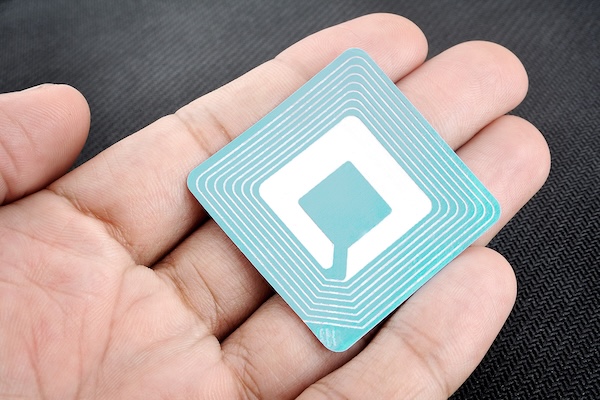
RFID (Radio Frequency Identification) is a wireless communication technology that uses electromagnetic fields to automatically identify and track tags attached to objects. An RFID tag contains a microchip and antenna that communicates with a reader using radio waves.
These tags can be:
- Passive tags (no internal power source)
- Active tags (battery-powered, extended range)
- Semi-passive tags (battery powers the chip, communication still reader-driven)
Active tags can transmit signals over 100 feet (30+ meters), while passive tags rely entirely on the reader’s energy.
RFID systems typically consist of three components:
- RFID tags attached to assets, pallets, tools, or products
- RFID readers (fixed or handheld devices)
- Backend software systems that process and interpret the data
Tags may be read-only, read-write, or WORM (write once, read many). They typically store a unique identifier, serial number, or EPC (Electronic Product Code).
In industrial environments, RFID is not just about identification. It is about continuous visibility. Systems like RFID work-in-process tracking allow manufacturers to monitor production stages in real time, reducing bottlenecks and improving throughput.
RFID also:
- Identifies items without line-of-sight
- Reads through packaging and non-metal materials
- Scans multiple items simultaneously
RFID operates across three main frequency bands:
- Low Frequency (LF)
- High Frequency (HF)
- Ultra High Frequency (UHF)
UHF is the most widely used in supply chain and warehouse operations due to its longer read range and ability to scan multiple tags simultaneously.
Common applications include inventory tracking, access control, and industrial asset monitoring. Deployments often begin with planning services like RFID site assessment.
What Is NFC?
NFC (Near Field Communication) is a subset of high-frequency RFID technology designed for extremely short-range communication, typically within 4 centimeters or less. It is widely used in smartphones and consumer devices for secure, close-range data exchange.
It enables secure, interactive exchanges between devices, most commonly between a smartphone and another NFC-enabled object.
Unlike most RFID implementations, NFC is inherently bidirectional. Two NFC-enabled devices can both send and receive data, which makes it useful for:
- Mobile payments
- Access control systems
- Identity verification
- Device pairing
Where RFID is built for scale and automation, NFC is built for intentional interaction. The user must actively bring devices into very close proximity, which adds a layer of security and control.
RFID vs NFC: Core Technical Differences
While RFID and NFC share underlying radio frequency principles, their implementation differs significantly.
1. Range
RFID systems can operate from a few centimeters to over 10 meters depending on configuration. NFC is limited to under 4 cm.
2. Communication Type
RFID is generally one-way communication from tag to reader. NFC supports two-way communication.
3. Use Case Design
RFID is optimized for bulk scanning and automation. NFC is optimized for secure, intentional interactions.
4. Data Capacity
RFID relies heavily on backend systems for full context, though tags may store identifiers such as EPC codes. NFC stores smaller amounts of directly accessible data.
5. Power Source
Passive RFID uses energy from the reader, active RFID uses batteries, and NFC is passive but only activates at extremely close range.
RFID in Industrial and Manufacturing Systems
RFID is a foundational technology in modern manufacturing because it enables real-time tracking of inventory, components, and work-in-process while reducing manual scanning.
With RFID inventory management, organizations eliminate blind spots and improve accuracy across warehouse operations.
RFID is also widely used for asset tracking through RFID asset management, helping organizations reduce loss, downtime, and inefficiency.
In production environments, RFID work-in-process tracking enables real-time visibility into manufacturing flow, improving throughput and reducing bottlenecks.
Advanced deployments often include geofencing capabilities through RFID geofencing, enabling alerts when assets move across defined zones.
Industry deployments are typically supported through RFID consulting to ensure proper architecture, scalability, and data integrity.
NFC in Consumer and Enterprise Use Cases
NFC is widely used in consumer environments because it is simple, secure, and built into most modern smartphones.
Common applications include:
- Contactless payments
- Access control badges
- Mobile device pairing
- Identity verification systems
A familiar example is tap-based transit fare systems used on buses, trains, and subways.
Because NFC requires intentional proximity, it significantly reduces accidental or unauthorized reads.
Security Differences
RFID security varies depending on implementation and frequency type. Some systems include encryption, while others rely on backend security controls.
Because some RFID systems can be read from several meters away, privacy concerns have been raised around unauthorized scanning and tracking risks.
NFC is generally more secure by design due to its extremely short range and intentional interaction model.
In enterprise environments, RFID security is typically enforced through platforms like RFID hardware systems and integrated software controls.
System Integration and Data Flow
RFID systems integrate deeply into enterprise infrastructure, feeding real-time data into ERP, MES, and warehouse management systems.
NFC systems typically connect to mobile applications or localized authentication platforms and handle smaller transactional data flows.
In complex deployments, RFID consulting helps ensure system architecture is optimized for scale and reliability.
For broader context and documentation, organizations often reference FactorySense resources.
When to Use RFID vs NFC
Use RFID when you need:
- Large-scale inventory tracking
- Automated warehouse visibility
- Real-time operational intelligence
- Multi-item scanning at distance
Use NFC when you need:
- Secure authentication
- Contactless payments
- Device pairing
- Intentional user interactions
The Future: Coexistence, Not Competition

RFID and NFC are increasingly part of layered digital ecosystems. RFID handles system-wide visibility, while NFC handles secure user interaction at the edge.
Platforms like FactorySense demonstrate how RFID systems are evolving into full operational intelligence layers, supported by tools such as RFID site assessment and broader RFID solutions.
As manufacturing becomes more AI-driven, RFID will continue to serve as the backbone for real-time data, while NFC will remain essential for secure human-device interaction.
Conclusion
RFID and NFC are often confused, but they solve different problems. RFID is about scale, automation, and operational visibility. NFC is about proximity, security, and user interaction.
Together, they form complementary layers of modern connected systems, especially in manufacturing, logistics, and supply chain environments where both efficiency and security matter.
Frequently Asked Questions (FAQs)
What are passive RFID tags and how do they work?
Passive RFID tags do not have their own power source. They are powered by the electromagnetic field generated by an RFID reader, which activates the chip and allows it to transmit data. They are commonly used for inventory tracking and asset management due to low cost and long lifespan.
How does an NFC tag differ from a passive RFID tag?
An NFC tag is a specialized type of high-frequency passive RFID tag (13.56 MHz) designed for very short-range communication. It supports secure, user-initiated interactions such as payments or pairing. RFID tags, by contrast, are typically optimized for automated scanning and tracking at longer distances.
What is RFID tracking and where is it commonly used?
RFID tracking refers to automatically identifying and monitoring the location and status of tagged items. It is widely used in manufacturing, logistics, retail inventory, and transportation to improve visibility and reduce manual processes.
Can NFC-enabled phones read RFID tags?
Some NFC-enabled phones can read certain high-frequency RFID tags operating at 13.56 MHz. However, they cannot read most UHF RFID systems used in industrial tracking. NFC phones are primarily designed for secure close-range interactions rather than large-scale asset tracking.