From Complexity to Control: Optimizing Supply Chains with Real-Time RFID Data


- RFID tracking gives real-time visibility into supply chain operations by continuously capturing the movement of materials, inventory and assets.
- Real-time data surfaces bottlenecks and inventory problems as they form, rather than after they hit performance.
- Integrated with ERP and MES, RFID becomes a live operational data layer underneath decisions currently made on stale numbers.
Complexity is now built into modern supply chains
Modern supply chains function as interconnected networks of suppliers, production facilities, warehouses and distribution channels. Materials are constantly in motion, inventory changes throughout the day, and production schedules shift based on demand, capacity and upstream disruptions.
Most manufacturers do not struggle because they lack systems. They struggle because those systems are not synchronized with real-time operations. ERP platforms reflect delayed updates. Warehouse systems capture only local movement. Production teams rely on manual reporting. Logistics data often arrives after the physical movement has already happened.
When systems do not reflect reality in real time, decision-making becomes reactive. Problems are discovered after they have already hit production, inventory or delivery performance. The common outcomes are inventory inaccuracy, production delays caused by missing materials, excess safety stock, and coordination breakdowns between production, warehouse and logistics teams.
What we find when we walk a plant
Before any deployment we run a facility survey: we walk the floor or the yard with the operations team, trace how material actually moves, and compare that against what the systems of record believe is happening. We have done this across aerospace, defense, medical device and laydown yard environments, and the same pattern turns up almost every time.
Nobody lacks systems. There is an ERP, usually a good one, often a warehouse system and sometimes an MES. What is missing is a reliable connection between the physical event and the system record, and in its place sits a person with a clipboard, a spreadsheet or a scanner, updating things later.
The question that ends the debate is rarely technical. It is asking a plant manager to tell us, right now, where a specific work order is. The answer usually involves walking somewhere to look.
The second thing we find is that people already know where the gaps are. Ask the team which areas of the plant they do not trust the numbers for and they will name them immediately: the staging area, the tool crib, the outdoor yard, anything that moves between buildings. Those answers are consistent enough across sites to be predictive, and they are usually where a deployment should start.
The third is that the cost of the gap is being paid already, just not in a line item anyone tracks. It shows up as safety stock held against an inventory number nobody believes, as expediting, as searching, and as production waiting on material that is somewhere on site.
Why real-time RFID data changes supply chain performance
Supply chain optimization depends on one core capability: understanding what is happening as it happens. Without real-time data, organizations operate in hindsight. They analyze disruptions after they occur, which limits their ability to prevent the next one.
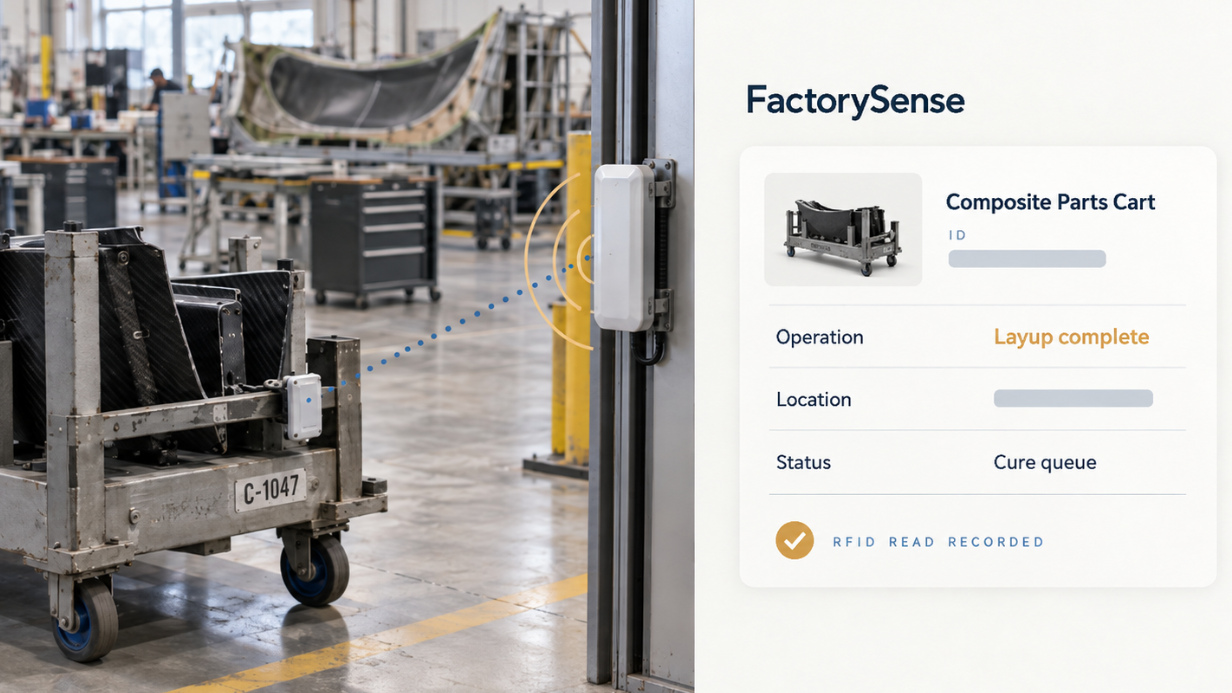
RFID tags and readers automatically read items as they move through the facility, creating a live operational data stream that reflects actual conditions on the ground. Instead of periodic updates, teams get continuous visibility, and decision-making shifts from reactive to proactive.
Real-time bottleneck detection and flow control
Bottlenecks rarely appear suddenly. They develop gradually as small delays accumulate across multiple stages of the operation, and without real-time visibility they stay hidden until they begin to affect throughput or delivery performance.
RFID makes those constraints visible as they form. When work in process slows at a workstation, the system reflects it immediately. When receiving delays occur, the upstream impact becomes visible before it reaches the line. When staging areas congest, the buildup is detectable in real time rather than discovered at shift change.
That changes what a supervisor can actually do. Labor can be rebalanced while work in process is still accumulating. Procurement can investigate a supply delay the day it appears. Warehouse flow can be adjusted while the congestion is still a minor inconvenience.
Inventory accuracy is the financial argument
Inventory accuracy is where operations meets finance, which is usually where an RFID business case is won or lost. It drives production continuity, fulfillment speed and working capital efficiency at the same time. In most environments it degrades for two mundane reasons: updates are manual, and system synchronization lags physical movement.
Continuous capture removes both. Every movement is recorded without a person scanning anything, which produces a continuously updated view of inventory across all locations rather than a snapshot that was accurate at the last cycle count. The downstream effects are the ones a CFO recognizes: fewer stockouts, lower safety stock, and less capital tied up hedging against a number nobody trusts.
What changes in a defense or aerospace environment
In regulated manufacturing the visibility argument acquires a compliance dimension. Traceability obligations under DFARS and export control obligations under ITAR both assume an organization can demonstrate, after the fact, where a controlled item was and who handled it. Tool accountability carries a similar burden in AS9100 environments, where a calibrated tool outside its calibration window is a finding rather than an inconvenience.
A system built for throughput can usually be made to answer a compliance question. A system built for compliance can rarely be made fast. The distinction matters when scoping, because the read points an auditor needs are not always the read points an operations manager needs, and retrofitting one onto the other is how deployments overrun.
The role of standards in tagging decisions
Buyers evaluating RFID for the first time often assume they are choosing a proprietary technology. They are not. Passive UHF RFID runs on the EPC Gen2 air interface, standardized internationally as ISO/IEC 18000-63, and the body maintaining the wider automatic identification standards landscape is AIM Global.
That settled air interface is only half the question. What actually gets written to the tag is governed by a separate layer, and it is where most of the real decisions sit. As our printing partner TSC sets out in its guide to standards-based RFID printing and encoding, two industry-standard numbering systems are in use, GS1 and ISO/IEC. The two organizations cooperated far enough to reserve a single distinguishing bit, the T-bit: set to 0 the tag is encoded to GS1, set to 1 it is encoded to ISO/IEC.
An RFID chip holds very little data, typically 96, 128 or 256 bits, which is 12, 16 or 32 characters. Organizations with different information to carry in that space have historically invented their own way of packing it.
RFID has been commercially available for around forty years, and for much of that period no standard dictated how data was written. Early adopters built their own schemes and produced tags only their own software could read. Inside a vertically integrated operation that worked. It stops working the moment a pallet arrives from a supplier encoding to a scheme you have never seen, which is precisely the situation supplier-level tagging is supposed to solve.
The practical advice from TSC is blunt and we agree with it: use standards-based encodings and resist the temptation to invent your own. The saving from packing a few extra characters into the chip is never worth becoming the only party who can read your own inventory.
Three things follow for anyone scoping a deployment. Encoding happens at print time, so the label printer is a data system rather than a peripheral and belongs in the integration conversation early. Serialization needs deciding before the first roll is printed, because retrofitting unique identity onto a tagged population means retagging it. And encoding should be validated rather than assumed, through read-after-write verification at the printer, so a bad tag is caught where it is created rather than where something downstream fails to find an item the system insists exists.
Strengthening ERP and MES alignment
ERP and MES systems depend on accurate and timely data. When the input is delayed or incomplete, the output loses reliability no matter how good the system is.
RFID can supply timely operational events from the physical environment when the relevant movements pass through designed read points. Production progress, inventory location and work-order movement can then be updated closer to the moment they occur, rather than waiting for a later manual transaction. That reduces the gap between planned operations and actual execution, which is the gap most digital transformation programs are actually trying to close.
Visibility gets harder when the item leaves your building
Several of the articles being consolidated into this page focused on end-to-end visibility, and there is one point worth preserving: the data problem becomes harder when a shipment crosses organizational boundaries. A tag may be encoded correctly at the manufacturer and still become useless downstream if partners do not share identifiers, event semantics or a reliable way to exchange visibility data.
This is where standards matter more than proprietary dashboards. GS1 EPCIS provides a common model for sharing visibility events across systems and organizations, while the EPC UHF Gen2 air-interface standard helps ensure compatible passive UHF readers and tags can communicate. Neither standard creates end-to-end visibility by itself. Trading partners still have to agree on identity, event meaning, data access and which handoffs are actually instrumented.
That distinction is important because passive RFID should not be described as continuous shipment tracking. It produces observations where reader infrastructure exists. For many supply chains, a trustworthy sequence of receiving, staging, shipping and arrival events is enough to narrow uncertainty dramatically without pretending every pallet is continuously located between those points.
Questions worth asking before you scope
The questions that separate a deployment that lands from one that stalls are rarely about the tags. They are about the environment and the integration. How does the system behave around metal, liquids, composites and outdoor yards, where physics rather than software sets the limits? Which system of record does the data land in, and does a read become a transaction in the ERP or a line in a separate dashboard nobody opens?
Then the operational ones. Who installs it, who supports it when a reader fails on second shift, and what does the hardware footprint look like on a floor that is already crowded? Finally, and most usefully, what does the pilot involve, how long does it take, and what specifically will it have proved when it finishes?
From complexity to control
Supply chains will always be complex. The objective is not to remove complexity but to control it, and control requires seeing the operation as it actually is rather than as it was at the last count.
RFID provides that visibility by continuously capturing movement across materials, inventory and workflows, turning fragmented systems into a single operational data layer. Integrated with ERP and MES, it becomes the foundation the rest of a digital transformation program stands on.
How does RFID improve supply chain optimization?
RFID provides real-time visibility into material and inventory movement, so teams identify inefficiencies earlier and adjust against current conditions rather than last week's report.
Can RFID reduce supply chain bottlenecks?
Yes. RFID enables early detection of bottlenecks by tracking work in process and material flow in real time, allowing intervention before delays escalate into disruptions.
Does RFID integrate with ERP systems?
Yes. RFID integrates with ERP and MES platforms to provide real-time operational data, improving inventory accuracy and alignment between physical operations and digital systems.
Schedule a complementary working session with an RFID professional to discuss your floor or yard, your systems of record, and where the visibility gap between them is costing you.
Book a session