How RFID Powers Modern Factory Operations: FactorySense and TSC Printers in Action


- Encoding errors propagate. A misprogrammed tag can link to the wrong item or fail to read, and everything downstream inherits that error.
- Read-after-write verification catches a failed encode at the printer, before the label enters production.
- Printing and software solve different parts of the same traceability problem: the printer creates and verifies the tag identity, while the software associates it with the correct item and interprets the reads that follow.
In a connected factory, every item carries an identity, and that identity is written at the moment a label is printed. When encoding is done well nobody thinks about it again. When it is done badly it surfaces weeks later as a traceability gap, a mis-picked order or an audit discrepancy, and the cause is rarely obvious by then.
This article looks at what encoding actually involves and how TSC printers and FactorySense fit together on the plant floor. It is the first in a series written with our printing partner TSC. The second, covering standards and tag validation in detail, is the importance of standards in RFID printing and encoding.
Why encoding is the foundation
Encoding writes digital data to a tag's microchip, creating an identity a reader can resolve without a person or a line of sight. Each encoded tag becomes a durable identifier that follows the item through production.
Compared with a barcode, an RFID tag holds more structured data, can be read without line of sight, and can be read alongside hundreds of others at once. Those three differences are what make automatic capture possible rather than merely faster scanning.
From label to identity
Printing an RFID label is a coordinated process rather than a print job. In a typical configuration it runs in five steps.
- Label design. A layout is created containing the printed elements and the RFID data fields.
- Data input. Item-level data is pulled from the ERP or from FactorySense.
- Encoding. The printer programs the chip with a unique EPC or serialized value.
- Verification. The printer's internal reader reads the tag back to confirm the encode succeeded.
- Activation. The verified identity is registered so the tag can be tracked across readers and zones.
Each label leaves the printer as both a physical identifier and a record in a system, which is the point at which the physical and digital versions of an item are bound together.
Why accuracy at this step is worth the attention
A single encoding error propagates. A misprogrammed tag either links to the wrong item or fails to read, and in a high-volume environment neither is discovered where it happened. It surfaces as a delay, a discrepancy or a compliance question somewhere downstream.
Getting it right protects three things: data integrity across ERP, MES and warehouse systems, automation that depends on the identity being correct, and traceability for recalls, warranty and regulatory reporting.
What the printer contributes
The printer handles the physical part of the identity-creation process, and the useful features are the ones that prevent a bad label from entering production.
- Inline UHF encoding writes the EPC or other identifier as the label is printed.
- Read-after-write verification checks the tag immediately and rejects a failed encode at the printer rather than farther downstream.
- Encoding calibration matters because the inlay is not always in the same position from one label construction to another. The printer has to energize the intended tag without programming the one beside it.
- Media handling has to match the actual label construction, including synthetic and thicker on-metal materials.
- Remote management becomes important once printers are distributed across a plant or multiple sites, because encode settings need to stay consistent.
The practical question is not simply whether a printer supports RFID. It is whether it can reliably encode the specific inlay and media you intend to run, at production speed, and verify the result before the label leaves the machine.
What the software contributes
The printer produces a correct tag. FactorySense keeps that tag meaningful for the rest of its life.
- Tag registration, recording each identity as it is created.
- Data synchronization, so the ERP or MES holds the same identity as the floor.
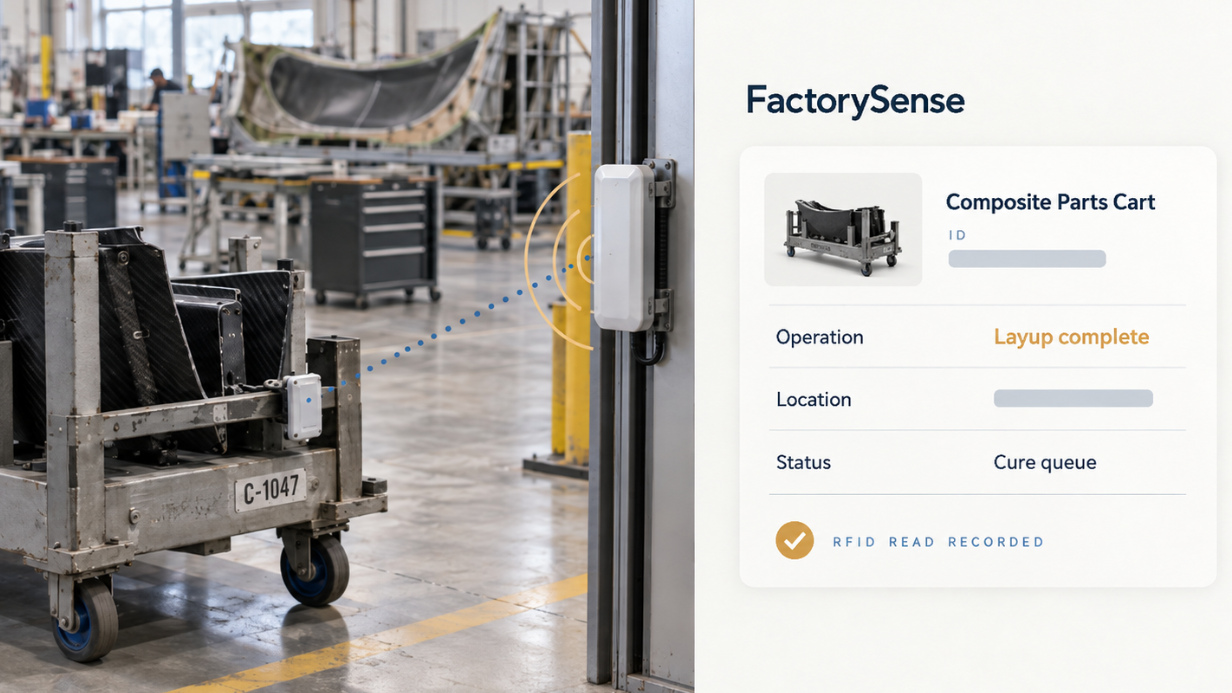
- Event tracking, collecting reads from fixed and handheld readers and mapping movement and dwell time.
- Reporting on flow, bottlenecks and utilization.
How the loop closes
In a typical plant the sequence runs: the ERP or MES generates a work order; FactorySense generates an identity for each item; the print job is formatted and sent to a TSC printer; the printer encodes, verifies and prints; the verification result returns to FactorySense; the tag is activated and tracked as it moves through the facility.
The printer's job is to encode the intended identity and verify that the tag can be read before it enters the process. From there, the software has to associate that identity with the correct item, carry it into the ERP or MES, and make sense of the reads that follow as the item moves.
A failure at either point breaks traceability. A correctly encoded tag that is registered against the wrong work order is still wrong, just in a different system.
Scoping a first deployment
Start with one production line or cell rather than a facility. Match the tag media to the read distance you actually need; UHF for warehouse-scale reads, short-range technologies where proximity is the point. Verify read zones around conveyors, racks and exits rather than assuming coverage. And agree what you will measure before you begin: encode success rate, read rate in position, and whether the identity arrives correctly in the system of record.
A controlled first phase with a measurable result is a better basis for a wider rollout than a broad trial that proves the technology works in general.
The next step
Tag media, printer configuration and encoding strategy depend on what is being tagged and where it has to be read. Book a technical briefing and we will work through those choices against your environment.
What is RFID encoding and why does it matter?
Encoding writes data to the tag's microchip, creating an identity that readers can resolve automatically. It matters because everything downstream depends on it. If the identity is wrong or unreadable, the visibility built on top of it is wrong too.
Where does the printer end and the software begin?
The printer writes and verifies the tag. The software registers the identity, synchronizes it with the systems of record, and collects read events from fixed and handheld readers as the item moves. Neither half is useful without the other.
How should a first deployment be scoped?
One production line or cell, with the tag media matched to the read distance you actually need, the read zones around conveyors, racks and exits verified, and a measurable result agreed in advance. Scope it to answer one question rather than to demonstrate the technology.
Schedule a complementary working session with an RFID professional to discuss your floor or yard, your systems of record, and where the visibility gap between them is costing you.
Book a session