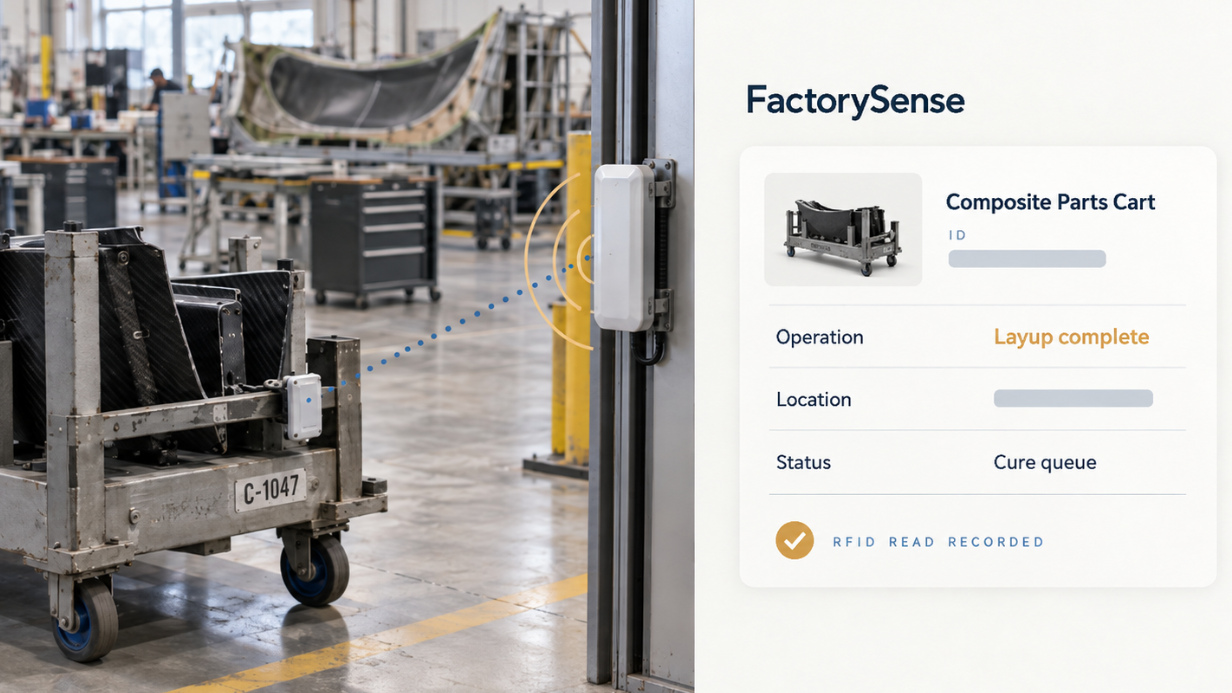
Understanding How RFID Works Without Power: A Simple Guide

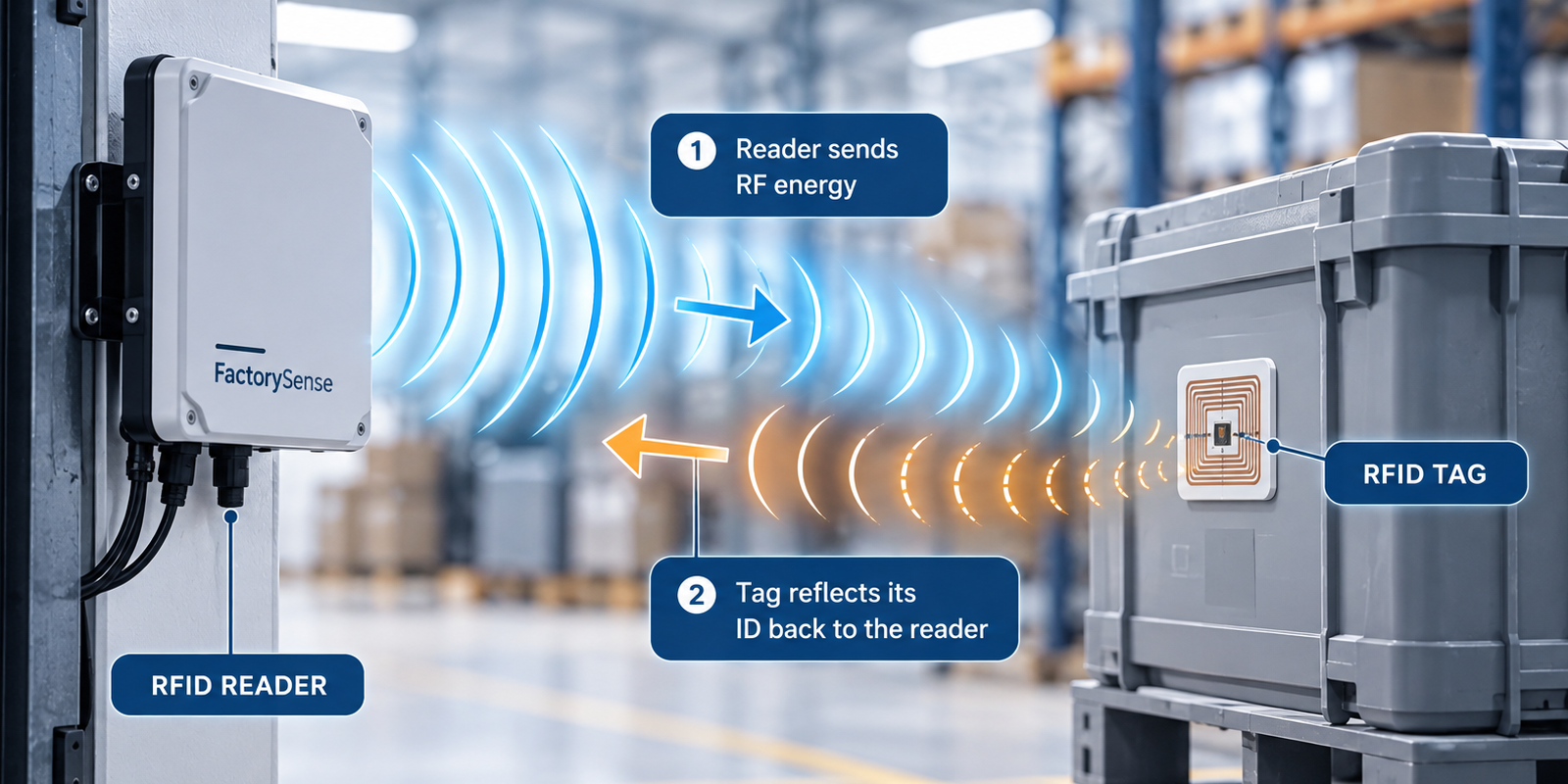
- A passive RFID tag is battery-free, not power-free: it takes operating energy from the reader for the brief period in which it communicates.
- LF and HF RFID commonly use near-field magnetic coupling; passive UHF or RAIN RFID typically harvests RF energy and returns data through backscatter.
- Real-world read range depends on the complete forward and return link, including reader power, tag sensitivity, orientation and surrounding materials.
A passive RFID tag has no battery, but it is not literally powerless. It borrows energy from the RFID reader for the fraction of a second it needs to wake up, process a command and respond.
That is the useful answer to the question. The more interesting part is how it happens, because the mechanism is different depending on the frequency. Low-frequency and high-frequency RFID commonly use near-field magnetic coupling. Passive UHF RFID, including RAIN RFID, operates differently: the tag harvests energy from the reader's radio signal and returns data by backscattering that same signal. The distinction matters because most industrial asset, inventory and work-in-process systems use passive UHF.
What is inside a passive RFID tag?
A basic passive RFID tag has two electronic parts: an antenna and an integrated circuit, usually called the tag chip. They are mounted together as an inlay, which can then be converted into a paper label, placed on foam for use near metal, or enclosed in a more durable housing.
The antenna has two jobs. It captures energy from the reader, and it provides the path by which the tag communicates back. The chip uses that harvested energy to run its logic and access its memory, which typically holds an identifier and may also contain additional user data depending on the tag.
There is no battery to recharge or replace. When the reader's field is removed, the tag stops operating until it is energized again.
How passive UHF RFID gets power
In the passive UHF systems used for much of manufacturing, logistics and asset tracking, a reader sends a continuous radio-frequency signal through its antenna. A tag inside the read zone receives a tiny amount of that RF energy through its own antenna. The tag chip rectifies the incoming RF signal into DC power and stores enough energy internally to operate for the exchange.
That available power is extremely small, which is one reason tag and antenna design matter so much. If the tag cannot harvest enough energy to cross its operating threshold, it never wakes up and there is no response to receive.
This is also why "read range" is not a fixed property of the tag alone. Reader power, reader-antenna gain, tag orientation, tag sensitivity, surrounding materials and the return path all contribute to whether the complete link works.
How a tag sends data back without a transmitter
Once the chip is powered, a passive UHF tag does not generate a conventional radio transmission of its own. Instead, it changes the electrical load on its antenna in a controlled pattern. That changes how much of the reader's signal is reflected back toward the reader.
The reader detects those changes in the reflected signal and decodes them as data. This is backscatter communication.
The RAIN RFID Alliance describes this as passive backscatter: the reader talks first, the tag receives energy and information from the reader's radio signal, and the tag replies by modulating its antenna reflectivity. GS1's architecture describes the same basic mechanism for passive UHF Gen2 systems. The current GS1 UHF Gen2 air-interface standard is closely aligned with ISO/IEC 18000-63.
For an industrial system, that exchange may take place many times while a tagged item remains in the read zone. The reader software then has to reduce those repeated observations into a useful event. Our guide to RFID integration and middleware explains what happens after the radio layer.
LF and HF passive RFID use a different coupling mechanism
The phrase "RFID without power" covers more than one radio technology. Low-frequency RFID and much of high-frequency RFID, including NFC, normally operate in the near field. The reader creates a changing magnetic field, and the tag couples to that field in a way that is often compared to a very loosely coupled transformer.
Passive UHF RFID is generally a far-field system. The tag is harvesting energy from an electromagnetic wave and returning data by backscatter. Calling all passive RFID "inductive coupling" blurs this difference and can lead to bad assumptions about read distance, antenna design and behavior around materials.
If you are comparing these technologies for a project, our RFID versus NFC guide covers the practical differences between short-range HF/NFC and UHF RFID.
Why passive UHF tags can be read from meters away
The tag does not need enough energy to run a battery-powered radio. It only needs enough to operate a very low-power chip and change the reflection from its antenna. That is what makes multi-meter passive reads possible with no onboard power source.
But the return signal is weak. A successful read depends on both directions of the link: enough energy has to reach the tag to power it, and enough backscattered energy has to return to the reader to be detected. The RAIN RFID Alliance's system-design guidance treats these as the forward and return links, and whichever one is weaker limits the practical read range.
This is why a tag advertised for a long read distance may perform very differently when it is attached to the actual item.
Metal, liquids and orientation change the answer
Passive RFID depends on the antenna behaving as designed. Attach the same inlay directly to metal and the antenna may detune badly. Put it against a water-filled container and RF energy may be absorbed. Rotate a linearly polarized tag relative to a linearly polarized reader antenna and the available energy can fall sharply.
Those effects are not edge cases in manufacturing; they are normal design inputs. On-metal tags use constructions that separate or tune the antenna for the surface. Tags for liquid-heavy products are selected and positioned differently. Reader antennas are placed and polarized for the movement being observed.
This is why we test tags on the real object and in the real read position during a pre-installation survey. A tag that performs well in free air tells you very little about how it will behave on a metal fixture, inside a dense tote or beside a liquid container.
What "battery-free" buys you
Removing the battery changes the economics and maintenance burden of the system. Passive tags can be small, inexpensive and deployed in very large numbers. There is no battery-replacement program, and a tag can remain usable for years if the chip, antenna and attachment survive the environment.
The tradeoff is that the reader infrastructure does more of the work. Passive tags do not continuously announce their location. They become visible when they enter a read zone or when someone deliberately searches for them with a handheld reader.
That distinction is why passive RFID is particularly good at questions such as "did this work order leave this cell?", "which tools are in this crib?", or "which pallets passed receiving?" For continuous wide-area location, an active technology may be a better fit.
What happens after the tag responds
The radio exchange only gives the reader an identifier. The business value appears when software connects that identifier to the right asset, item, work order or container and interprets the read in context.
A fixed reader at a production boundary can turn a passive response into a work-in-process event. A dock-door read can update receiving. A handheld can use repeated responses to guide an operator toward a missing item. Our asset-tracking guide and WIP guide show how those patterns differ in practice.
The simple version
A passive RFID tag works without a battery because the reader supplies the energy. In LF and HF systems that commonly happens through near-field coupling. In passive UHF systems, the tag harvests energy from the reader's radio wave and answers by backscattering it.
The elegance of the technology is that the tag can be almost inert until it is needed. The engineering challenge is making sure enough energy reaches the tag, enough of the response reaches the reader, and the system knows what to do with the read once it has it.
How can an RFID tag work with no battery?
The reader supplies the energy. A passive tag captures part of the reader's field, converts it into electrical power and uses that power to operate its chip long enough to respond.
Does a passive UHF RFID tag transmit a radio signal?
Not in the conventional sense. It changes how its antenna reflects the reader's signal. The reader detects those changes and decodes them as data, a process called backscatter.
Why does metal affect passive RFID?
Metal changes the electromagnetic environment around the tag and can detune a conventional antenna. On-metal tags use constructions designed to operate correctly when mounted on conductive surfaces.
Schedule a complementary working session with an RFID professional to discuss your floor or yard, your systems of record, and where the visibility gap between them is costing you.
Book a session