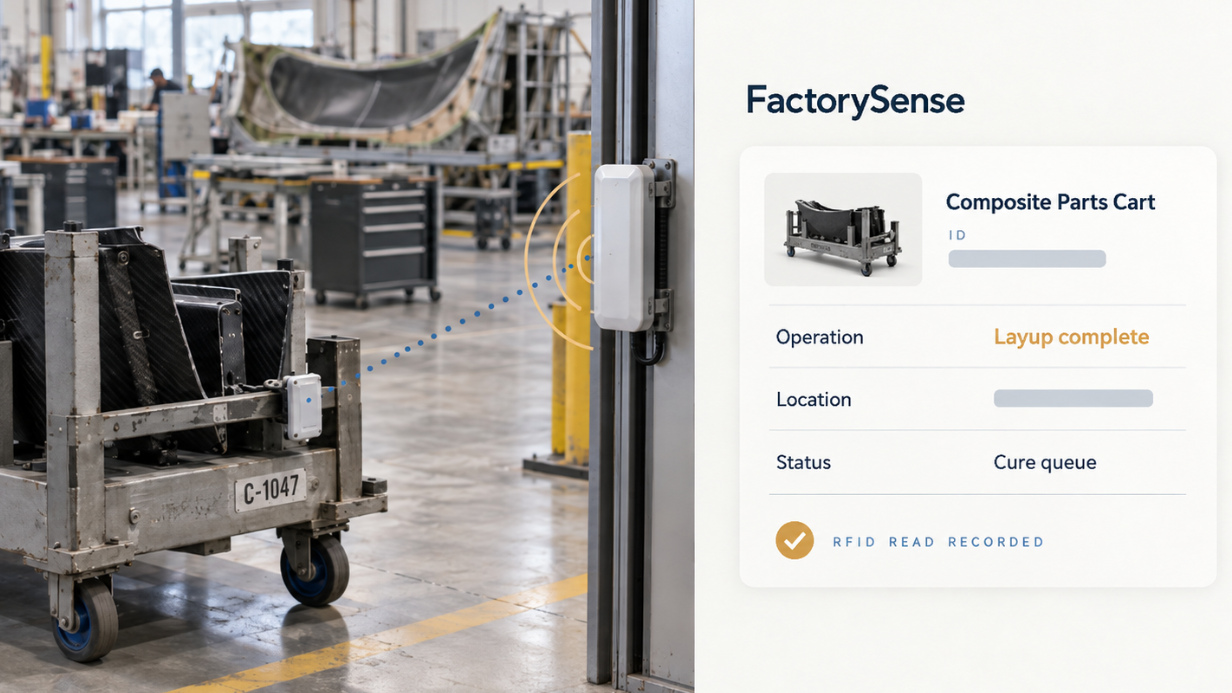
NFC vs RFID: What’s the Difference?

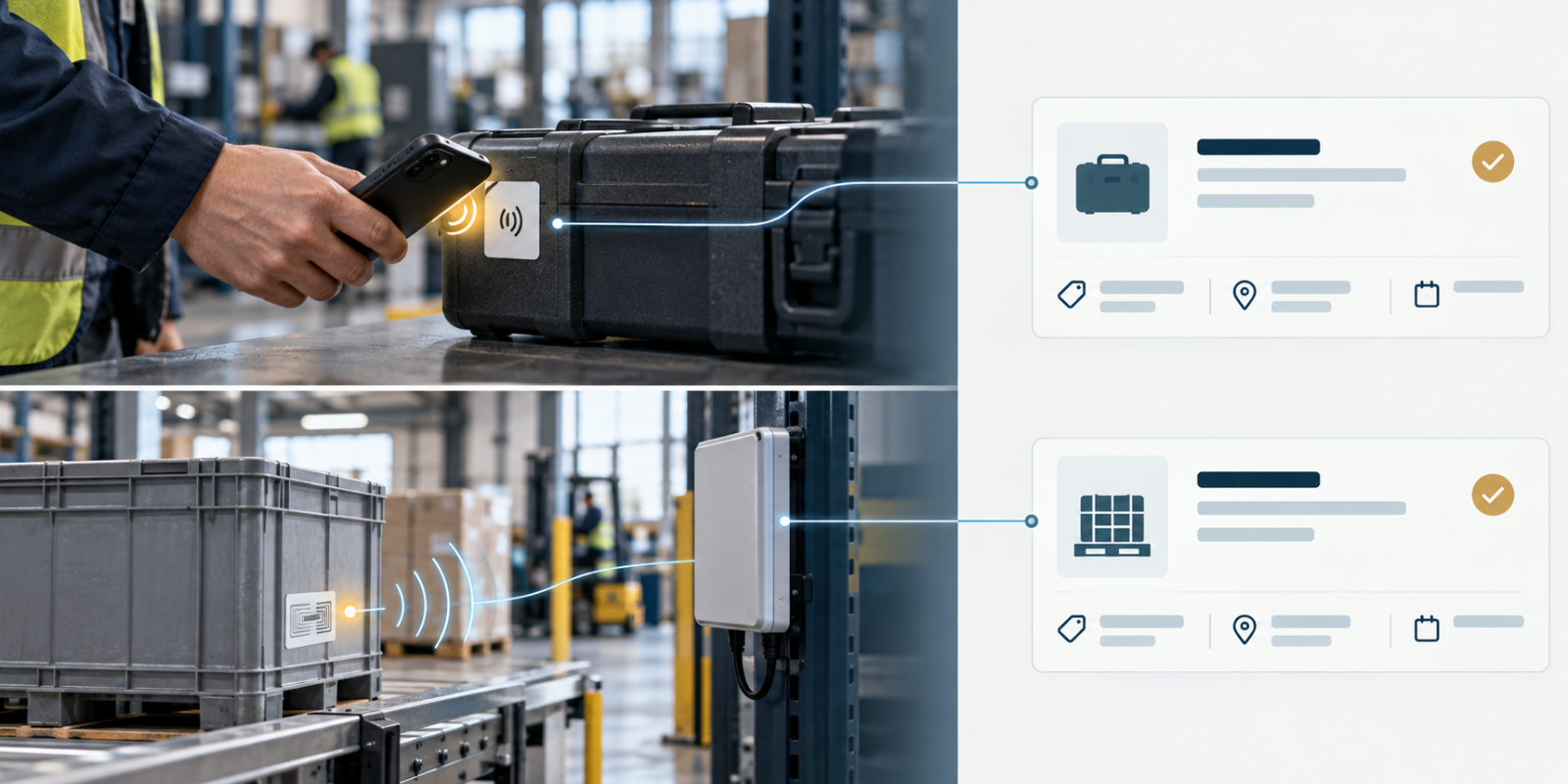
- NFC is designed around a deliberate close-range tap, while industrial passive UHF RFID is commonly used for automatic identification at controlled read points.
- Smartphone support makes NFC useful for user-initiated equipment and product interactions; UHF RFID generally requires dedicated reader infrastructure.
- Choose the technology from the event the process needs rather than from range alone.
NFC and RFID are related technologies, but they are designed around different interactions. NFC is built around a deliberate tap or very close-range exchange, primarily intended for payments and other secure close-range transactions. Industrial RFID is usually built around identifying tagged objects automatically as they move through a process or location.
That difference matters more than the fact that both use radio. A smartphone reading an NFC tag on a machine is a user-initiated interaction. A passive UHF portal identifying a pallet as it crosses a dock door is an infrastructure event. They can both carry identity, but the process around that identity - and where each technology functions best - is very different.
NFC is a short-range RFID technology
Near Field Communication operates at 13.56 MHz and is designed for close-proximity communication. The NFC Forum describes NFC as a contactless technology centered on a tap, with certified connections designed for very short operating distances.
NFC supports several modes, including reading passive tags, card emulation and communication between compatible devices. Smartphones are a major reason it is so useful: many users already carry the reader.
That makes NFC attractive for interactions such as equipment identification, maintenance instructions, access, configuration, product information and other workflows where a person intentionally brings a phone or reader to the tag.
Industrial RFID usually means passive UHF
When manufacturers talk about RFID for inventory, WIP, asset tracking or warehouse automation, they are usually referring to passive UHF RFID. Those systems use fixed or handheld readers to identify tagged objects at greater distances than NFC and can inventory multiple tags during the same reader cycle.
Passive UHF is therefore better suited to automated movement capture. A pallet can be observed as it passes a portal, a set of tools can be audited with a handheld, or a WIP traveler can be identified at a production transition without requiring a person to tap each item.
Our guide to how passive RFID works without a battery explains the energy-harvesting and backscatter mechanism in more detail.
The useful distinction is intentional interaction versus automatic capture
NFC works well when proximity is part of the user experience. The person is supposed to tap the tag. That short range can be an advantage because it makes the user's intent clear.
Passive UHF RFID works well when the business wants the event to occur without asking someone to deliberately scan. The reader infrastructure observes tagged items as they move through a designed read zone.
Neither model is inherently better. They support different process designs.
Range is only one difference
It is tempting to reduce the comparison to “NFC is short range and RFID is long range,” but that misses several practical differences.
Reader ecosystem. NFC can often use a smartphone or tablet. Industrial UHF RFID normally uses dedicated fixed or handheld readers.
Interaction model. NFC is typically one deliberate interaction at a time. UHF RFID can identify several tags in the reader's field without direct line of sight.
Infrastructure. NFC frequently places the intelligence in the user's device and backend service. Automated UHF tracking usually requires installed readers, antennas and event-processing software.
Read-zone design. With NFC the short range naturally constrains the interaction. With UHF, antenna placement, power, surrounding materials and software filtering determine what a read means.
NFC can be useful in industrial environments
NFC should not be dismissed as a consumer-payment technology. The same tap-based interaction can be useful on industrial assets where a person needs to identify a specific object intentionally.
A technician might tap a machine to open its maintenance record, retrieve setup instructions, confirm an inspection point or access documentation. A reusable container could carry NFC for a close-range service interaction while UHF RFID on the same item supports automated movement tracking elsewhere.
This is another reason the technologies should not be treated as competitors. An object can carry more than one data carrier when the workflows justify it.
Security depends on the implementation
NFC's short operating range is useful because a transaction generally requires deliberate physical proximity, but short range should not be confused with automatic security. Authentication, encryption, credential storage and backend verification depend on the tag, device and application design.
The same is true for RFID more broadly. A basic identifier is not a security credential merely because it is carried over radio. When authentication matters, the system needs a credential and verification architecture designed for that purpose.
Choose based on the event you want to create
If an employee should intentionally identify one machine with a phone, NFC is often a natural fit. If hundreds of tagged items need to move through receiving without individual scans, passive UHF RFID is the more relevant architecture.
If the requirement is repeated zone-level presence across a broad area, neither may be the complete answer and an active RTLS technology may be more appropriate. Our RFID and RTLS architecture guide covers that decision.
The useful question is therefore not “NFC or RFID?” It is what interaction the process needs: a deliberate tap, an automatic read at a controlled point, an ad hoc handheld search or ongoing location presence. Once the event is clear, the technology choice becomes much easier.
Is NFC a type of RFID?
Yes. NFC is a short-range radio-frequency identification and communication technology operating at 13.56 MHz, but its tap-oriented interaction model differs from industrial passive UHF RFID.
Can a smartphone read industrial UHF RFID tags?
Most smartphones include NFC, not general-purpose UHF RFID readers. Industrial UHF tags normally require a dedicated handheld or fixed UHF reader.
Can one product use both NFC and UHF RFID?
Yes. Some products or assets use NFC for deliberate smartphone interactions and UHF RFID for automated inventory or movement capture.
Schedule a complementary working session with an RFID professional to discuss your floor or yard, your systems of record, and where the visibility gap between them is costing you.
Book a session