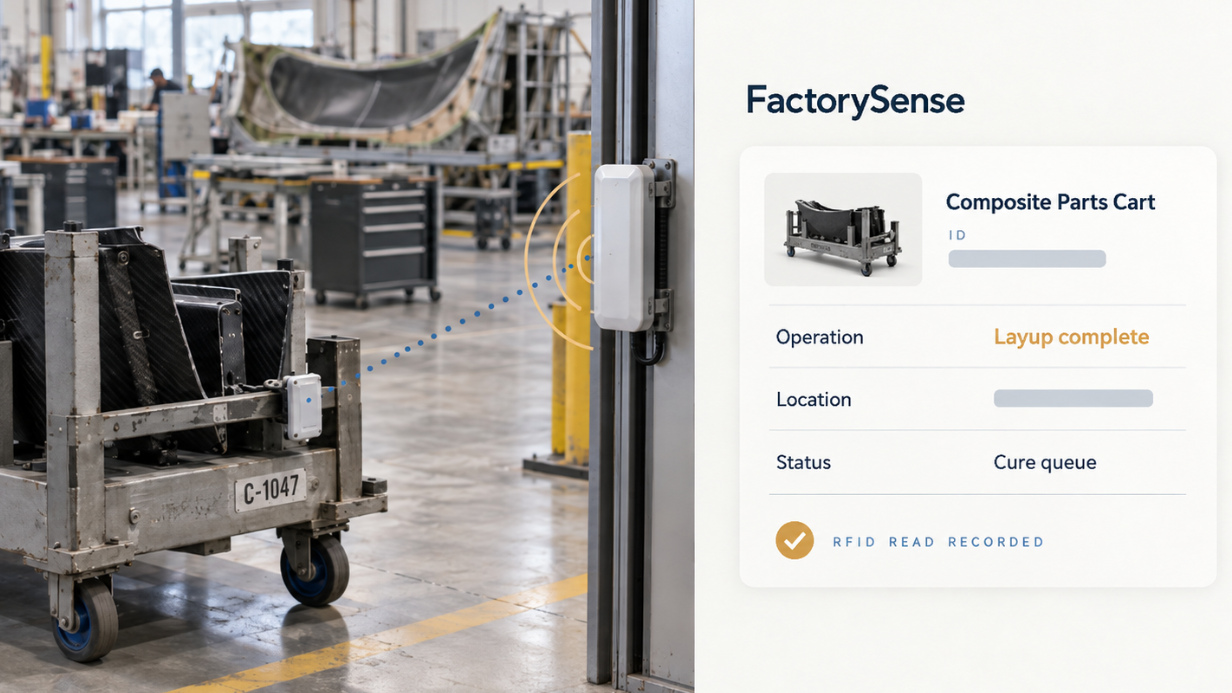
The Physical Data Gap: Why Digital Transformation Loses Touch With the Factory Floor


- Transaction data and physical-state data are related but not identical; digital systems become stale when physical events are not recorded reliably.
- RFID is one way to observe selected physical events automatically, but it does not replace master-data quality, governance or integration.
- As AI and automation scale, data lineage and event quality matter more because stale physical data can propagate into downstream decisions.
Manufacturers have spent heavily on ERP, MES, analytics, cloud platforms and increasingly AI. None of those systems can observe the factory floor on their own. They work from records created by transactions, sensors and people. When the record of the physical process is incomplete or late, the digital model begins to drift from what is actually happening.
That gap is easy to underestimate because the software may still look internally consistent. The ERP shows a pallet in receiving because no transfer was posted. The MES shows a job at machining because the operator moved the traveler without recording the handoff. An asset-management system says a tool is available because nobody checked it out. Each record may be technically valid as a database state and still be operationally wrong.
RFID can help close that gap where the missing information is a physical event that can be observed reliably: an item crossed a controlled point, entered a zone, left a crib, arrived at a process step or returned to inventory. It is not the only way to improve operational data, and it is not a substitute for sound master data, governance or system integration. It is one way to make selected parts of the physical process less dependent on someone remembering to create the digital record.
The data problem is broader than RFID
The current AI discussion makes this issue more visible because weak data foundations become harder to hide as software begins making recommendations or taking actions from enterprise data. McKinsey's 2026 work on AI data readiness reports that only 7% of companies have fully scaled AI across their organizations, while more than two-thirds of high-performing companies identify data as the primary obstacle to enabling AI. McKinsey's point is about enterprise data broadly, not RFID, but the underlying discipline applies on a factory floor: data needs to be reliable, traceable and reusable before downstream systems can be expected to trust it.
NIST's 2026 AI and machine-learning roadmap for smart manufacturing makes a similar point from an industrial perspective. It identifies effective data management, integration with heterogeneous sensing and control systems, and trustworthy operation as core challenges in manufacturing AI. Again, the problem starts before the model.
Transaction data and physical-state data are not the same thing
An ERP transaction says what the business recorded. A physical-state event says what was observed in the operation. Those two should usually agree, but the process that connects them is not automatic.
If a forklift moves a pallet from receiving to staging and the transfer is posted immediately, the transaction record is enough. If the pallet moves and the transaction is delayed, the ERP remains internally coherent but physically stale. A later AI model, planning routine or dashboard inherits that stale state unless another source corrects it.
That is why physical visibility should be treated as its own data layer. GS1 EPCIS formalizes a similar distinction by defining visibility-event data around what happened, when and where it happened, and the relevant business context. EPCIS is carrier-neutral; RFID is one way to generate those events.
Where RFID can close the gap
RFID is strongest where movement is frequent, the identity of the item matters, and relying on a person to scan every transition creates enough missed or delayed transactions to affect operations. Receiving, WIP transitions, tool cribs, warehouse staging, shipping and returnable containers are common examples.
The system still has to interpret the observation correctly. A reader seeing an EPC beside a doorway does not necessarily mean the item crossed the doorway. Software has to filter duplicate observations, associate the read with the correct physical context and decide whether the event is strong enough to update the system of record.
Our guide to integrating RFID with ERP, WMS and MES systems covers that event layer in more detail. The important point here is that the digital record should be created from an event with business meaning, not from raw reader noise.
The same gap appears in work-in-process
WIP is a good example because a manufacturing system may know what should happen next without knowing what physically happened last. A job can leave one operation and wait in a queue before the MES is updated. Another can be moved for rework outside the normal routing. A supervisor may know where it is from experience while the digital system remains behind.
RFID does not solve production control by itself. It can make selected transitions observable automatically so the digital process history is less dependent on retrospective entry. That history is valuable to operators first; only after it is trusted does it become useful for bottleneck analysis, scheduling models or AI.
Our WIP tracking article focuses on that operating problem rather than the broader data architecture.
Inventory and asset data have the same failure mode
Inventory accuracy deteriorates when receipts, transfers, consumption and returns are not reflected consistently. Asset records deteriorate when custody and location changes are not captured. The details differ, but the underlying problem is the same: the system record becomes an approximation of the physical world.
That does not mean every discrepancy justifies RFID. If barcode execution is disciplined and the process already produces trustworthy data at acceptable cost, adding RFID may have little value. The case becomes stronger where automatic identification can remove a recurring manual transaction or provide evidence that the current process cannot generate reliably.
For inventory specifically, our RFID inventory-management guide covers the operational tradeoffs and measurement approach.
The architecture should preserve lineage
As data moves from a reader into middleware, then into an ERP, data warehouse, digital twin or AI model, the organization should be able to trace what happened to it. Which reader observed the tag? Which event logic converted the observation into a movement? Which identity did the system resolve? Which transaction followed?
This becomes more important as automation increases. McKinsey's data-readiness work emphasizes lineage and traceability because AI systems increasingly recombine data across applications and workflows. On the shop floor, lineage is equally practical: when an operator disputes a location or an automated workflow behaves unexpectedly, the team needs to reconstruct the event chain rather than simply trust the latest database value.
AI raises the consequence of stale physical data
When a dashboard is wrong, a person may notice and correct it. When an AI agent or automated workflow acts from the same stale data, the error can propagate faster. That does not make AI inherently unsafe; it increases the importance of deciding which source is authoritative, how current the data needs to be, and what confidence is required before automation acts.
The AI/RFID relationship is covered directly in our article on how RFID data can improve AI-driven supply-chain decisions. The useful sequence is deliberate: establish trustworthy operational events first, use them in normal business systems, and add more advanced decision support where the use case justifies it.
How to evaluate a physical-data gap
A good starting question is not “Where could we put RFID?” It is “Which important decisions are being made from a system record we do not fully trust?” Then trace the uncertainty backward.
Sometimes the answer is master-data quality. Sometimes it is a broken integration. Sometimes operators are entering transactions late because the workflow is badly designed. Sometimes the business genuinely lacks a reliable way to observe movement, and RFID is a good fit. The technology should be selected after the failure mode is understood.
If the issue is physical visibility, define the event that would remove the uncertainty, how often it occurs, what level of location precision is required and what should happen when the observation disagrees with the expected process. That gives the team something concrete to pilot and measure.
Digital transformation becomes more credible when physical evidence improves
The strongest digital-transformation programs do not assume that more software automatically means more operational truth. They build a chain between physical events and digital records that can be inspected, measured and corrected.
RFID can be an important part of that chain in manufacturing because it makes selected events observable without depending on a manual scan. But the broader lesson is about data discipline. A digital twin, AI model or executive dashboard cannot be more current than the data flowing into it.
Before adding another analytical layer, it is worth asking whether the organization can already answer the basic physical questions with confidence: What is here? Where was it last observed? What process step did it reach? What moved, and when? If those answers are uncertain, closing that gap may create more value than adding another model on top of it.
What is the physical data gap in manufacturing?
It is the difference between what is physically happening in the operation and what digital systems currently record. The gap can come from delayed transactions, missed scans, incomplete integrations or events the business does not observe reliably.
Does RFID solve data-quality problems by itself?
No. RFID can improve selected physical-event data, but master data, identity resolution, event logic, integration, governance and process ownership still determine whether the resulting record is trustworthy.
Why does the data gap matter more as companies adopt AI?
AI and automated workflows can act on stale or incomplete data faster than a human dashboard user would. That increases the importance of knowing which data is authoritative, how current it is and how it was produced.
Schedule a complementary working session with an RFID professional to discuss your floor or yard, your systems of record, and where the visibility gap between them is costing you.
Book a session