
What's New in the RFID Industry?
What's New in the RFID Industry?
Article Key Points
- Enhanced RFID hardware includes more durable tags and smarter readers, enabling longer read ranges and better scanning accuracy.
- Advanced RFID software integrates cloud technology and AI-driven analytics for real-time data access, predictive insights, and improved security.
- RFID applications are expanding across industries, revolutionizing warehouse management, supply chain visibility, and manufacturing processes.
RFID Basics
Radio Frequency Identification, more commonly known as RFID, has long been a transformative technology across industries like warehousing, manufacturing, and supply chain management. From streamlining inventory tracking to enhancing production line visibility, RFID has become a critical tool for businesses aiming to improve efficiency and reduce errors. But like all technology, RFID continues to evolve. In this article, we explore what’s new in the RFID industry, examining hardware and software innovations, emerging applications, and the trends shaping the future of this powerful technology.
Understanding RFID Technology
Before diving into the latest developments, it’s important to understand the RFID basics. So, what does RFID stand for? RFID stands for Radio Frequency Identification, a technology that uses electromagnetic fields to automatically identify and track tags attached to objects. These tags can contain a variety of information, from unique identification numbers to detailed product data.
RFID systems typically include three main components:
- Tags: Small devices attached to items that contain electronically stored information. There are passive RFID tags, meaning they don’t have their own power source, or active RFID tags, which are battery-powered and can transmit signals over longer distances.
- Readers: Devices that send and receive radio signals to communicate with RFID tags.
- Software: Systems that process the data collected by readers, enabling businesses to monitor, analyze, and act on it in real time; like FactorySense.
RFID technology is highly versatile. While traditionally used for simple inventory counts, modern RFID systems can support complex tracking, monitoring, and even predictive analytics, making them invaluable for warehouses, manufacturing lines, and entire supply chains.
How Big is the RFID Market?
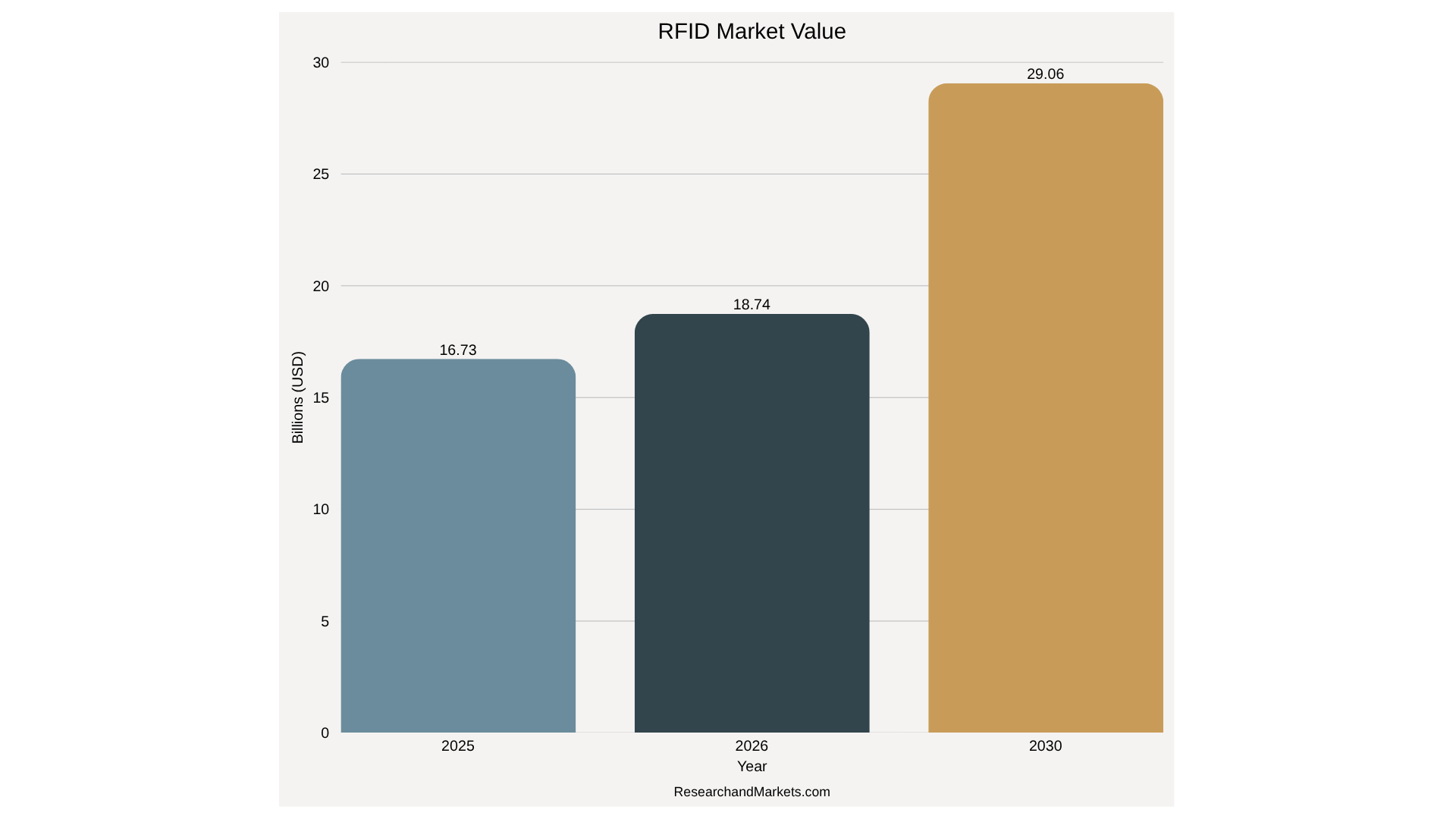
The RFID market is experiencing rapid expansion, driven by increasing adoption across various industries. In 2025 the RFID market value reached a total of 16.73 billion USD, with its projected value for 2026 increasing to almost 19 billion. As businesses recognize the value of RFID technology in improving inventory management, asset tracking, and supply chain visibility, demand for RFID systems continues to surge. This growth is further fueled by advancements in hardware, software, and integration capabilities, making RFID solutions more accessible and effective for organizations of all sizes. With all this considered, the RFID market is estimated to be worth over 29 billion USD by 2030.
Innovations in RFID Hardware
One of the most significant areas of advancement in the RFID industry is hardware. Both RFID tags and readers have seen improvements that enhance durability, efficiency, and versatility.
Advanced RFID Tags
Modern RFID tags are now more robust than ever. Industrial-grade tags can withstand extreme temperatures, moisture, and harsh chemicals, making them suitable for use in manufacturing facilities and cold storage warehouses. Some newer tags also feature longer read ranges, allowing them to communicate with readers from several meters away.
Another important development is energy efficiency. Passive tags, which rely on the energy transmitted by readers, are now able to function over longer distances and under challenging conditions. Meanwhile, active tags, which use batteries to broadcast signals, have improved battery life and better signal strength.
Smarter RFID Readers
RFID readers have also evolved. Multi-directional readers can capture tag data from multiple angles, reducing blind spots and improving scanning accuracy. IoT-enabled readers can communicate directly with cloud-based RFID systems, enabling real-time data collection and integration with other business technologies.
Integration with Automation
One of the most exciting applications of new hardware is its integration with automated systems. In modern warehouses, RFID readers are often embedded in conveyor belts, robotic arms, or forklifts, allowing for fully automated scanning without manual intervention. This not only speeds up inventory processes but also reduces human error and operational costs.
Example: Many e-commerce fulfillment centers now rely on RFID to automatically track incoming shipments, update inventory levels, and alert staff to low-stock items in real time.
Software and Data Management Advances
While hardware advancements have been impressive, the real power of RFID comes from software and data management systems. Modern RFID software goes far beyond simple scanning, providing analytics, predictive insights, and integration with enterprise systems.
Cloud Integration
Many RFID systems now leverage cloud technology, enabling businesses to access real-time inventory and asset data from anywhere. Cloud-based RFID platforms reduce the need for complex on-site servers and allow multiple sites to share information seamlessly.
Advanced Analytics and AI
RFID software increasingly incorporates artificial intelligence and machine learning. By analyzing data collected from tags and readers, businesses can identify patterns, optimize workflows, and predict future needs. For example, AI-driven RFID analytics can forecast stock shortages, highlight inefficiencies in manufacturing lines, and even detect equipment that may need maintenance.
Enhanced Security and Traceability
Security has become a major focus in RFID software development. Modern RFID systems consist of encryption and authentication protocols to ensure that data cannot be tampered with or intercepted. Traceability is also improved, allowing businesses to track every movement of an item throughout the supply chain, which is especially important for industries like pharmaceuticals, aerospace, and food production.
RFID Applications Across Industries
The evolution of RFID technology has opened up new applications across a wide range of industries. Its benefits are particularly evident in warehousing, supply chain management, and manufacturing.
Warehouse Management
In warehouses, RFID is revolutionizing inventory tracking. Unlike traditional barcode systems, which require line-of-sight scanning, RFID can read multiple items simultaneously without manual intervention. This drastically reduces counting errors and improves operational speed.
Key benefits:
- Real-time inventory updates
- Reduced labor costs
- Minimization of stockouts and overstocking
Automated guided vehicles (AGVs) and robotic systems equipped with RFID readers can now move items, scan them, and update inventory databases automatically, allowing warehouses to operate with fewer staff while maintaining higher accuracy.
Supply Chain Visibility
RFID technology is also transforming supply chain management. By tagging shipments at each stage of the journey, businesses gain complete visibility into where products are at any given moment. This level of transparency enables faster response to delays, improved logistics planning, and better compliance with industry regulations.
Use cases include:
- Monitoring shipments from suppliers to distribution centers
- Tracking high-value assets in real time
- Ensuring compliance in highly regulated industries
Manufacturing and Production
In manufacturing, RFID helps companies track tools, components, and finished products throughout the production process. This not only improves quality control but also reduces downtime caused by misplaced parts or equipment.
Modern RFID systems can even monitor the condition of machinery and detect anomalies before failures occur. Predictive maintenance powered by RFID data analytics is helping manufacturers reduce unplanned downtime and extend the life of critical equipment.
Example: Automotive manufacturers are using RFID to track every part on the assembly line, ensuring that each vehicle is built to exact specifications and reducing recalls caused by missing or incorrect components.
Emerging Trends and Future Outlook
The RFID industry continues to evolve rapidly, and several emerging trends are shaping the future of this technology.
Integration with IoT and Industry 4.0
RFID is becoming a key enabler of Industry 4.0, where connected devices communicate seamlessly to optimize industrial processes. IoT-enabled RFID systems can collect data from sensors, track inventory, and even automate restocking based on predictive analytics.
Smart Logistics and Autonomous Warehouses
With advancements in robotics and automation, warehouses of the future may operate almost entirely autonomously. RFID plays a crucial role in these environments by providing the visibility needed to guide robots, automated forklifts, and drones without human oversight.
Predictive Analytics and AI-Driven Insights
The combination of RFID, AI, and machine learning allows businesses to not only track fixed assets but also anticipate needs. From predicting supply chain disruptions to forecasting production bottlenecks, predictive analytics is helping companies make smarter decisions faster.
Challenges to Consider
While RFID technology offers enormous potential, there are challenges that businesses must address:
- Cost: Implementing an RFID system can be expensive, particularly for smaller businesses.
- Integration: Connecting RFID data with existing enterprise systems can require significant effort and technical expertise.
- Data Management: Large volumes of RFID data require robust storage, processing, and analysis capabilities.
Despite these challenges, the benefits of modern RFID systems—real-time visibility, automation, and improved decision-making—far outweigh the costs for most medium and large-scale operations.
Conclusion
The RFID industry is experiencing an exciting phase of innovation. From advanced tags and readers to AI-driven analytics and cloud-based platforms, RFID technology is enabling businesses to operate more efficiently, accurately, and intelligently than ever before. Whether in warehouses, supply chains, or manufacturing floors, RFID is no longer just a tracking tool—it’s a strategic asset that drives operational excellence.
As the technology continues to integrate with IoT, robotics, and predictive analytics, businesses that adopt modern RFID solutions will be better positioned to thrive in an increasingly competitive and fast-paced industrial landscape.
For companies seeking to enhance efficiency, reduce errors, and gain actionable insights, investing in the latest RFID technology isn’t just an option—it’s becoming a necessity.
Frequently Asked Questions
What is RFID?
The RFID basics, or Radio Frequency Identification, are this: it is a technology that uses electromagnetic fields to automatically detect and track active or passive RFID tags attached to various objects.
How is RFID used in warehouses and manufacturing?
In these settings, RFID systems combine tags, readers, and software to provide real-time tracking of inventory, parts, and equipment, boosting accuracy and streamlining operations.
What are the main advantages of using RFID technology today?
- Real-time asset and inventory visibility
- Reduction in manual labor and errors
- Predictive analytics to optimize supply chains and manufacturing
- Improved compliance and traceability across processes