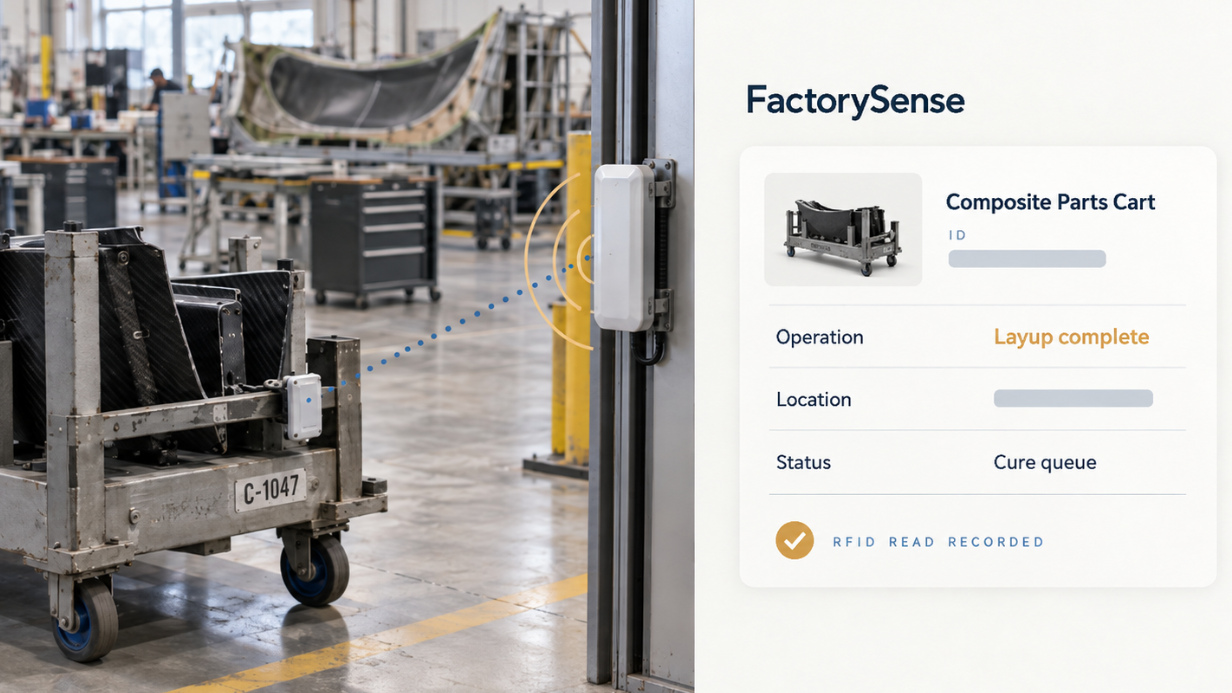
How to Integrate Your Existing Systems with an RFID Infrastructure


- Most RFID integration work is data mapping rather than hardware. The systems audit, not the tag selection, decides the scope and the cost.
- Middleware filters raw reads into events the ERP, WMS or MES can treat as transactions. Without it, a reader produces noise rather than data.
- A pilot should prove one named success criterion in one area, with the measurement agreed before the first tag is printed.
Most manufacturers evaluating RFID start by asking which tags and readers they need. That is rarely where the project succeeds or fails. The hardware decision is bounded and well understood. The integration decision, meaning how a read on the floor becomes a transaction in the system of record, is where scope moves, timelines slip and budgets get revisited.
This is a guide to that second decision: what to audit before you commit, where the real work sits, and how to scope a pilot that ends in a decision rather than a debate.
Start with a systems audit, not a tag selection
Before any deployment we run a facility survey, walking the floor or the yard with the operations team, tracing how material actually moves and comparing that against what the systems of record believe is happening. The same exercise applies to the systems themselves, and it is the step most often skipped.
A useful audit answers four questions:
- Which systems hold the authoritative record for each thing you intend to track, and what happens today when two of them disagree?
- Where does data enter those systems manually, and who does it? Those points are usually what RFID replaces, and they are where the process change lands.
- What identifiers already exist on the items, and are they unique and consistent across every system that touches them?
- Which read events would need to become transactions, and which are only ever going to be useful as a dashboard?
That last distinction matters more than it sounds. A read that updates the ERP changes what the business does next. A read that populates a dashboard changes what somebody looks at. Both are legitimate, they cost very different amounts to build, and confusing them is how integration scope doubles.
The work is data mapping, not connectivity
Connectivity is largely a solved problem. In most cases the APIs on existing ERP, WMS and MES platforms will accept RFID data without modification, and no upgrade is required to receive it.
What is not solved for you is the mapping. Deciding that a read at a specific portal means a work order has moved to the next operation, that a read in the tool crib means a calibrated tool has been issued to a named person, or that the absence of a read for a defined period means an item should be flagged as missing. Each of those is a business rule, not a technical one, and each needs an owner in operations rather than in IT.
Identity is the other half. If an asset is known by one number in the ERP, another on the maintenance system and a handwritten label on the item itself, RFID does not resolve that. It exposes it. Reconciling identifiers before deployment is unglamorous and it is usually the single largest task in the project.
What middleware is actually for
A reader does not produce data. It produces reads, thousands of them a minute, most of them repeats of the same tag sitting within range. Sending that stream directly at an ERP would be neither useful nor survivable.
Middleware sits between the two and does the filtering: deduplicating reads, applying the rules that turn a pattern of reads into a single meaningful event, and passing only that event to the system of record. When people describe an RFID deployment as noisy or unreliable, the fault is usually here rather than in the hardware.
Two things to check when evaluating it. Whether the filtering logic is configurable by your team or only by the vendor, because the rules will change once the system is in use. And whether it can hold events when a downstream system is unavailable, because a plant network will drop and reads that occurred during the outage still happened.
Security belongs in the design, not the retrofit
In regulated manufacturing this is not optional. Traceability obligations under DFARS and export control obligations under ITAR both assume you can demonstrate after the fact where a controlled item was and who handled it, which makes the integrity of the read record part of the compliance argument rather than an IT concern.
Three practical measures carry most of the weight. Encrypt data in transit and at rest using current standards. Define access control by role, so that changing a business rule is a different permission from viewing a dashboard. And keep sensitive information out of the tag itself, holding it in the middleware against the tag identifier, so that a tag read by an unauthorized reader discloses nothing useful.
You do not have to replace what you already have
Few facilities start from nothing. Barcode systems, BLE beacons and GPS on outdoor equipment are common, and they often work well for what they were bought to do. The question is whether the new system can sit alongside them rather than requiring their removal.
Existing systems can stay in place if the integration layer resolves their events against the same identity. A barcode scan, a BLE ping and an RFID read are different observations of the same object; the useful result is one asset history rather than three systems each holding part of the answer.
That matters most during transition. Plants rarely replace every tracking technology at once, and they usually should not. A proven barcode or GPS workflow can keep doing its job while RFID fills the gaps that require automatic capture.
Scope a pilot that ends in a decision
A pilot exists to answer one question, and the most common mistake is scoping it to demonstrate that RFID works. It does. What you do not yet know is whether it works in your environment, against your systems, at a cost your finance team will accept.
Three things make the difference:
- Pick one area and one criterion. Not a representative sample of everything, but the place your team already distrusts the numbers. Ask which parts of the plant they do not trust and they will name them immediately, and those answers are consistent enough across sites to be predictive.
- Define the measurement before the first tag is printed. Agree what counts as success, how it will be measured and against what baseline. A pilot without a pre-agreed baseline ends in disagreement about whether it worked.
- Include the integration in the pilot. A pilot that proves reads happen but stops short of writing to the ERP has not tested the part of the project that carries the risk.
One detail that is easy to defer and expensive to retrofit: encoding happens at print time, so serialization needs deciding before the first roll is printed. Adding unique identity to a population that is already tagged means retagging it. We cover that in more detail in the importance of standards in RFID printing and encoding.
Questions worth asking before you commit
The questions that separate a deployment that lands from one that stalls are rarely about tags. Which system of record does the data land in, and does a read become a transaction there or a line in a dashboard nobody opens? How does the system behave around metal, liquids, composites and outdoor yards, where physics rather than software sets the limits? Who supports it when a reader fails on second shift, and is that the same organization that installed it?
If you want to see how the resulting data layer sits underneath ERP and MES once it is running, how manufacturers connect real-time factory data to business systems covers the operating picture rather than the build.
The next step
Integration scope is decided by what your systems and your floor actually look like, which is why we start with a facility visibility assessment rather than a proposal. We walk the area you distrust, trace how material moves against what your systems believe, and come back with the read points, the integration work and the pilot criterion written down.
Book a Facility Visibility Assessment and we will scope it against your environment.
Does RFID require changes to our ERP or WMS?
In most cases, no. Existing system APIs will accept RFID reads without modification. The work sits in data mapping: deciding which read event becomes which transaction, and making identifiers consistent across systems. That mapping, not the hardware, is where integration projects overrun.
What does the integration actually connect to?
Middleware sits between the readers and the systems of record, filtering raw reads into meaningful events before they reach the ERP, WMS or MES. Without that layer a reader produces thousands of duplicate reads a minute and no usable transaction.
How long does a pilot take, and what does it prove?
A pilot should be scoped to prove one named success criterion in one area, not to demonstrate that RFID works. Define the criterion and the measurement before the first tag is printed, otherwise the pilot ends in debate rather than a decision.
Schedule a complementary working session with an RFID professional to discuss your floor or yard, your systems of record, and where the visibility gap between them is costing you.
Book a session