Why RFID Asset Tracking Systems Fail and How to Fix Them

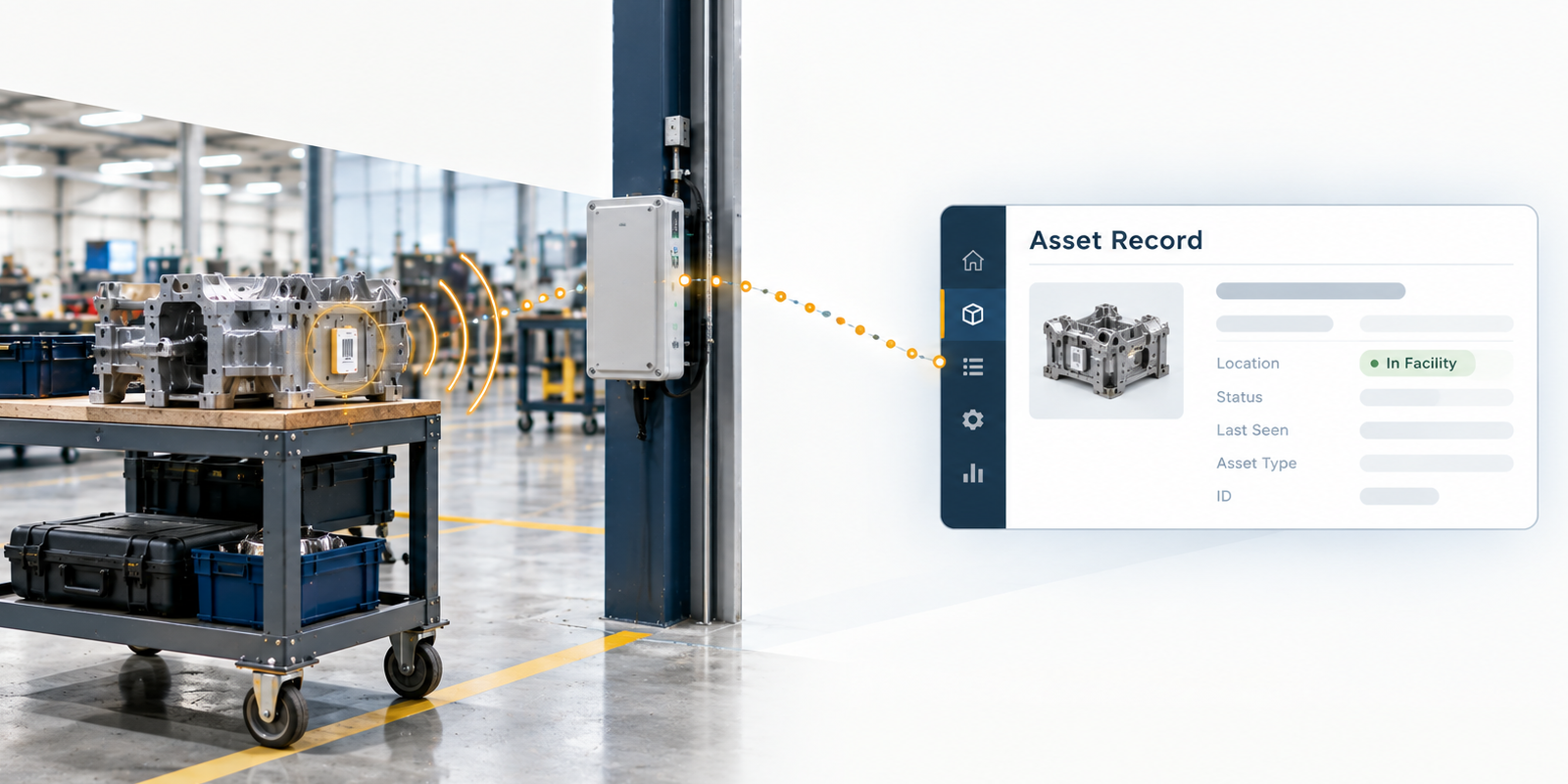
- Separate RF failures from event-logic, integration and process failures before replacing hardware.
- The goal is not maximum read range or raw read rate; it is reliable separation between intended and unintended events.
- Validate corrective work through the full physical-to-digital chain, from tag observation through the ERP, WMS or MES transaction.
RFID systems rarely fail because radio frequency identification itself does not work. More often, the deployment was designed around a technology assumption that did not match the physical process. The wrong tag was selected for the object. A reader was placed where it could see too much or too little. Software treated every read as equally meaningful. The ERP integration was added late. Or the system was technically functional but created enough false events that operators stopped trusting it.
Those failures tend to look similar from the outside: missed reads, duplicate reads, inconsistent locations, unreliable dashboards and a growing collection of manual workarounds. The temptation is to replace hardware. Sometimes that is necessary, but it is usually the wrong first move. Before changing equipment, we need to understand which layer of the system is actually failing.
Start by separating radio problems from process problems
A useful RFID troubleshooting process starts with a simple distinction. Is the system failing to observe the physical event, or is it observing the event and interpreting it incorrectly? Those are different problems.
If a tagged asset passes a reader and is not seen, the investigation belongs in the RF and hardware layer: tag choice, tag placement, orientation, reader power, antenna position, cable loss, environmental interference and the geometry of the read zone. If the reader sees the tag reliably but the application puts the asset in the wrong location or creates duplicate transactions, the RF layer may be fine. The problem is likely in filtering, event logic, configuration or integration.
We have been brought into deployments where a team spent months tuning antennas to solve what was ultimately a software-state problem. The reverse happens too: developers add increasingly complex filtering logic because the physical read zone was never designed to distinguish the intended movement in the first place. A good audit identifies the layer before prescribing the fix.
The tag is part of the RF system
Tag selection is one of the most common sources of disappointing performance because a tag that reads well in free air may perform very differently on the actual object. Metal changes the antenna environment. Liquids absorb energy. Carbon-heavy materials can behave differently from cardboard or plastic. Even the location and orientation of the tag on the same object can change the read margin materially.
The right test is therefore not “Can this reader see this tag?” It is whether the selected tag can be read with adequate margin on the real object, in the real orientation, throughout the intended process. Margin matters because a system tuned to the edge of readability may work during commissioning and fail as inventory density, forklift position or nearby equipment changes.
That is also why replacing a poorly performing tag with a larger or more expensive one is not automatically the answer. The deployment may need a different tag family, a different mounting position, a different antenna geometry or simply a more realistic definition of what the read zone is supposed to accomplish.
More read range can make a system worse
Many troubleshooting efforts begin by increasing transmit power. That can help a weak read, but it can also create a different failure: the reader starts seeing tags that are near the process but not actually part of it. At a doorway, for example, the system may read assets waiting beside the door and interpret them as having crossed it. Our warehouse RFID guide shows why these transition points should be designed around a business event rather than maximum RF coverage. The read rate goes up while the quality of the event data goes down.
The engineering objective is not maximum range. It is separation between the things that should be read and the things that should not. That may require directional antennas, shielding, physical process changes, power tuning, reader placement or software logic that uses timing and multiple observations together.
In difficult environments, a margin test or controlled power sweep can be more useful than repeatedly adjusting settings by feel. The point is to determine how much RF margin exists between the intended population and nearby tags, then choose settings that preserve that separation under normal operating variation.
Reader data is not the same as a business event
A fixed reader can report the same EPC dozens or hundreds of times while an item sits in its field. That is normal. The application still has to decide whether those observations mean “present,” “entered,” “left,” “moved,” “returned,” or nothing at all.
This is where some RFID systems become noisy. Raw reads are passed directly into dashboards or business systems without enough context. The user sees a flood of technically correct observations that do not correspond cleanly to the workflow. Eventually the team begins questioning the data and reintroduces manual checks.
Successful systems create an event layer between the reader and the ERP, WMS or MES. That layer filters duplicates, associates reads with a reader and antenna, applies timing or direction logic, resolves EPCs against known identities and decides which observations are important enough to become a transaction. Our article on integrating RFID with existing systems covers that architecture in more detail.
Integration failures can look like RFID failures
If the RFID platform knows exactly what happened but the ERP never receives the update, the operator experiences a tracking failure even though the RF system performed correctly. Integration should therefore be part of the troubleshooting scope from the beginning, not a separate software project that is assumed to be somebody else's problem.
The audit should follow one known item through the complete chain: tag identity, reader observation, edge processing, application event, API or message transfer, business-system transaction and final user-facing record. A timestamped trace through that path usually reveals where information is being dropped, delayed or transformed incorrectly.
It is also worth checking what happens when something goes wrong. Does the integration retry? Can duplicate events create duplicate receipts? Are failures visible in logs? Can an operator reconcile an exception without editing the database? Reliability depends as much on exception behavior as on the happy path.
The physical process may have changed since installation
An RFID system that once worked can degrade without any hardware failure. Racking moves. Product packaging changes. A new metal container is introduced. Forklift traffic shifts. Another reader is installed nearby. A work cell is reorganized and the tagged object now passes the antenna at a different angle.
That is why troubleshooting should include observation of the current process rather than relying on the original design drawing. We want to see the item move, where operators actually place it, how quickly it passes the read point and what other tagged inventory is present at the same time. Small differences in those details often explain why a deployment that looked sound during commissioning performs poorly six months later.
Training problems are usually process-design problems first
It is easy to blame adoption when users work around an RFID system, but repeated workarounds are often evidence that the process is asking people to compensate for poor system behavior. If the system creates frequent false alarms, requires employees to reclassify events or regularly disagrees with what they can see in front of them, retraining will not restore confidence for long.
Training matters once the workflow is stable. Operators should know what the system observes automatically, what still requires a manual action, how to resolve an exception and who owns the problem when the physical state and the system state disagree. But the deployment should remove unnecessary work rather than depend on perfect behavior to survive.
How to audit an underperforming RFID deployment
We typically approach a failed or underperforming system in layers. First, define a small number of transactions that are known to be wrong. Then reproduce them with controlled test items and capture evidence at each stage. The objective is to move from “RFID is unreliable” to a specific statement that can be tested.
- Physical layer: Is the tag appropriate for the object and environment? Is it mounted consistently?
- RF layer: Does the intended tag read with enough margin? Are nearby tags also being captured?
- Reader configuration: Are antenna, power, region, session and inventory settings appropriate for the use case? For passive UHF systems, GS1's current EPC UHF Gen2 specification is the standards reference for the air interface.
- Event logic: Are raw reads being converted into the correct presence or movement event?
- Identity: Does the EPC resolve to the correct asset, material, pallet or work order?
- Integration: Does the event reach the authoritative system reliably and only once?
- Process: Does the physical workflow still match the assumptions used when the read point was designed?
This layered approach also makes corrective work easier to validate. Instead of changing five things and hoping the outcome improves, the team can isolate a cause, change one part of the system and retest the same transaction.
Know when to tune and when to redesign
Not every failed deployment should be rescued in place. A read point that was installed in the wrong physical location may never become reliable through configuration alone. A passive-RFID design may have been chosen for a location problem that really requires active zone visibility. If the architecture itself is in question, the foundational What is RFID? guide explains the distinction between passive identification and active location approaches. An integration may be so tightly coupled to obsolete software that replacing it is safer than continuing to patch it.
The decision should depend on whether the original architecture still matches the requirement. If it does, tuning and targeted repairs are usually more economical. If the business question changed, or if the original design never had a credible way to answer it, redesign is the better choice even when some of the hardware can be reused.
Validation should use the process, not a bench test
A repaired system is not finished when the reader successfully sees a tag in a test area. It is finished when the intended process runs repeatedly under realistic conditions and produces the correct business events. That means testing normal flow, edge cases and failure conditions: mixed tags, busy read zones, missing items, duplicate observations, network interruptions and operator exceptions.
The final acceptance criteria should be written in process terms. Did the correct item move to the correct state? Did the system avoid moving nearby items? Did the event reach the ERP or MES? Could the exception be investigated from the logs? Those measures are far more useful than an isolated read-rate percentage.
An RFID project becomes reliable when the physical process, RF design, event logic and enterprise integration agree on what happened. Troubleshooting works the same way. Find the layer where that agreement breaks, fix that layer, and validate the complete chain again.
Why do RFID systems fail?
Common causes include poor tag selection, weak or overly broad read zones, environmental changes, incorrect reader configuration, noisy event logic and incomplete integration with business systems.
Should I increase reader power when RFID reads are being missed?
Not automatically. Higher power can improve weak reads but may also capture nearby tags that should not be part of the event. The objective is adequate margin and separation, not maximum range.
Can an existing failed RFID deployment be repaired?
Often, yes. A structured audit can identify whether the problem is in hardware, RF design, software, integration or process. Redesign is appropriate when the original architecture does not match the actual requirement.
Schedule a complementary working session with an RFID professional to discuss your floor or yard, your systems of record, and where the visibility gap between them is costing you.
Book a session