RFID Tag Examples: Which Tag Type Fits Which Object?


- A standard label can be ideal for cardboard or packaging but fail badly when placed directly on metal or near liquid.
- Reusable assets often justify rugged on-metal or encapsulated tags, while disposable products favor inexpensive labels.
- Tag construction and frequency must be selected together with the reader architecture and required business event.
An RFID tag is not one product category in the same sense as a barcode label. The chip, antenna, substrate, enclosure, attachment method and operating frequency can all change depending on what is being identified and how it moves. The most useful tag examples are therefore tied to the object and process they are designed to survive.
Printable passive UHF labels
A printable UHF RFID label combines an inlay with printable face stock and adhesive. It is well suited to cartons, many plastic containers, retail goods and other surfaces where a thin disposable identifier makes sense. Louis Garneau's RFID labeling deployment is an example of using encoded labels as part of an existing manufacturing and shipping workflow.
On-metal tags
Conventional UHF inlays can detune badly when placed directly against metal. On-metal tags use spacing, antenna structures or encapsulation designed for the conductive surface, and they are common on tools, fixtures, IT equipment and industrial assets. The actual tag still has to be tested on the specific object because size, mounting position and nearby geometry affect performance.
Rugged reusable hard tags
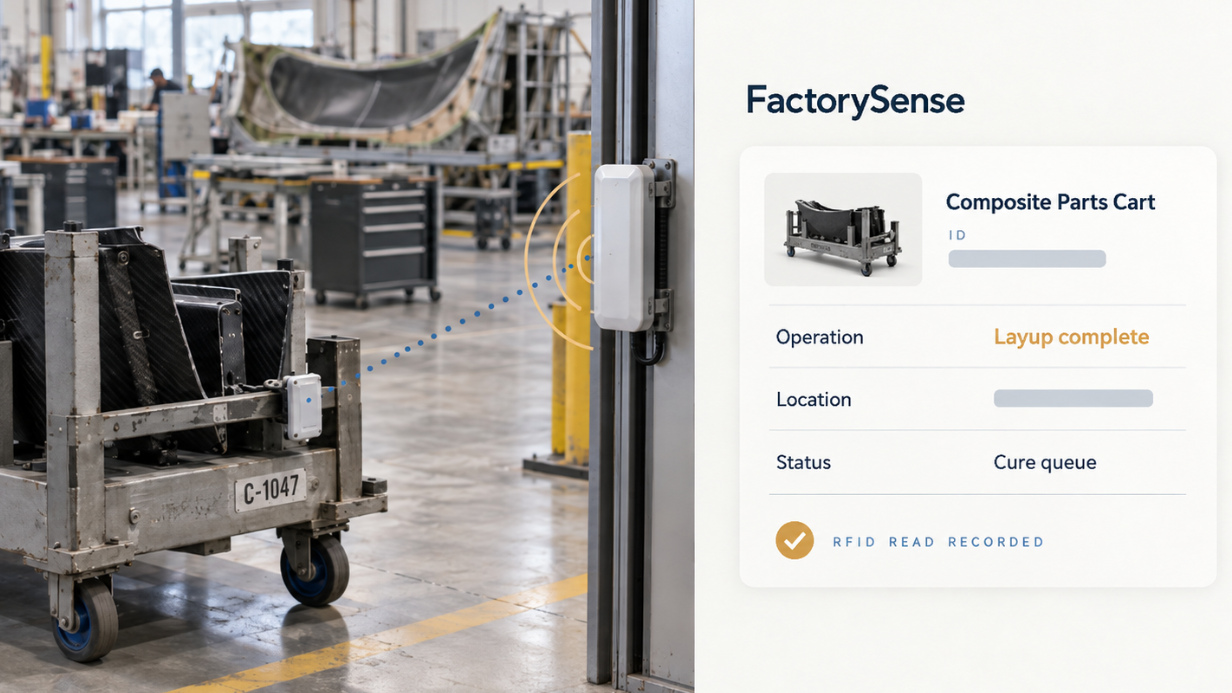
Long-lived assets often justify an encapsulated tag with mechanical mounting, strong adhesive or both. These tags can be selected for impact, chemicals, washdown, outdoor exposure or repeated handling and are common on carts, containers, test equipment and calibrated tools. Our tag reuse guide explains why the data model matters as much as the physical durability when a tag is reassigned.
High-temperature and process-resistant tags
Some production environments expose tags to ovens, curing cycles, paint processes, sterilization or aggressive cleaning. In those applications, the limiting specification may be temperature, chemical compatibility or the mounting method rather than read range. A tag that reads beautifully on the bench is useless if its housing, adhesive or antenna cannot survive the process.
Tags on WIP carriers and travelers
In manufacturing, the most useful RFID target is sometimes not the part itself. A reusable carrier, tote, traveler or fixture can carry the identity through operations while the MES preserves the detailed product genealogy. The Honeywell WIP deployment and our WIP tracking guide show why choosing the durable process object can be more reliable than forcing a tag onto every component.
HF and NFC tags
HF RFID operates at 13.56 MHz under standards such as ISO/IEC 18000-3, and NFC uses the same base frequency with protocols designed for close, intentional interaction. NFC tags are useful when a phone or nearby reader should deliberately interact with one object, such as opening documentation or verifying an item. Our NFC versus RFID guide compares that behavior with longer-range passive UHF capture.
Active tags and BLE beacons
Powered tags add a battery and transmitter, which changes the economics and location architecture. They are useful where repeated wide-area presence, sensor telemetry or longer-range broadcasts justify a larger tag and ongoing battery maintenance. The RFID and RTLS guide explains when powered location technologies fit better than passive checkpoint tracking.
How to choose among these examples
Start with the mounting surface, environment, required service life and business event. Then test the candidate on the real object at the real read point before standardizing it across a site. Our pre-installation guide describes that selection process because the best tag on a datasheet can still be the wrong tag once it is attached to the actual asset.
Sources and further reading
What are common examples of RFID tags?
Common examples include printable passive UHF labels, on-metal tags, rugged reusable hard tags, high-temperature tags, laundry tags, NFC tags and powered active tags or BLE beacons. The right type depends on the object, environment and tracking method.
Can a normal RFID label be placed on metal?
Usually not without performance loss. Metal changes the electromagnetic behavior of a conventional tag antenna, so on-metal applications normally use a tag construction designed and tuned for conductive surfaces.
Which RFID tags are used for manufacturing WIP?
WIP may use a disposable label, reusable carrier tag, traveler tag or rugged asset tag depending on whether the identity follows the product, container or fixture. The tag should be selected around the actual read point and process exposure.
Schedule a complementary working session with an RFID professional to discuss your floor or yard, your systems of record, and where the visibility gap between them is costing you.
Book a session