How RFID Inventory Management Transforms Supply Chain Efficiency


- The gain is not faster counting, it is that counting stops being a scheduled event. The record updates as material moves.
- Published retail deployments report inventory accuracy moving from the mid-60s into the 90s. Industrial environments are harder because metal, liquid and dense racking affect read performance.
- RFID feeds the warehouse management system rather than replacing it. The integration, not the hardware, is what determines whether the data changes any decision.
Inventory accuracy is the number everyone quotes and few people trust. Traditional methods, manual counts and barcode scanning, produce a figure that is correct on the day of the count and decays from there. The question worth asking is not how accurate the last count was, but how accurate the record is right now.
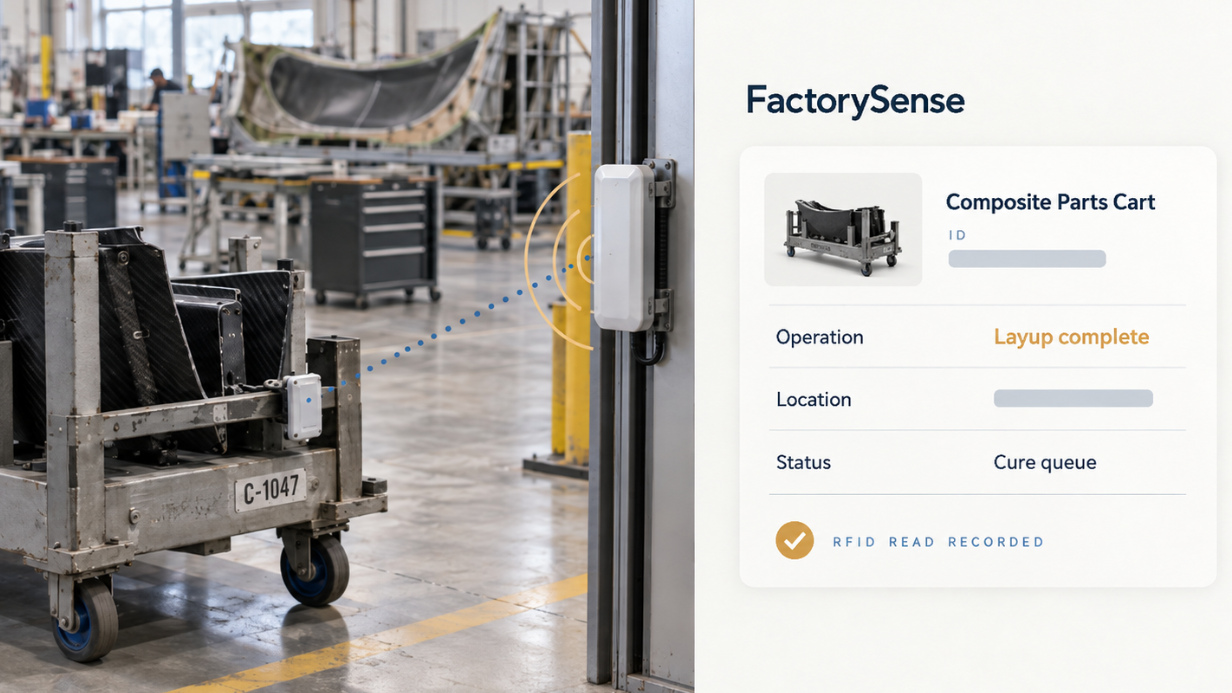
RFID changes that by removing the count as a discrete event. Material passing a read point updates the record without anyone doing anything, which means the figure reflects movement rather than the last audit.
What the system is
Three components, none of which is useful alone.
- Tags, passive or active, carrying an identity for each item, carton or pallet.
- Readers, fixed at boundaries or handheld for audits, capturing those identities as they move.
- Software, reducing a stream of raw reads into stock levels, movements and exceptions the business can act on.
The difference from barcode is not speed of scanning. It is that no one has to scan. Line of sight is not required, hundreds of items read at once, and the human step disappears along with the human error rate.
What changes operationally
Three things, in rough order of how quickly they show up.
Counting stops being a project. A cycle count that took a shift becomes something that happens continuously, which means discrepancies surface within hours rather than at quarter end.
Receiving becomes a check rather than a transcription. Inbound material is verified against the purchase order at the dock, and discrepancies are raised while the carrier is still there.
Stock decisions rest on a current number. Safety stock held against a figure nobody trusts is working capital spent hedging an accuracy problem. When the number is current, the hedge can shrink.
What the published evidence shows, and what it does not
The most frequently cited accuracy gains come from retail. RFID Journal reported that the Siman Group, a Central American department store chain, improved inventory accuracy from 65 to 70 percent up to 95 percent after deploying RFID. Levi's Brazil has reported a similar move, from roughly 67 percent to close to 100 percent over eighteen months.
Those are real, published figures and worth knowing. They are also retail, and that matters more than it might appear. Retail inventory is largely soft goods on open shelving, which is close to the ideal case for RF performance. Industrial inventory is metal, liquids, dense racking and outdoor yards, all of which absorb or reflect signal.
So the honest reading is that the direction is well evidenced and the magnitude is site-specific. Anyone quoting a retail accuracy figure as what you will achieve in a metal-dense plant is selling rather than advising.
Where it fits in industrial operations
In manufacturing and industrial distribution the applications that pay are raw material and component tracking into production, work in process between operations, finished goods staging and dispatch, and returnable containers, which are the assets most often lost precisely because nobody treats them as assets.
Outdoor staging and laydown yards are their own case. The counting problem there is not accuracy so much as findability across a large open area, and the read strategy differs accordingly.
Implementing it
Three decisions carry most of the outcome.
Tag selection against the environment. Metal and liquid require on-metal or foam-backed tags, and getting this wrong is the most common reason a pilot underperforms.
Read point placement. Readers go where material crosses a boundary that means something, not where cabling is convenient.
Integration with the WMS or ERP. RFID feeds the system of record; it does not replace it. If the read does not become a transaction, you have built a second inventory system that disagrees with the first. The integration article covers what that involves.
Staff adoption follows from the first two. When the system is accurate people use it; when it is not they revert to walking the floor, and the deployment quietly fails.
The next step
What accuracy you can reach, and what it is worth, depends on your materials, your racking and your current baseline. Book a Facility Visibility Assessment and we will measure the baseline before anyone quotes you a figure.
How much does inventory accuracy actually improve?
It depends entirely on the starting point and the read point design. Published retail deployments have reported moves from the mid-60s into the 90s, but those are retail environments with favorable materials. In metal-dense industrial settings the physics is harder and the honest answer is that a site survey tells you, not a case study from another sector.
Does RFID replace our warehouse management system?
No. It feeds it. The WMS remains the system of record; RFID changes how reliably and how often that record is updated.
What makes industrial inventory harder than retail?
Materials and mix. Retail inventory is largely soft goods on open shelving, which reads well. Industrial inventory involves metal, liquids, dense racking and outdoor yards, all of which affect read performance and change the tag and reader specification.
Schedule a complementary working session with an RFID professional to discuss your floor or yard, your systems of record, and where the visibility gap between them is costing you.
Book a session